2022 Outreach and Engagement Activities
USGS Briefed North Slope Borough Planning Commission: Alaska Science Center Supervisory Wildlife Biologist John Pearce provided an in-person briefing to the North Slope Borough Planning Commission on December 15, 2022. Pearce gave an update about recent and ongoing USGS Ecosystems Mission Area research on the North Slope of Alaska and learned of any concerns or questions from Commissioners related to planned USGS activities in the region.
USGS Scientists Attended the Alaska Eskimo Whaling Commission Meeting: Alaska Science Center scientists Todd Atwood and John Pearce attended the Alaska Eskimo Whaling Commission (AEWC) meeting, December 12-15, 2022. Atwood discussed the 2022 Southern Beaufort Sea polar bear sampling effort and solicited input on field activities planned for 2023. Pearce assisted with a presentation by USFWS on planned vessel cruises in the Chukchi Sea in 2023 to quantify the age and demography of the Pacific walrus population. The AEWC manages the bowhead whale subsistence hunt locally through a cooperative agreement with the National Oceanic and Atmospheric Administration. The USGS Alaska Science Center plans its field effort with input from the AEWC to avoid disturbing subsistence activities.
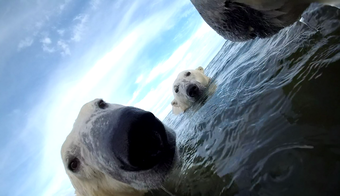
USGS Attended the Alaska Nannut Co-Management Council Meeting: Alaska Science Center scientist Todd Atwood attended the Alaska Nannut Co-Management Council (ANCC) meeting on December 7, 2022. Atwood provided an update on polar bear research and solicited input on field activities planned for 2022. The ANCC co-manages polar bears with the U.S. Fish and Wildlife Service. ANCC board members represent communities situated along the Chukchi Sea and Beaufort Sea coasts.
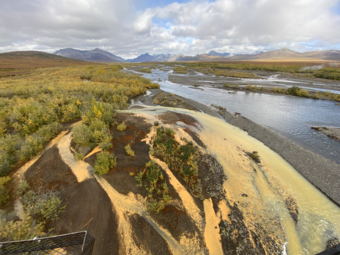
Arctic Rivers Summit Workshop: USGS Alaska Science Center scientists Mike Carey and Josh Koch attended the Arctic Rivers Summit in Anchorage, Alaska December 6-8, 2022. The workshop is part of a five-year Arctic Rivers Project funded by the National Science Foundation's Navigating the New Arctic Program and plans to discuss the current and potential future states of Alaskan and Yukon rivers and fish. The Summit brought together up to 150 Tribal and First Nation leaders, community members, managers, and knowledge holders, western scientists, federal, state, and provincial agency representatives, academic partners, and non-governmental organizations.
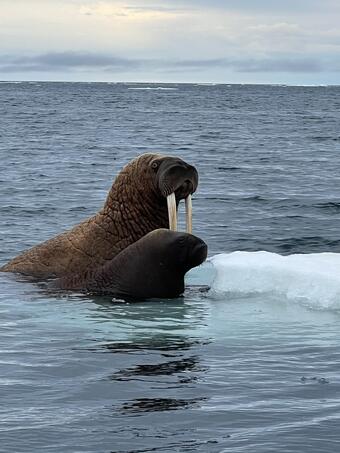
USGS Attended Eskimo Walrus Commission Meeting: USGS scientists William Beatty, Anthony Fischbach, Karyn Rode, and John Pearce met with the Eskimo Walrus Commission December 5-6, 2022, in Anchorage, Alaska to discuss previous, ongoing, and future USGS-led research on Pacific walruses. These updates to Commissioners included recent USGS work on evaluation of satellite imagery for walrus haulout monitoring, new estimates of walrus regional abundance at a haulout from drone imagery, a new estimate of total walrus abundance, and monitoring walrus body condition through collaboration with hunters on St. Lawrence Island and with USFWS. The Eskimo Walrus Commission represents Alaska's coastal walrus hunting communities and works on resource co-management issues on behalf of Alaska Natives in coastal Yupik and Inupiaq communities in collaboration with state and federal agencies.
USGS Participated in Science and Job Fair in Nuiqsut, Alaska: Alaska Science Center scientist John Pearce participated in a Science and Job Fair community event in the northern Alaska village of Nuiqsut on November 10, 2022. The biennial event is attended by federal and state agencies, environmental consulting firms, and industry representatives working near the community of Nuiqsut on the North Slope of Alaska. Pearce provided information and hands-on activities related to recent and ongoing USGS research near Nuiqsut on migratory birds, Pacific walrus, and polar bears.
USGS Participated in Eskimo Walrus Commission Young Hunters – Walrus Summit: USGS Alaska Science Center Research Wildlife Biologist Tony Fischbach was invited to participate in the Young Hunters - Walrus Summit being hosted in Nome, Alaska by the Eskimo Walrus Commission, which represents Alaska's coastal walrus hunting communities and works on resource co-management issues in collaboration with state and federal agencies. On October 6, 2022, Fischbach gave a presentation on “Walrus Environments: Habitats, Climate and Research” in collaboration with Gay Sheffield, Marine Advisory Program Agent for Alaska Sea Grant.
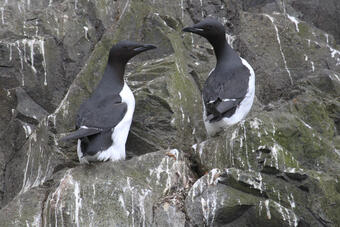
USGS Attended the Alaska Migratory Bird Co-Management Council Meeting: Alaska Science Center scientist John Pearce attended the virtual Alaska Migratory Bird Co-Management Council on October 5-6, 2022, to listen to discussions and give a brief update on current USGS activities related to migratory birds. The Alaska Migratory Bird Co-Management Council was formed in 2000 and consists of the U.S. Fish and Wildlife Service, the Alaska Department of Fish and Game, and representatives of Alaska Native councils and communities across the state. The Council's primary purpose is to conserve migratory birds through development of recommendations for Alaska Native subsistence harvest in Alaska.
USGS Hosted Quarterly Meeting on Alaska Transboundary Rivers Project with Stakeholders: Alaska Science Center Hydrologist Jenn Hamblen hosted the quarterly meeting on the USGS Alaska Transboundary Rivers Project with stakeholders in Alaska and Canada on September 29, 2022. The USGS project collects discrete and continuous water quality and solids data for six transboundary watersheds: the Alsek, Chilkat, Taku, Stikine, Unuk, and Salmon rivers. There is active mining on the Canadian side of the border in all but two of these watersheds, and planned mining activity within Alaska in one watershed. Participants included other researchers and stakeholders from Tribes, First Nations, agencies, and nonprofit organizations. Goals included collaborating with researchers to help ensure data is comparable, working with partners to fill in gaps in data collection on the watershed scale, and seeking feedback to help ensure that data collected from the USGS project meets stakeholder needs. This meeting focused on co-sampling opportunities between Tribes and the USGS to compare field and lab methods as well as the creation of a regional GIS database of watershed research in the study area.
USGS Presented at the 2022 Tlingit & Haida Southeast Environmental Conference: Jennifer Hamblen, Alaska Science Center Hydrologist, presented preliminary results of the US Geological Survey Southeast Alaska Transboundary Rivers Project on August 30, 2022. Tribes, First Nations, and the USGS collaborate to monitor the water quality and quantity of five transboundary rivers in Southeast Alaska. The session included speakers from the Southeast Alaska Indigenous Transboundary Commission and Tlingit & Haida, who spoke about transboundary rivers research and community concerns with the predicted increase in mining in these watersheds. The conference is hosted by the Central Council of Tlingit and Haida Indian Tribes of Alaska each fall. This was the first time this conference was held live as well as remotely, with over 140 attendees from throughout the nation.
USGS Attended the Inuvialuit-Inupiat Joint Polar Bear Commission meeting: Alaska Science Center scientist Todd Atwood attended the Inuvialuit-Inupiat Joint Polar Bear Commission meeting August 16-17, 2022, in Vancouver, B.C. The commission includes members from northern communities in Alaska, Yukon, and the Northwest Territories, and makes recommendations on the management of Southern Beaufort Sea polar bears. Atwood discussed the 2022 polar bear sampling effort and solicited input on field activities planned for 2023.
USGS Drone Studies on Walrus Presented to Alaska Native Village Corporation: Alaska Science Center walrus researcher Anthony Fischbach provided study results to the Cully Corporation on the use of survey drones to estimate walrus abundance and to ground-truth satellite imagery interpretation of the occurrence of walruses resting onshore. USGS survey drone work recently determined that more than 150 thousand walruses used coastal areas on and adjacent to Cully Corporation lands near the community of Point Lay during the two study years (2018 and 2019). USGS satellite imagery interpretation provided precise footprints of the native corporation lands used by walruses during 2018-2020. During the presentation, USGS learned that these study results are providing the basis for Cully Corporation to evaluate the conservation value of an easement to protect walruses resting on these native corporation lands. USGS was able to collect these survey drone data with support of the USGS National Uncrewed Systems Office prior to 2019 executive and secretarial orders that banned use of survey drones within the Department of Interior. The survey drone platform is a valuable toolset to help collect data and inform management of Department of Interior resources.
USGS Bering Sea Science Highlighted by International Arctic Research Center New Publication: Alaska Science Center science on salmon, walrus, seabirds, and harmful algal blooms was highlighted in the 2022 Bering Region Ocean Update, an annual report by the Alaska Ocean Observing System (AOOS) and the International Arctic Research Center. The focal areas of the report (salmon, walrus, crab, halibut, seabirds, and climate) were topics of interest identified by a Community Advisory Panel comprised primarily of Indigenous resource managers and knowledge holders from across Alaska.
Scientist Delivered Invited Presentations at One Health and Local Environmental Observer Network Meetings: Andy Ramey, USGS Alaska Science Center Research Wildlife Geneticist, delivered invited presentations on the ongoing outbreak of highly pathogenic avian influenza (HPAI) in wild birds inhabiting North America at the Alaska One Health Group meeting hosted by the Alaska Native Tribal Health Consortium and Centers for Disease Control and Prevention Arctic Investigations Program on June 7, 2022 and at the Local Environmental Observer Network Spring Webinar hosted by the Alaska Native Tribal Health Consortium on June 14, 2022. In these presentations, Andy provided background information on HPAI in wild birds, a situational update on recent detections of HPAI in North American and Alaska, information on how to report observations of sick and dead birds potentially affected by HPAI, and links to online resources where the public can track recent detections of HPAI in North America and find guidance on best practices to minimize risk to human and animal health.
USGS Participated in NSF Panel Discussion on Participatory Research and Indigenous Leadership in Research: Alaska Science Center Associate Center Director for Ecosystems John Pearce participated in a panel discussion for employees at the National Science Foundation on June 6, 2022, to discuss aspects of the new IARPC Arctic Research Plan that address Participatory Research. Pearce is the liaison for the co-leads of the IARPC Participatory Research and Indigenous Leadership in Research Foundational Activity: Maija Katak Lukin (Native Relations Program Manager for the National Park Service Alaska Region) and Ciisquq Crystal Leonetti (Alaska Native Affairs Specialist with the USFWS).
USGS Hosted Quarterly Meeting on Alaska Transboundary Rivers Project with Stakeholders: Alaska Science Center Hydrologist Jenn Hamblen hosted the quarterly meeting on the USGS Alaska Transboundary Rivers Project with stakeholders in Alaska and Canada on June 14, 2022. The USGS project collects discrete and continuous water quality and solids data for five transboundary watersheds: the Alsek, Taku, Stikine, Unuk, and Salmon rivers. There is active mining on the Canadian side of the border in all but one of these watersheds. Participants included other researchers and stakeholders from Tribes, First Nations, agencies, and nonprofit organizations. Goals included collaborating with researchers to help ensure data is comparable, working with partners to fill in gaps in data collection on the watershed scale, and seeking feedback to help ensure that data collected from the USGS project meets stakeholder needs. This meeting focused on a presentation by Taku River Tlingit First Nation about their watershed monitoring projects in the Taku watershed.
USGS Attended the Alaska Migratory Bird Co-Management Council Meeting: Alaska Science Center scientist John Pearce attended the virtual Alaska Migratory Bird Co-Management Council on April 7, 2022, to listen to discussions and give a brief update on USGS migratory bird research activities. The Alaska Migratory Bird Co-Management Council was formed in 2000 and consists of the U.S. Fish and Wildlife Service, the Alaska Department of Fish and Game, and representatives of Alaska Native councils and communities across the state. The Council's primary purpose is to conserve migratory birds through development of recommendations for Alaska Native subsistence harvest in Alaska.
USGS Collaborates with USFWS and Eskimo Walrus Commission: USGS is collaborating with the US Fish and Wildlife Service Marine Mammals Management Office and the Eskimo Walrus Commission as part of a steering committee to guide development of a walrus management tool for use by US Fish and Wildlife Service. The tool, an analytical model, will inform species status assessments and evaluate potential impacts of harvests and other sources of stress and mortality on the population. The model is also intended to serve as a tool for subsistence hunting communities in Alaska and Chukotka to inform local harvest-management programs.
USGS Attended Ice Seal Committee Meeting: Alaska Science Center scientist Karyn Rode attended the annual Ice Seal Committee meeting March 25, 2022. Rode provided a briefing on the paper “Seal body condition and atmospheric circulation patterns influence polar bear body condition, recruitment, and feeding ecology in the Chukchi Sea” published 2021 in Global Change Biology. The publication documented relationships between the body condition of polar bears and that of their primary prey, ringed and bearded seals. Seal body condition included in the study was obtained from measurements of harvested ice seals in collaboration with Alaska Native hunters and the Alaska Department of Fish and Game. The Ice Seal Committee was established to preserve and enhance ice seal habitat, protect and enhance Alaska Native culture and traditions – particularly activities associated with subsistence use and to disseminate timely and reliable information about ice seals through research and outreach.
USGS Attended the Alaska Eskimo Whaling Commission Meeting: Alaska Science Center scientist Todd Atwood virtually attended the Alaska Eskimo Whaling Commission (AEWC) meeting on February 4, 2022. Atwood discussed the plan for sampling bears in 2022 and ask for feedback. The polar bear research program plans its field effort with input from the AEWC to avoid disturbing subsistence activities.
USGS Attended the Barrow Whaling Captain’s Association Meeting: Alaska Science Center scientist Todd Atwood virtually attended the Barrow Whaling Captain’s Association (BWCA) meeting on January 28, 2022. Atwood provided a summary of the 2021 polar bear sampling effort and solicited input on field activities planned for 2022. The polar bear research program plans its field effort with input from the BWCA to avoid disturbing subsistence activities.
USGS Attended the Polar Bear Technical Committee Meeting: Alaska Science Center Research Wildlife Biologist Todd Atwood virtually attended the Polar Bear Technical Committee (PBTC) meeting on January 25-28, 2022. The PBTC supports the Polar Bear Administrative Committee (PBAC) by reviewing scientific research and Indigenous Traditional Knowledge and providing the PBAC with an annual status assessment of the polar bear subpopulations in Canada. Atwood provided an update on a collaborative US-Canada study to estimate the abundance of Beaufort Sea polar bears.
USGS Attends the Alaska Nannut Co-Management Council Meeting: Alaska Science Center scientist Todd Atwood virtually attended the Alaska Nannut Co-Management Council (ANCC) meeting on January 13, 2022. Atwood provided an update on polar bear research and solicited input on field activities planned for 2022. The ANCC co-manages polar bears with the U.S. Fish and Wildlife Service. ANCC board members represent communities situated along the Chukchi Sea and Beaufort Sea coasts.