



The case of the missing sulfur dioxide at Yellowstone
Beneath Yellowstone's steaming geysers and fumaroles lies a chemical mystery: where did all the sulfur dioxide go?
Yellowstone Caldera Chronicles is a weekly column written by scientists and collaborators of the Yellowstone Volcano Observatory. This week's contribution is from Jennifer Lewicki, Research Geologist with the USGS California Volcano Observatory.
When you think about active volcanoes, you might picture towering plumes of gas billowing into the sky—plumes that are rich in sulfur dioxide, or SO2, which is the gas that causes volcanic smog and can be detected by satellites from space. Volcanoes like Kīlauea in Hawaiʻi routinely emit hundreds to thousands of metric tons of SO2 per day, creating a visible haze that affects air quality across the islands. Mount Etna in Italy, Ambrym in Vanuatu, and many other active volcanic systems worldwide are prolific SO2 emitters, and their gas emissions serve as a critical monitoring tool for volcano observatories.

But here's something curious: despite sitting atop one of the planet's largest magmatic systems, Yellowstone emits essentially no detectable sulfur dioxide. This might seem puzzling; after all, Yellowstone is among the highest CO2-emitting volcanic systems on Earth. The park's hydrothermal areas are constantly degassing, producing the billowing steam plumes and rotten-egg smell (from hydrogen sulfide, H2S, gas) that are iconic features of places like Norris Geyser Basin and the Mud Volcano area. With all this volcanic gas activity, where is the SO2?
The first piece of the puzzle involves the depth at which Yellowstone's magma resides. Extensive geophysical studies have revealed that Yellowstone's magmatic system consists of two main bodies. The upper rhyolitic magma chamber sits mostly between about 4 and 17 kilometers (2.5 to 10 miles) beneath the surface, while a much larger, deeper basaltic reservoir extends from approximately 20 to 50 kilometers (12 to 30 miles) depth.
This is considerably deeper than the magma at many actively erupting volcanoes. When magma ascends toward the surface, decreasing pressure allows dissolved gases to escape, much like bubbles forming when you open a soda bottle. Different gases exsolve at different depths based on their solubility in magma. Carbon dioxide, which has very low solubility, begins bubbling out at great depths, 40 kilometers or more. Sulfur dioxide, in contrast, typically comes out at much shallower depths, often within only a few kilometers of the surface.
At Yellowstone, because the shallowest magma sits at least several kilometers underground, any small amount of SO2 that does exsolve from the magma has a long journey through the crust before it can reach the atmosphere. And during that journey, something important happens; it encounters water.
Yellowstone National Park hosts one of the world's most extensive hydrothermal systems, with more than 10,000 thermal features spread across over 100 thermal areas. This vast network of hot water, steam, and altered rock overlies the magma chamber, creating a highly reactive chemical environment. When magmatic gases like SO2 rise through this water-saturated system, they undergo a process volcanologists call "scrubbing."
Scrubbing refers to chemical reactions between volcanic gases and water (or rock) that remove certain gases before they can reach the surface. When SO2 gas encounters liquid water in Yellowstone's hydrothermal system, it rapidly dissolves and undergoes a chemical transformation called disproportionation. Through a series of reactions, the SO2 is converted into H2S, dissolved sulfate ions, and sometimes elemental sulfur, which makes up the yellow deposits you see around many of Yellowstone's thermal features.
The absence of SO2 at Yellowstone is actually good news for monitoring purposes. If the Yellowstone Volcano Observatory were to suddenly detect SO2 emissions, it would be a significant sign that something had changed. Such an emergence would suggest that magma had risen to much shallower depths and established dry gas pathways through the hydrothermal system—basically that the water had disappeared due to the heat of the magma—which are both indicators of increased volcanic unrest.
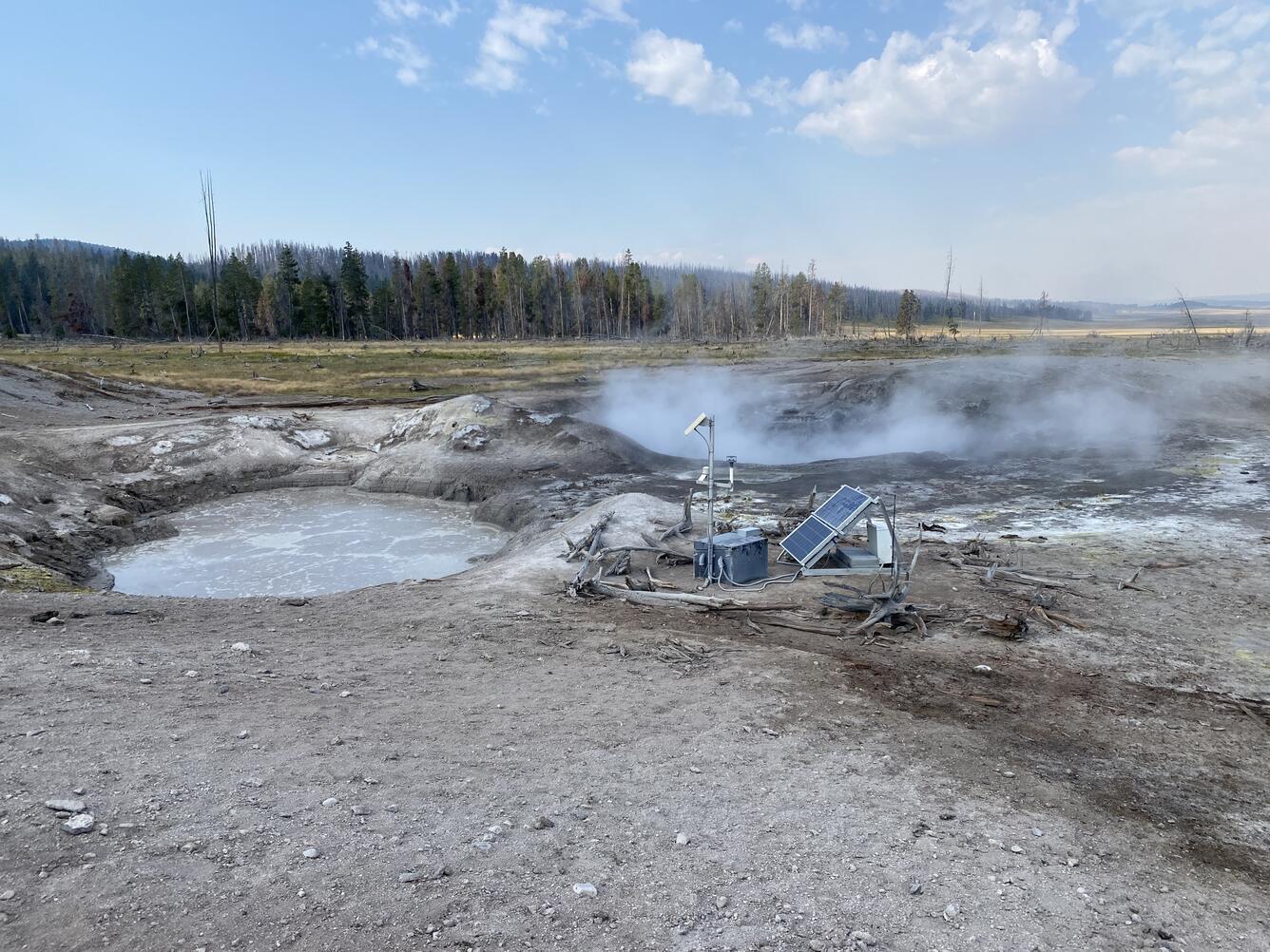
For now, though, the Yellowstone Volcano Observatory monitors the gases that do escape, primarily CO2, which comes out of the magma early and deeply and isn't easily scrubbed by water, and H2S, which can come from a variety of different processes, including transformation of the missing SO2. A multi-GAS station currently deployed at Mud Volcano continuously measures these gas concentrations, helping scientists track any changes in the volcanic system's behavior.
So, the next time you visit Yellowstone and smell that distinctive sulfurous odor wafting from a steaming fumarole, remember, you are smelling the evidence of a highly efficient natural chemical factory, one that converts SO2 deep underground into the H2S you detect at the surface. The missing SO2 isn't really missing at all, it has just been chemically transformed during its journey through one of Earth's most remarkable hydrothermal systems.