



Hydrologic Change
Hydrologic Change
The amount of freshwater on the Earth’s surface and in the ground is determined by geology, land use, climate, habitat type, and human management of water resources. The Ecosystems Land Change Science Program conducts multidisciplinary research to establish a sound scientific basis to understand and anticipate the impacts of future change on the Nation's water infrastructure and ecosystems.
Filter Total Items: 31
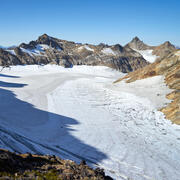
Glaciers and Landscape Change
Mountain glaciers are dynamic reservoirs of frozen water, deeply interconnected with their surrounding ecosystems. Glacier change in North America has major societal impacts, including to water resources, natural hazard risk, tourism disruption, fisheries, and global sea level change. Understanding and quantifying precise connections between changing glaciers, the surrounding landscape and climate...

Connections between Forested and Urban Landscapes and Implications for Water Supply
Downstream communities rely upon forested mountains for high-quality water needed for water supply and agricultural irrigation. However, these forests are vulnerable to disturbances such as wildfire, drought, and flood, and are also affected by air pollution from adjacent urban and agricultural lands. Interactions between forested, urban, and agricultural landscapes can have substantial impacts on...
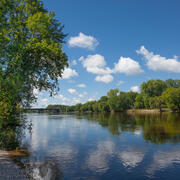
How Science Helps Manage Changing Water Availability and Quality: Droughts, Floods, Avalanches and More
Droughts, floods, and avalanches are extreme events in the water cycle that can have catastrophic and lasting impacts on ecosystems and society. In addition to these extreme events, human changes to the landscape (including land use changes) can have substantial impacts on freshwater resources as well. Science from the USGS Ecosystems Land Change Science Program helps managers and decision-makers...
By
Ecosystems Land Change Science Program, Alaska Science Center, Earth Resources Observation and Science (EROS) Center , Geosciences and Environmental Change Science Center, New England Water Science Center, Northern Rocky Mountain Science Center, Southwest Biological Science Center, Wetland and Aquatic Research Center
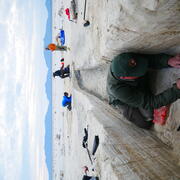
Research Enhancing Park Recreation and Tourism
Scientists from the USGS Ecosystems Land Change Science Program work hand-in-hand with park managers to support abundant and enduring outdoor recreation and tourism opportunities in the Nation’s national parks.
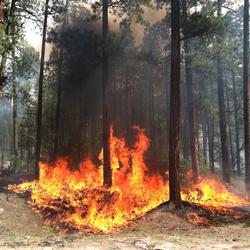
Reducing Wildfire Risks with Science
Hotter and drier conditions are making wildfires more intense and destructive across the United States. Science from the USGS Ecosystems Land Change Science Program informs local to national reduction of wildfire hazards, which saves money in avoided losses and fire suppression costs, as well as saves human lives.

Effects of global change on alpine and subalpine ecosystems
Atmospheric nitrogen deposition, changing environmental patterns, and recreation are rapidly altering high elevation ecosystems. This project will evaluate long-term biogeochemical, hydrological, and ecological trends in Rocky Mountain National Park to understand the causes and rates of change in alpine and subalpine waters, soils, and vegetation. Resource managers of high-elevation, protected...

Holocene and Modern Drivers of Wetland Change
On a global scale, wetland systems are affected by precipitation extremes, changing sea level, and population growth, influencing their capacity to moderate storm surge, filter contaminants, and provide habitats for fish and wildlife. This research takes a long-term perspective on the resilience of wetlands to a range of environmental- and human-induced changes and supports wetland management by...

Environmental streamflows in the United States: historical patterns and predictions
The term environmental streamflows refers to the magnitude, frequency, seasonal timing, duration, and rate of change of streamflows needed to sustain freshwater and estuary ecosystems and human wellbeing. It is important that environmental streamflow assessments by water managers consider changes in climate, land use, and water management; this cannot be done effectively without understanding...

Interdisciplinary Modeling of Land Use, Climate, and Hydrologic Processes
This project focuses on development of new interdisciplinary modeling capabilities of long-term time series that capture interactions among climate, land use, water use, and water availability. Research builds on expanding the USGS Forecasting Scenarios of Land Use (FORE-SCE) model and integrating with spatially explicit models from other disciplines. Interdisciplinary models will be co-developed...

Arctic Biogeochemical Response to Permafrost Thaw (ABRUPT)
Warming and thawing of permafrost soils in the Arctic is expected to become widespread over the coming decades. Permafrost thaw changes ecosystem structure and function, affects resource availability for wildlife and society, and decreases ground stability which affects human infrastructure. Since permafrost soils contain about half of the global soil carbon (C) pool, the magnitude of C losses...

Understanding long-term drivers of vegetation change and stability in the Southern Rocky Mountains with paleoecological data and ecological models
Drought and fire are powerful disturbance agents that can trigger rapid and lasting changes in the forests of western North America. Over the last decade, increases in fire size and severity coincided with warming, drought, and earlier snowmelt, factors that projected climatic changes are likely to exacerbate. However, recent observations are brief relative to the lifespans of trees and include...

Quaternary Hydroclimate Records of Spring Ecosystems
Desert springs and wetlands are among the most biologically productive, diverse, and fragile ecosystems on Earth. They are home to thousands of rare, endemic, and endangered plants and animals and reflect the availability and health of emergent groundwater. Despite the ecological importance of these wetlands, our knowledge of how they might respond to future environmental conditions is limited...