



Decision Science and Quantitative Methods
Decision Science and Quantitative Methods
At the Eastern Ecological Science Center (EESC), we strive to provide world-class science to inform natural resource decisions that preserve and enhance our quality of life.
EESC Makes an Impact
EESC Makes an Impact
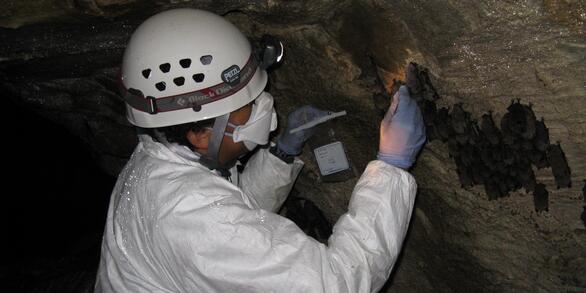
How does EESC decision science and quantitative methods help reduce management costs and increase efficiency?
EESC Makes an Impact
EESC Makes an Impact

How does EESC decision science and quantitative methods help preserve our hunting resources?

Filter Total Items: 67

Hierarchical Models for Estimation of Population Parameters
The Challenge: Much of wildlife research consists of the description of variation in data. Some of the variation results from spatial and temporal change in populations, while some results from biologically irrelevant sampling variation induced by the process of data collection. Distinguishing relevant from irrelevant variation is the first task of statistical analysis, but the job does not end...

Development of Computer Software for the Analysis of Animal Population Parameters
Biologists at USGS Eastern Ecological Science Center (EESC), as well as cooperating agencies are constantly looking for new ways of answering questions about the status of animal populations and how animal populations change over time. To address these questions, data are collected on captures and or sightings of animals which can be used to estimate parameters which affect the population using...

Managing the Future Status of the Shenandoah Salamander
The Shenandoah salamander is listed as an endangered salamander that is at risk of extinction due to its small, high-elevation range, competition with the co-occurring red-backed salamander, and the predicted habitat changes in the Appalachian mountain range. We are working with multiple partners to understand the current status of the species, predict future status, and continually engage...

Integrating Habitat and Harvest Management for Northern Pintails
The Challenge: Several blue-ribbon panels have challenged the waterfowl management world to recognize the linkages between the two primary management frameworks: harvest management under the Migratory Bird Treaty Act, and habitat management under the North American Waterfowl Management Plan. Because these two frameworks seek to manage the same populations, there needs to be better coordination, in...

Modeling, Estimation, and Adaptive Management of Florida Manatees
The Challenge: Florida manatees are threatened by watercraft-related mortality, the potential loss of warmwater habitat, red tide events, and other anthropogenic factors. The USFWS and the Florida Fish and Wildlife Conservation Commission have regulatory authorities under the Endangered Species Act (ESA), the Marine Mammal Protection Act (MMPA), and state statutes to recover manatees. To support...

Adaptive Management for Threatened and Endangered Species
The Challenge: Threatened and endangered species have to be managed in the face of uncertainty, but traditionally, there has been reluctance to think about adaptive management of listed species. Management agencies with responsibility for threatened and endangered species need tools to help manage in the face of uncertainty, with the hope of reducing that uncertainty.

Structured Decision Making: Methods, Applications, and Capacity-Building
The Challenge: The field of decision analysis is a rich and mature discipline that provides robust methods for helping decision makers understand the nature of their decisions, involve stakeholders and scientists in appropriate steps of the process, and develop transparent records for the public. The use of these structured approaches is emerging in natural resource management, and there is strong...