Female Northern Cardinal banded at the USGS Bird Banding Lab
Female Northern Cardinal banded at the USGS Bird Banding LabFemale Northern Cardinal banded at the USGS Bird Banding Lab banding station, fall 2024


Official websites use .gov
A .gov website belongs to an official government organization in the United States.

Secure .gov websites use HTTPS
A lock () or https:// means you’ve safely connected to the .gov website. Share sensitive information only on official, secure websites.

Images of bird banding.

Female Northern Cardinal banded at the USGS Bird Banding Lab banding station, fall 2024
Female Northern Cardinal banded at the USGS Bird Banding Lab banding station, fall 2024

These tiny balls of energy are sometimes referred to as mice with the way they scurry around the forest floor. During the breeding season, males will sing one of the more complex songs out of North American bird species. Each song lasts 5-10 seconds and consists of unique bubbly notes which the individual will combine and modify over time.
These tiny balls of energy are sometimes referred to as mice with the way they scurry around the forest floor. During the breeding season, males will sing one of the more complex songs out of North American bird species. Each song lasts 5-10 seconds and consists of unique bubbly notes which the individual will combine and modify over time.

One can really see how a Golden-crowned Kinglet got their name! This bird was handled and marked at the EESC Bird Banding Lab's Fall Migration Station.
One can really see how a Golden-crowned Kinglet got their name! This bird was handled and marked at the EESC Bird Banding Lab's Fall Migration Station.

The sparrows pictured here represent the main sparrow species the EESC Bird Banding Lab’s Fall Migration Station sees each year. And last year, the White-throated Sparrow was the most numerous species banded at the station.
The sparrows pictured here represent the main sparrow species the EESC Bird Banding Lab’s Fall Migration Station sees each year. And last year, the White-throated Sparrow was the most numerous species banded at the station.

What’s so cool about this bird? Check out that large seed-cracking, grasshopper-chomping bill, that helps us ID this as a Blue Grosbeak. Based on its plumage, the banders were able to determine this bird was born this year and was caught in the same net as two other young Blue Grosbeaks.
What’s so cool about this bird? Check out that large seed-cracking, grasshopper-chomping bill, that helps us ID this as a Blue Grosbeak. Based on its plumage, the banders were able to determine this bird was born this year and was caught in the same net as two other young Blue Grosbeaks.

In 2024, the long-term fall migration bird banding station at Patuxent Research Refuge had it's first Prairie Warbler since 2019!
In 2024, the long-term fall migration bird banding station at Patuxent Research Refuge had it's first Prairie Warbler since 2019!

Scientists at the banding station collect population data, including age and sex. Due to color contrast, Indigo Bunting wings are a great example of the feather wear and replacement that scientists look at to age a bird. This male Indigo Bunting has 3 different feather ages, which tells us it was born last year.
Scientists at the banding station collect population data, including age and sex. Due to color contrast, Indigo Bunting wings are a great example of the feather wear and replacement that scientists look at to age a bird. This male Indigo Bunting has 3 different feather ages, which tells us it was born last year.

Hooded Warbler are a treat at the EESC Bird Banding Lab Fall Migration Station, as the station bands an average of two each fall. Based on data collected, the individual pictured hatched this year and is a male.
Hooded Warbler are a treat at the EESC Bird Banding Lab Fall Migration Station, as the station bands an average of two each fall. Based on data collected, the individual pictured hatched this year and is a male.

Front left side windows of EESC Gabrielson building replaced with bird collision deterrent “dots” to prevent bird collisions with glass.
Front left side windows of EESC Gabrielson building replaced with bird collision deterrent “dots” to prevent bird collisions with glass.

Vinyl “dots” installed on the glass at EESC Gabrielson building in a 2x2 inch grid pattern.
Vinyl “dots” installed on the glass at EESC Gabrielson building in a 2x2 inch grid pattern.

The House Finch pictured was quite the surprise at the BBL's Fall Migration Station at Patuxent Research Refuge in 2023. Despite being common feeder birds in Maryland, this is only the second House Finch banded at the Migration Station since the 1990s!
The House Finch pictured was quite the surprise at the BBL's Fall Migration Station at Patuxent Research Refuge in 2023. Despite being common feeder birds in Maryland, this is only the second House Finch banded at the Migration Station since the 1990s!

A biologist gently extends the wing of a Blue-headed Vireo to look for clues on how old the bird is. During fall migration, scientists can generally determine if a bird was hatched during the current year or if the bird is older. They do this by looking at the general wear of the feathers, and if the bird has retained any of their plumage as a nestling.
A biologist gently extends the wing of a Blue-headed Vireo to look for clues on how old the bird is. During fall migration, scientists can generally determine if a bird was hatched during the current year or if the bird is older. They do this by looking at the general wear of the feathers, and if the bird has retained any of their plumage as a nestling.

Field Sparrows, like the one pictured, are one of 15 different sparrow species that have been banded at the BBL's Fall Migration Station.
Field Sparrows, like the one pictured, are one of 15 different sparrow species that have been banded at the BBL's Fall Migration Station.

At the Bird Banding Lab's Fall Migration Station, Winter Wrens are one of the smallest species they band. They have the smallest tail measurement at the station, between 26-36 millimeters!
At the Bird Banding Lab's Fall Migration Station, Winter Wrens are one of the smallest species they band. They have the smallest tail measurement at the station, between 26-36 millimeters!

The USGS Bird Banding Lab's new banding station set up in 2023, complete with a pavilion and shed.
The USGS Bird Banding Lab's new banding station set up in 2023, complete with a pavilion and shed.

This year the lab has recorded its second highest number of banded Cape-May Warblers, like the hatch-year male pictured here, since operations began at the Fall Migration Station in 1979.
This year the lab has recorded its second highest number of banded Cape-May Warblers, like the hatch-year male pictured here, since operations began at the Fall Migration Station in 1979.

This Black-throated Green Warbler is one of 38 species of warbler banded at the EESC BBL’s Fall Migration Station.
This Black-throated Green Warbler is one of 38 species of warbler banded at the EESC BBL’s Fall Migration Station.

Brown Thrashers are one the larger species of passerine banded at the Fall Migration Station, and the team captures roughly a dozen individuals each year.
Brown Thrashers are one the larger species of passerine banded at the Fall Migration Station, and the team captures roughly a dozen individuals each year.

What a treat! The banding team catches a Warbling Vireo once every couple of years. This individual was banded on September 15th. They get their name from the varied, burbling, fast-paced song that the males produce.
What a treat! The banding team catches a Warbling Vireo once every couple of years. This individual was banded on September 15th. They get their name from the varied, burbling, fast-paced song that the males produce.

Scientists at the Fall Migration Station look for clues to identify whether an individual is a male or female to determine the demographics of a population. In Magnolia Warblers looking at the white spots in the tail is a good clue. The large square tail spots, like the one pictured, indicate this is a male Magnolia Warbler.
Scientists at the Fall Migration Station look for clues to identify whether an individual is a male or female to determine the demographics of a population. In Magnolia Warblers looking at the white spots in the tail is a good clue. The large square tail spots, like the one pictured, indicate this is a male Magnolia Warbler.
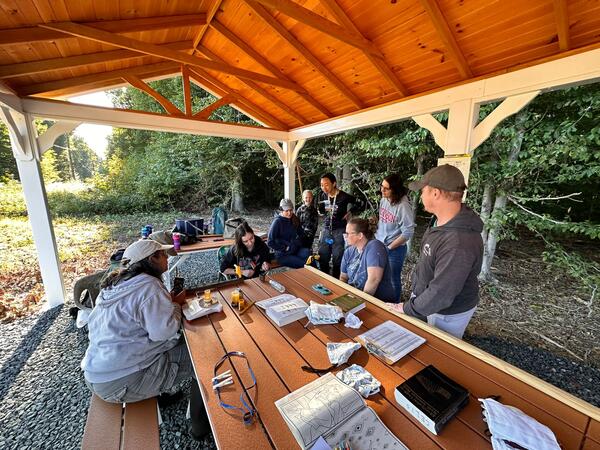
Bird Banding Laboratory staff band birds at their newly renovated migration station in the fall of 2023.
Bird Banding Laboratory staff band birds at their newly renovated migration station in the fall of 2023.