



Small fragments of dark, glassy impact melt particles from Meteor Crater, and larger, white shock-melted Coconino sandstone.
How can I tell if I have found an impact crater?
There are many natural processes other than impacts that can create circular features and depressions on the surface of the Earth. Examples include glaciation, volcanism, sinkholes, atolls, salt domes, intrusions, and hydrothermal explosions (to name just a few). Prehistoric mines and quarries are also sometimes mistaken for impact craters.
Although the USGS has been involved in impact crater research, we are neither the experts nor the ultimate authority on impact craters. Canada’s University of New Brunswick Planetary and Space Science Center is the best resource for confirming a structure as an impact crater. They maintain an Earth Impact Database and provide guidelines for identification of impact craters.
Learn more: This Dynamic Planet: World Map of Volcanoes, Earthquakes, Impact Craters, and Plate Tectonics
Related

Could magnetic reversals be caused by meteorite or comet impacts? Could magnetic reversals be caused by meteorite or comet impacts?
Although extremely unlikely, it might be possible for a reversal of the Earth's magnetic field to be triggered by a meteorite or comet impact, or even for it to be caused by something more "gentle," such as the melting of the polar ice caps. Self-contained dynamic systems like Earth’s dynamo can have reversals without any outside influence. Reversals of Earth's magnetic field can simply happen...

What is a sinkhole? What is a sinkhole?
A sinkhole is a depression in the ground that has no natural external surface drainage. Basically, this means that when it rains, all of the water stays inside the sinkhole and typically drains into the subsurface. Sinkholes are most common in what geologists call, “ karst terrain.” These are regions where the types of rock below the land surface can naturally be dissolved by groundwater...

When did dinosaurs become extinct? When did dinosaurs become extinct?
Dinosaurs went extinct about 65 million years ago (at the end of the Cretaceous Period), after living on Earth for about 165 million years. If all of Earth time from the very beginning of the dinosaurs to today were compressed into 365 days (one calendar year), the dinosaurs appeared January 1 and became extinct the third week of September. (Using this same time scale, the Earth would have formed...

Did people and dinosaurs live at the same time? Did people and dinosaurs live at the same time?
No! After the dinosaurs died out, nearly 65 million years passed before people appeared on Earth. However, small mammals (including shrew-sized primates) were alive at the time of the dinosaurs. Some scientists who study dinosaurs (vertebrate paleontologists) now think that birds are direct descendants of one line of carnivorous dinosaurs, and some consider that they in fact represent modern...

I think I found a meteorite. How can I tell for sure? I think I found a meteorite. How can I tell for sure?
Meteorites are fragments of rock or metal that fall to Earth from space. They are very rare, but many people find unusual rocks or pieces of metal and wonder if they might have found a meteorite. The USGS doesn't verify meteorites, but they have several properties that help distinguish them from other rocks: Density: Meteorites are usually quite heavy for their size, since they contain metallic...

Meteor Crater impact melt particles
Small fragments of dark, glassy impact melt particles from Meteor Crater, and larger, white shock-melted Coconino sandstone.

Asteroid Impact Modeling Working Group Hikes into Meteor Crater
Asteroid Impact Modeling Working Group Hikes into Meteor CraterThis photograph shows members of the Asteroid Impact Modeling Working Group workshop participants descending into Meteor Crater in northern Arizona. Meteor Crater is the best-preserved asteroid impact crater on Earth. It has been used to study the effects of impact, and as a site to train astronauts.
Asteroid Impact Modeling Working Group Hikes into Meteor Crater
Asteroid Impact Modeling Working Group Hikes into Meteor CraterThis photograph shows members of the Asteroid Impact Modeling Working Group workshop participants descending into Meteor Crater in northern Arizona. Meteor Crater is the best-preserved asteroid impact crater on Earth. It has been used to study the effects of impact, and as a site to train astronauts.

Chesapeake Bay Meteorite impact Crater

Figure showing the potential dispersal of asteroid outfall from an impact in Colorado.
Figure showing the potential dispersal of asteroid outfall from an impact in Colorado.Figure from the Planetary Defense Conference Abstract showing the potential dispersal of asteroid outfall from an impact in Colorado.
Figure showing the potential dispersal of asteroid outfall from an impact in Colorado.
Figure showing the potential dispersal of asteroid outfall from an impact in Colorado.Figure from the Planetary Defense Conference Abstract showing the potential dispersal of asteroid outfall from an impact in Colorado.

Gale crater
Infrared mosaic image of Mars Gale crater by the Thermal Emission Imaging Spectrometer (THEMIS) of the USGS Astrogeology Science Center and Arizona State University. The Mars Science Laboratory is scheduled to land in Gale crater Aug. 5, 2012.
Infrared mosaic image of Mars Gale crater by the Thermal Emission Imaging Spectrometer (THEMIS) of the USGS Astrogeology Science Center and Arizona State University. The Mars Science Laboratory is scheduled to land in Gale crater Aug. 5, 2012.

Chesapeake Bay Impact Crater
February 2013 public lecture, presented by David Powars

Cratered cones near Hephaestus Fossae
Cratered cones near Hephaestus Fossae, Mars. This might look at first glance like a cinder cone, but it is more likely an impact crater. Using the shadow, one can tell that its floor is at a lower elevation than the surrounding landscape. A cinder cone would rise above the landscape.
Cratered cones near Hephaestus Fossae, Mars. This might look at first glance like a cinder cone, but it is more likely an impact crater. Using the shadow, one can tell that its floor is at a lower elevation than the surrounding landscape. A cinder cone would rise above the landscape.

PubTalk 3/2007 — Impact!
Piecing together the story of a giant meteorite crater beneath the Atlantic coast
By David S. Powars, Geologist, and R.D. Catchings, Geophysicist
Piecing together the story of a giant meteorite crater beneath the Atlantic coast
By David S. Powars, Geologist, and R.D. Catchings, Geophysicist

Shoemaker Crater
Resembling splotches of yellow and green paint, salt-encrusted seasonal lakes dot the floor of Western Australia's Shoemaker impact structure. The structure was formed about 1.7 billion years ago and is currently the oldest known impact site in Australia.
Resembling splotches of yellow and green paint, salt-encrusted seasonal lakes dot the floor of Western Australia's Shoemaker impact structure. The structure was formed about 1.7 billion years ago and is currently the oldest known impact site in Australia.

Aerial view of Meteor Crater, Coconino County, Arizona
Aerial view of Meteor Crater, Coconino County, ArizonaAerial view of Arizona's Meteor Crater, a 180 meter deep, 1.2 kilometer diameter bowl-shaped impact crater in Northern Arizona. The crater formed approximately 50,000 years ago by the impact of a 100,000-ton iron-nickel meteorite that was approximately 30 meters in diameter and struck at an approximate speed of 12-20 km/sec.
Aerial view of Meteor Crater, Coconino County, Arizona
Aerial view of Meteor Crater, Coconino County, ArizonaAerial view of Arizona's Meteor Crater, a 180 meter deep, 1.2 kilometer diameter bowl-shaped impact crater in Northern Arizona. The crater formed approximately 50,000 years ago by the impact of a 100,000-ton iron-nickel meteorite that was approximately 30 meters in diameter and struck at an approximate speed of 12-20 km/sec.
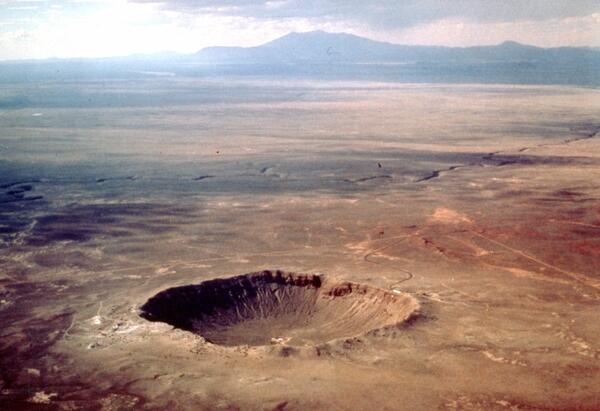
Aerial view of Meteor Crater, color, Coconino County, Arizona
Aerial view of Meteor Crater, color, Coconino County, ArizonaMeteor Crater formed approximately 50,000 years ago by the impact of a 100,000-ton iron-nickel meteorite, ~30 m in diameter, which struck at an approximate speed of 12-20 km/sec.
Aerial view of Meteor Crater, color, Coconino County, Arizona
Aerial view of Meteor Crater, color, Coconino County, ArizonaMeteor Crater formed approximately 50,000 years ago by the impact of a 100,000-ton iron-nickel meteorite, ~30 m in diameter, which struck at an approximate speed of 12-20 km/sec.
Related
Could magnetic reversals be caused by meteorite or comet impacts? Could magnetic reversals be caused by meteorite or comet impacts?
Although extremely unlikely, it might be possible for a reversal of the Earth's magnetic field to be triggered by a meteorite or comet impact, or even for it to be caused by something more "gentle," such as the melting of the polar ice caps. Self-contained dynamic systems like Earth’s dynamo can have reversals without any outside influence. Reversals of Earth's magnetic field can simply happen...
What is a sinkhole? What is a sinkhole?
A sinkhole is a depression in the ground that has no natural external surface drainage. Basically, this means that when it rains, all of the water stays inside the sinkhole and typically drains into the subsurface. Sinkholes are most common in what geologists call, “ karst terrain.” These are regions where the types of rock below the land surface can naturally be dissolved by groundwater...
When did dinosaurs become extinct? When did dinosaurs become extinct?
Dinosaurs went extinct about 65 million years ago (at the end of the Cretaceous Period), after living on Earth for about 165 million years. If all of Earth time from the very beginning of the dinosaurs to today were compressed into 365 days (one calendar year), the dinosaurs appeared January 1 and became extinct the third week of September. (Using this same time scale, the Earth would have formed...
Did people and dinosaurs live at the same time? Did people and dinosaurs live at the same time?
No! After the dinosaurs died out, nearly 65 million years passed before people appeared on Earth. However, small mammals (including shrew-sized primates) were alive at the time of the dinosaurs. Some scientists who study dinosaurs (vertebrate paleontologists) now think that birds are direct descendants of one line of carnivorous dinosaurs, and some consider that they in fact represent modern...
I think I found a meteorite. How can I tell for sure? I think I found a meteorite. How can I tell for sure?
Meteorites are fragments of rock or metal that fall to Earth from space. They are very rare, but many people find unusual rocks or pieces of metal and wonder if they might have found a meteorite. The USGS doesn't verify meteorites, but they have several properties that help distinguish them from other rocks: Density: Meteorites are usually quite heavy for their size, since they contain metallic...
Meteor Crater impact melt particles
Small fragments of dark, glassy impact melt particles from Meteor Crater, and larger, white shock-melted Coconino sandstone.
Small fragments of dark, glassy impact melt particles from Meteor Crater, and larger, white shock-melted Coconino sandstone.
Asteroid Impact Modeling Working Group Hikes into Meteor Crater
Asteroid Impact Modeling Working Group Hikes into Meteor CraterThis photograph shows members of the Asteroid Impact Modeling Working Group workshop participants descending into Meteor Crater in northern Arizona. Meteor Crater is the best-preserved asteroid impact crater on Earth. It has been used to study the effects of impact, and as a site to train astronauts.
Asteroid Impact Modeling Working Group Hikes into Meteor Crater
Asteroid Impact Modeling Working Group Hikes into Meteor CraterThis photograph shows members of the Asteroid Impact Modeling Working Group workshop participants descending into Meteor Crater in northern Arizona. Meteor Crater is the best-preserved asteroid impact crater on Earth. It has been used to study the effects of impact, and as a site to train astronauts.
Chesapeake Bay Meteorite impact Crater
Figure showing the potential dispersal of asteroid outfall from an impact in Colorado.
Figure showing the potential dispersal of asteroid outfall from an impact in Colorado.Figure from the Planetary Defense Conference Abstract showing the potential dispersal of asteroid outfall from an impact in Colorado.
Figure showing the potential dispersal of asteroid outfall from an impact in Colorado.
Figure showing the potential dispersal of asteroid outfall from an impact in Colorado.Figure from the Planetary Defense Conference Abstract showing the potential dispersal of asteroid outfall from an impact in Colorado.
Gale crater
Infrared mosaic image of Mars Gale crater by the Thermal Emission Imaging Spectrometer (THEMIS) of the USGS Astrogeology Science Center and Arizona State University. The Mars Science Laboratory is scheduled to land in Gale crater Aug. 5, 2012.
Infrared mosaic image of Mars Gale crater by the Thermal Emission Imaging Spectrometer (THEMIS) of the USGS Astrogeology Science Center and Arizona State University. The Mars Science Laboratory is scheduled to land in Gale crater Aug. 5, 2012.
Chesapeake Bay Impact Crater
February 2013 public lecture, presented by David Powars
Cratered cones near Hephaestus Fossae
Cratered cones near Hephaestus Fossae, Mars. This might look at first glance like a cinder cone, but it is more likely an impact crater. Using the shadow, one can tell that its floor is at a lower elevation than the surrounding landscape. A cinder cone would rise above the landscape.
Cratered cones near Hephaestus Fossae, Mars. This might look at first glance like a cinder cone, but it is more likely an impact crater. Using the shadow, one can tell that its floor is at a lower elevation than the surrounding landscape. A cinder cone would rise above the landscape.
PubTalk 3/2007 — Impact!
Piecing together the story of a giant meteorite crater beneath the Atlantic coast
By David S. Powars, Geologist, and R.D. Catchings, Geophysicist
Piecing together the story of a giant meteorite crater beneath the Atlantic coast
By David S. Powars, Geologist, and R.D. Catchings, Geophysicist
Shoemaker Crater
Resembling splotches of yellow and green paint, salt-encrusted seasonal lakes dot the floor of Western Australia's Shoemaker impact structure. The structure was formed about 1.7 billion years ago and is currently the oldest known impact site in Australia.
Resembling splotches of yellow and green paint, salt-encrusted seasonal lakes dot the floor of Western Australia's Shoemaker impact structure. The structure was formed about 1.7 billion years ago and is currently the oldest known impact site in Australia.
Aerial view of Meteor Crater, Coconino County, Arizona
Aerial view of Meteor Crater, Coconino County, ArizonaAerial view of Arizona's Meteor Crater, a 180 meter deep, 1.2 kilometer diameter bowl-shaped impact crater in Northern Arizona. The crater formed approximately 50,000 years ago by the impact of a 100,000-ton iron-nickel meteorite that was approximately 30 meters in diameter and struck at an approximate speed of 12-20 km/sec.
Aerial view of Meteor Crater, Coconino County, Arizona
Aerial view of Meteor Crater, Coconino County, ArizonaAerial view of Arizona's Meteor Crater, a 180 meter deep, 1.2 kilometer diameter bowl-shaped impact crater in Northern Arizona. The crater formed approximately 50,000 years ago by the impact of a 100,000-ton iron-nickel meteorite that was approximately 30 meters in diameter and struck at an approximate speed of 12-20 km/sec.
Aerial view of Meteor Crater, color, Coconino County, Arizona
Aerial view of Meteor Crater, color, Coconino County, ArizonaMeteor Crater formed approximately 50,000 years ago by the impact of a 100,000-ton iron-nickel meteorite, ~30 m in diameter, which struck at an approximate speed of 12-20 km/sec.
Aerial view of Meteor Crater, color, Coconino County, Arizona
Aerial view of Meteor Crater, color, Coconino County, ArizonaMeteor Crater formed approximately 50,000 years ago by the impact of a 100,000-ton iron-nickel meteorite, ~30 m in diameter, which struck at an approximate speed of 12-20 km/sec.
Updated Date: April 15, 2025