U.S. flag

An official website of the United States government

Images

Florence Bascom Geoscience Center images.

Filter Total Items: 152
A woman standing in a stream holds a tape measure to a tree root.
Examining Tree Roots

Physical Scientist Molly Huber of the Florence Bascom Geoscience Center examines tree roots in a location where a root cookie was recently cut.

Molly was there as part of a stream habitat/riparian assessment at Orson Creek in south central Pennsylvania.

Physical Scientist Molly Huber of the Florence Bascom Geoscience Center examines tree roots in a location where a root cookie was recently cut.

Molly was there as part of a stream habitat/riparian assessment at Orson Creek in south central Pennsylvania.

excavated hole in forest with hydraulic piping equipment and muddy water
Gold mining site along the Cuyuni River, Guyana

Permitted small-scale gold mining site along the Cuyuni River in northwestern Guyana, June 2022. The picture depicts two gold mining hydraulic “dredges” in an excavated pit approximately 1 hectare in size. (Pete Chirico, USGS).

Permitted small-scale gold mining site along the Cuyuni River in northwestern Guyana, June 2022. The picture depicts two gold mining hydraulic “dredges” in an excavated pit approximately 1 hectare in size. (Pete Chirico, USGS).

Mapping the geology near historical graphite deposits on Lead Hill in Ticonderoga, New York

Mapping the geology near historical graphite deposits on Lead Hill in Ticonderoga, New York

Photo Contest Winner | Spring 2022 | Where We Work

map of Chesapeake Bay region showing study site locations
Map showing the location of the Atlantic Subsurface Stratigraphic Initiative study area in Maryland and Virginia.

Map showing the location of the study area in Maryland and Virginia.  Each dot represents an outcrop (red), core (black) or water well (orange) where Paleogene formation thicknesses were obtained.  The circular feature in the southern portion of the map is the Chesapeake Bay Impact Crater.  Paleogene sediments are not present in the crater.

Map showing the location of the study area in Maryland and Virginia.  Each dot represents an outcrop (red), core (black) or water well (orange) where Paleogene formation thicknesses were obtained.  The circular feature in the southern portion of the map is the Chesapeake Bay Impact Crater.  Paleogene sediments are not present in the crater.

two people standing outside taking notes
Geologists taking field notes

USGS Geologists Jean Self-Trail and Mercer Parker taking field notes, Prince George’s County

USGS Geologists Jean Self-Trail and Mercer Parker taking field notes, Prince George’s County

shells on black beach sand
Paleocene bivalve mollusc shells, Aquina Formation, Charles County, Maryland
tan rock with numerous cm-scale shells and shell fragments
Paleocene gastropods and bivalve molluscs of the Aquia Formation

A densely packed shell bed of the Paleocene gastropods Kapalmerella mortonii and K. humerosa, along with various bivalve molluscs, King George County, Virginia

pick lying on a coarsening upward, fossil-rich outcrop
Aquia Formation (Paleocene) shell hash, Prince George’s County, Maryland

A typical Aquia Formation shell hash consisting mainly of the Paleocene gastropod Kapalmerella mortoni, Prince George’s County, Maryland

geologist standing on rock outcrop near water
Indurated bed of the Paleocene Aquia Formation, Prince George’s County, Maryland

USGS Scientist Laurel Bybell standing on an indurated bed of the Paleocene Aquia Formation with a thick layer of highly fossilferous Aquia sediment above, Prince George’s County, Maryland

small waterfall over grey and tan rock, surrounded by greenery
Aquia Formation (Paleocene), Prince George’s County, Maryland
Paper mill reservoir in the Black River Valley

Photo Contest Winner | July 2021 | Where We Work
Paper mill reservoir in the Black River Valley, western Adirondacks, near Lyonsdale, New York

Photo Contest Winner | July 2021 | Where We Work
Paper mill reservoir in the Black River Valley, western Adirondacks, near Lyonsdale, New York

Jean Self-Trail and Laurel Bybell in Prince Georges County, Maryland

Photo Contest Winner | July 2021 | People
Jean Self-Trail and Laurel Bybell in Prince Georges County, Maryland

Four close-up images of a longer sediment core (bottom).
Hurricane deposits in a sediment core

Four close-up images of a longer sediment core (bottom). The light coloring indicates coarser sand that likely occurred from overwash flooding during a previous hurricane. This is one of a few cores collected in northwest Florida by the USGS and partners to help understand past hurricane activity in the Gulf of Mexico and northern Atlantic Ocean.

Four close-up images of a longer sediment core (bottom). The light coloring indicates coarser sand that likely occurred from overwash flooding during a previous hurricane. This is one of a few cores collected in northwest Florida by the USGS and partners to help understand past hurricane activity in the Gulf of Mexico and northern Atlantic Ocean.

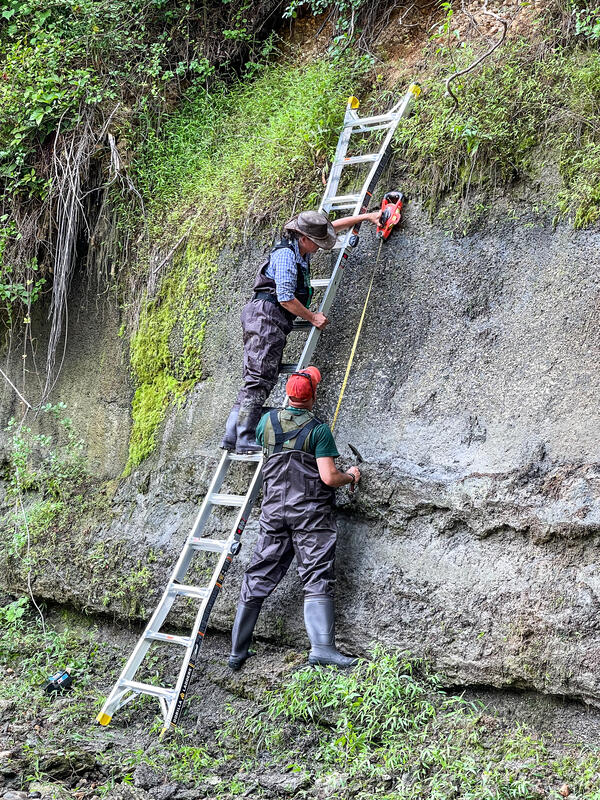
Randy Orndorff examines limestone on Lake Champlain, VT

Photo Contest Winner | Nov. 2019 | USGS at Work
Randy Orndorff examines limestone on Lake Champlain, VT

Landslide at Howard Gap Road

Northeast Region Photo Contest Winner | June 2019 | USGS at Work
Landslide at Howard Gap Road, Hendersonville NC; People (R to L): Kelsey O'Pry, Corey Scheip, Jesse Hill, Jessica DeWitt; UAV imaging and geologic field observations are done to map the extent and activity of this landslide; Hendersonville, NC

Northeast Region Photo Contest Winner | June 2019 | USGS at Work
Landslide at Howard Gap Road, Hendersonville NC; People (R to L): Kelsey O'Pry, Corey Scheip, Jesse Hill, Jessica DeWitt; UAV imaging and geologic field observations are done to map the extent and activity of this landslide; Hendersonville, NC

Satellite imagery of eastern berm of Jim Foot Key in Florida Bay before and after Hurricane Irma.
Impacts to island in Florida Bay following Hurricane Irma, 2017

Scientists from the Florence Bascom Geoscience Center first sampled four islands in Florida Bay, Everglades National Park, in April 2014 to collect cores to study sea level rise and storm history in the region.  In September 2017, Hurricane Irma (a category 4 storm at landfall in the Florida Keys) passed just to the west of our field sites.  The western-mo

Scientists from the Florence Bascom Geoscience Center first sampled four islands in Florida Bay, Everglades National Park, in April 2014 to collect cores to study sea level rise and storm history in the region.  In September 2017, Hurricane Irma (a category 4 storm at landfall in the Florida Keys) passed just to the west of our field sites.  The western-mo

J. Mitchell Doyle swamped in soil on the Pamunkey River, VA

Photo Contest Winner | Dec. 2019 | People
J. Mitchell Doyle swamped in soil on the Pamunkey River, VA

USGS scientist Jessica Rodysill studies a sediment core to identify storm deposits and help understand past hurricane activity. This core was collected from the Dominican Republic.
Sediment Core
Sediment Core
Sediment Core

USGS scientist Jessica Rodysill studies a sediment core to identify storm deposits and help understand past hurricane activity. This core was collected from the Dominican Republic. Credit: Kristen Steele, USGS.

USGS scientist Jessica Rodysill studies a sediment core to identify storm deposits and help understand past hurricane activity. This core was collected from the Dominican Republic. Credit: Kristen Steele, USGS.

Great Lakes Geologic Mapping Task 2
Great Lakes Geologic Mapping Task 2 Image

This is a photograph of a boulder (glacial erratic) in Massachussets. This photograph was taken during field work for task 2.

This is a photograph of a boulder (glacial erratic) in Massachussets. This photograph was taken during field work for task 2.

Was this page helpful?