



SPCMSC Scientists Perform Fieldwork on the Coral-Rubble Keys Protecting Dry Tortugas National Park
A team of U.S. Geological Survey scientists and National Park Service staff recently conducted fieldwork in Dry Tortugas National Park aimed at improving understanding of how coastal islands evolve over time and how severe storms influence their growth and erosion.
DRY TORTUGAS NATIONAL PARK, Fla. - From October 5 to 10, 2026, an interdisciplinary team from the St. Petersburg Coastal and Marine Science Center (SPCMSC), including Anastasios Stathakopoulos, Dan Ciarletta, and Lauren Toth, partnered with National Park Service (NPS) staff to collect sediment cores, paleoecological data, and Global Positioning System (GPS) survey measurements on Bush Key and Long Key. The research builds on recent U.S. Geological Survey studies and will help scientists better understand the long-term history of geomorphological change on the islands and the role major storms play in island accretion and erosion.
The islands of Dry Tortugas National Park are composed primarily of coral rubble and other reef-derived carbonate sediments. These dynamic landforms provide vital habitat for a variety of wildlife, including nesting seabirds, sea turtles, and sharks. They also serve an important protective function for nearby cultural and infrastructure resources within the park.
Bush Key and Long Key occupy a strategically important location in the park, helping shield historic Fort Jefferson on Garden Key, as well as the park's deep-water harbor and other maritime infrastructure, from wave action and coastal impacts. Understanding how these islands gain, lose, and redistribute sediment is critical to preserving both ecological and cultural resources.
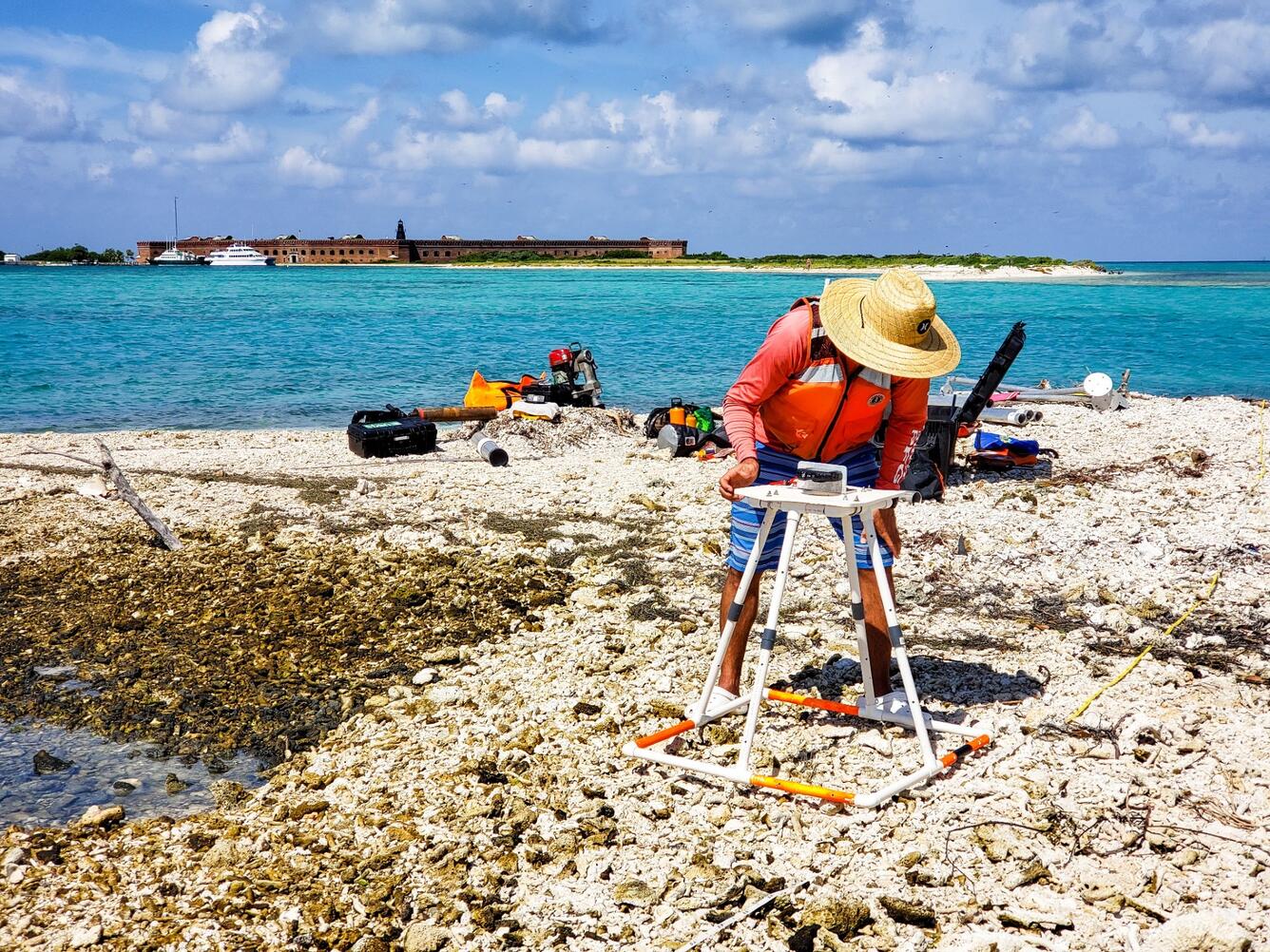
The research team's field activities focused on examining the long-term movement and accumulation of coral-derived sediments that form and sustain the islands. Sediment cores and paleoecological analyses provide records of past environmental conditions, while GPS surveys help document current island elevations and shoreline characteristics. Together, these data will help researchers reconstruct how the islands have changed over time and how they may respond to future environmental challenges.
The study also contributes to a growing body of research examining the connection between offshore coral reefs and island stability. Coral rubble that forms the foundation of Bush Key and Long Key originates from adjacent reef systems. Understanding the balance between sediment supply, erosion, and redistribution is essential for effective management and restoration planning.
Recent USGS research suggests that some of the reef-derived material supporting these islands may be thousands of years old. Scientists are working to determine whether this sediment supply is finite and how ongoing erosion and sediment transport may affect the future resilience of the islands.
Findings from the project will help resource managers better understand the processes that shape the Dry Tortugas landscape and inform future efforts to protect the park's valuable ecological habitats, historic resources, and coastal infrastructure.