



Climate and Environmental Change in the Gulf of America and Caribbean
This project documents paleoceanographic, climatic, and environmental changes in the Gulf of America and adjacent land areas over the last 10,000 years. The paleoenvironmental data is used to determine rates of change in the past, and to better understand both the natural and anthropogenic factors that contribute to climate variability on inter-annual to millennial timescales.
Paleoclimate Reconstruction from Marine and Lake Sediments
Highly-resolved records of past climate variability are increasingly important in light of the current need to differentiate between natural and anthropogenic climate change. Studies concentrate on the Holocene, the last 10,000 years. Analysis of microfossils, trace metal geochemistry, stable isotope geochemistry, and biomarkers sediment cores is performed at sub-millennial to decadal resolution in sediment cores from lakes and the deep ocean.

Coral Reefs as Climate Archives
Coral reefs are sentinels of climate change, responding to changes in water temperature, ocean pH, pollution and land use change near the coasts. This part of the project ties in closely with the CREST Project within the USGS Coastal and Marine Geology Program, and aims to reconstruct changes temperature, ocean circulation, sea level and the history of reef formation.

Paleoceanographic Proxy Calibration
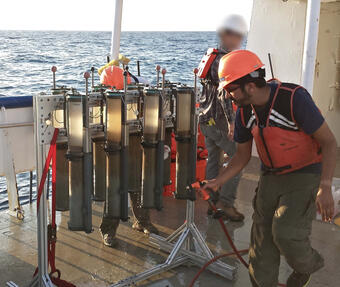
A sediment trap time series (2008-2018) in the northern Gulf of America is used to assess environmental controls on sediment flux, microfossil assemblages and the biogeochemistry of both molecular and calcium carbonate fossils. This information is used to improve calibrations, quantify uncertainties, and better understand the strengths and limitations of different paleoceanographic proxies in the Gulf of America.
This project documents paleoceanographic, climatic, and environmental changes in the Gulf of America and adjacent land areas over the last 10,000 years. The paleoenvironmental data is used to determine rates of change in the past, and to better understand both the natural and anthropogenic factors that contribute to climate variability on inter-annual to millennial timescales.
Paleoclimate Reconstruction from Marine and Lake Sediments
Highly-resolved records of past climate variability are increasingly important in light of the current need to differentiate between natural and anthropogenic climate change. Studies concentrate on the Holocene, the last 10,000 years. Analysis of microfossils, trace metal geochemistry, stable isotope geochemistry, and biomarkers sediment cores is performed at sub-millennial to decadal resolution in sediment cores from lakes and the deep ocean.
Coral Reefs as Climate Archives
Coral reefs are sentinels of climate change, responding to changes in water temperature, ocean pH, pollution and land use change near the coasts. This part of the project ties in closely with the CREST Project within the USGS Coastal and Marine Geology Program, and aims to reconstruct changes temperature, ocean circulation, sea level and the history of reef formation.
Paleoceanographic Proxy Calibration
A sediment trap time series (2008-2018) in the northern Gulf of America is used to assess environmental controls on sediment flux, microfossil assemblages and the biogeochemistry of both molecular and calcium carbonate fossils. This information is used to improve calibrations, quantify uncertainties, and better understand the strengths and limitations of different paleoceanographic proxies in the Gulf of America.