



Our Research on a Tire Chemical and its Impact on Fish Featured in LakeLine Magazine
We are excited to announce that our work on 6PPD, a toxic chemical used in nearly all vehicle tires, was recently featured in the Fall 2025 issue of LakeLine Magazine.
LakeLine Magazine is the official publication of the North American Lake Management Society (NALMS). This recognition of our work highlights the importance of our ongoing efforts to understand and mitigate the impacts of tire wear particles on aquatic ecosystems.
The article, titled “Treading water: How 6PPD-quinone reaches our local water bodies & what it means for sensitive fish species,” provides an in-depth look at how this compound forms, moves through stormwater systems, and affects fish populations. Authored by USGS scientists Rachael Lane, Justin Greer, Stephanie Gordon, Brianna Williams, and Kelly Smalling, the piece underscores the critical role of science in addressing emerging contaminants in urban environments.
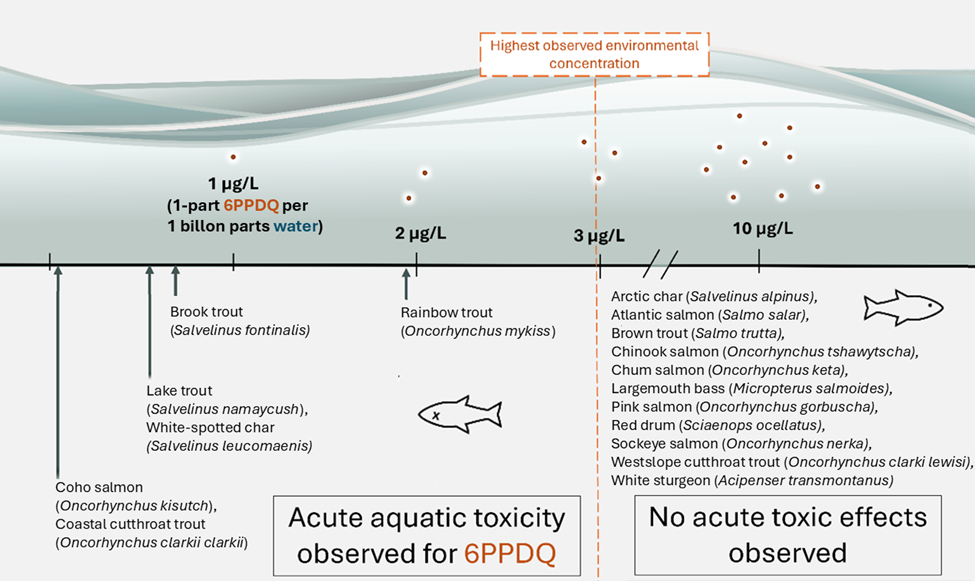
What is 6PPD-quinone and why does it matter?
6PPD is an antioxidant added to tires to prevent cracking and extend their lifespan. However, when exposed to oxygen, it transforms into 6PPD-quinone: a compound now linked to high mortality in coho salmon and other sensitive species. This chemical enters waterways primarily through stormwater runoff, posing a serious threat to fish populations and, by extension, the health of aquatic ecosystems.
The ecological impact and our response
Research has shown that extremely low concentrations of 6PPD-quinone can cause acute toxicity in coho salmon and several other salmonid species, jeopardizing recovery efforts for these iconic fish. The article highlights how our team is working with partners to trace the pathways of tire wear particles in the environment and identify practical solutions to reduce their impact.
Science in action for healthier watersheds
Our inclusion in LakeLine Magazine reflects a broader commitment to advancing science-based strategies that protect aquatic life. By monitoring emerging contaminants and collaborating across disciplines, we aim to develop solutions that safeguard both ecological integrity and community well-being.
You can read the full article in the Fall 2025 issue of LakeLine Magazine.