



Science in Action: Midnight Gillnetting On Lake Washington Shores
USGS Scientists and partners are taking a closer look at how nearshore lighting impacts young salmon survival in Lake Washington, WA.
At the south end of Lake Washington, where the Cedar River spills over a million salmon fry into the lake each Spring, nearshore lights from waterfront homes and nearby industrial areas illuminate the skies and waters beneath.
During the Spring of 2025, collaborators at the University of Washington observed juvenile salmon and their predators in the shallows near waterfront homes. This is an example of locations where young salmon may attempt to stay safe and hidden from predators overnight.
This year, USGS scientists are deploying gillnets overnight near one group of 5 houses west of the mouth of the Cedar River. Their aim: to catch predator fish, examine their stomach contents, and determine whether these shallow and brightly lit areas are “predation hotspots” for young salmon. They will be capturing predators such as yellow perch and bass and analyzing how lighting changes predation rates.
To accomplish this, scientists at the USGS Western Fisheries Research Center are sampling two consecutive nights per month. On the first night, participating homeowners will leave their nearshore home lights on. On the second night, homeowners will turn their lights off. This will help scientists determine whether the different lighting conditions affect salmon predation levels.
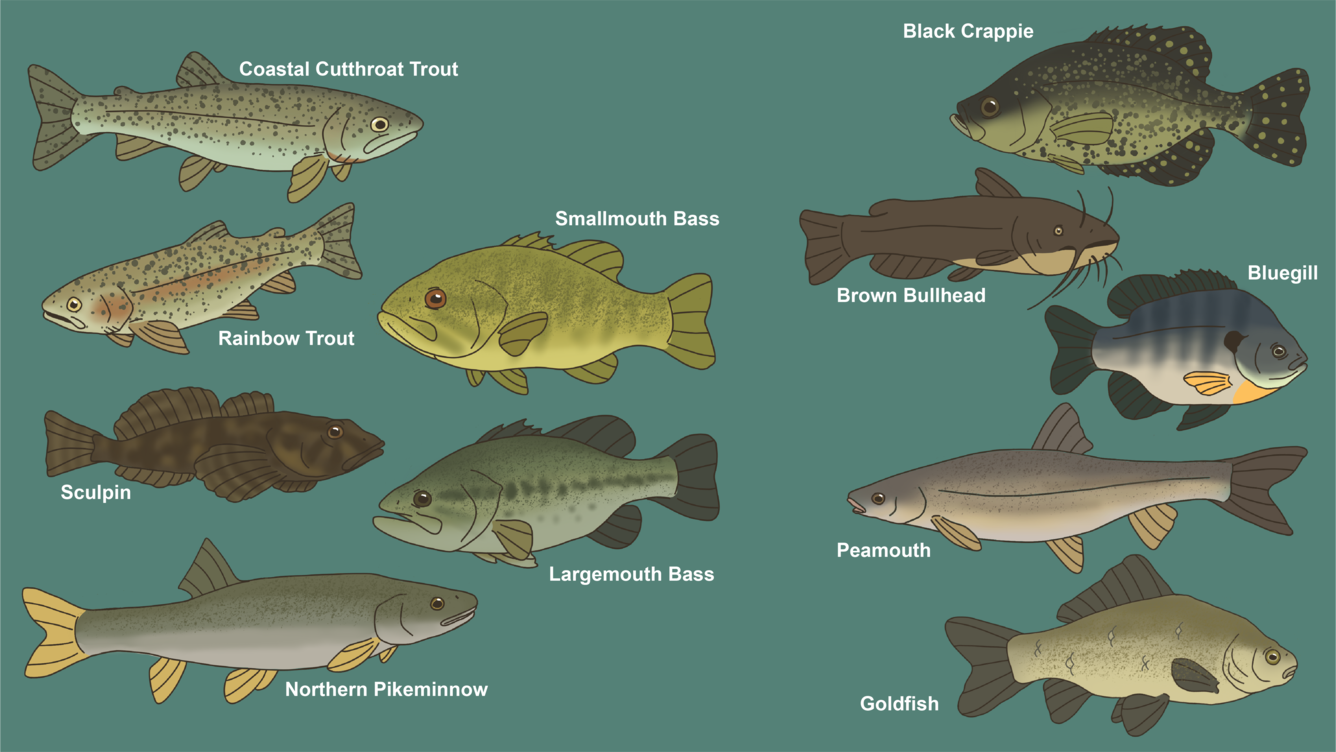
After collecting ~300 fish to date, we are beginning to learn about the composition of potential salmon predators at these shallow nearshore sites. Larger yellow perch appeared to dominate the areas through spring, shifting in June to
a new cohort of smaller yellow perch as well as bullhead, bass, crappie, bluegill, and others. This is a mix of friends and foe for young salmon. While fish like rainbow/cutthroat trout, large and smallmouth bass, pikeminnow, black crappie, and sculpin are all considered juvenile salmon predators, bullhead, bluegill, peamouth, and goldfish are not known to eat young salmon.
This nighttime project also involves collecting light measurements and deploying an acoustic camera along the Lake Washington shoreline to capture potential nocturnal predation and determine exactly where young salmon hang out at night. Scientists conducted late night snorkel surveys as well to help to ground truth the acoustic data.
This project will ultimately help us determine whether and, if so, to what extent residential shoreline lighting affects predation of young salmon. This will inform shoreline residents and local land use managers about best lighting practices for protecting these important fish.