



Do earthquakes large enough to collapse buildings and roads accompany volcanic eruptions?
Not usually. Earthquakes associated with eruptions rarely exceed magnitude 5, and these moderate earthquakes are not big enough to destroy buildings and roads.
The largest earthquakes at Mount St. Helens in 1980 were magnitude 5, large enough to sway trees and damage buildings, but not destroy them. During the huge eruption of Mount Pinatubo in the Philippines in 1991, dozens of light to moderate earthquakes (magnitude 3 to 5) were felt by several hundred thousand people. Many houses collapsed, but not primarily because of the shaking. Heavy ash from the eruption (made heavier by rain from a hurricane) accumulated on roofs and crushed them.
Stronger earthquakes sometimes DO occur near volcanoes as a result of tectonic faulting. For example, four magnitude 6 earthquakes struck Long Valley caldera, California, in 1980, and a magnitude 7.2 earthquake struck Kilauea Volcano, Hawaii, in 1975. Both volcanoes were quiet at the time. The Hawaii earthquake triggered a small eruption at the summit of Kilauea. No eruption occurred at Long Valley.
Learn more: Monitoring Volcano Seismicity Provides Insight to Volcanic Structure
Related

What was the largest volcanic eruption in the 20th century? What was the largest volcanic eruption in the 20th century?
The world's largest eruption of the 20th century occurred in 1912 at Novarupta on the Alaska Peninsula in what is now Katmai National Park and Preserve. An estimated 15 cubic kilometers of magma was explosively erupted during 60 hours beginning on June 6th. This volume is equivalent to 230 years of eruption at Kilauea (Hawaii) or about 30 times the volume erupted by Mount St. Helens (Washington)...

Where do earthquakes occur? Where do earthquakes occur?
Earthquakes can strike any location at any time, but history shows they occur in the same general patterns year after year, principally in three large zones of the earth: The world's greatest earthquake belt, the circum-Pacific seismic belt, is found along the rim of the Pacific Ocean, where about 81 percent of our planet's largest earthquakes occur. It has earned the nickname "Ring of Fire". Why...
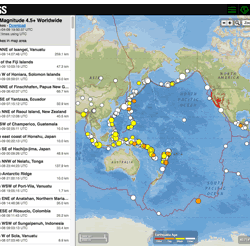
Where can I find current earthquake lists and maps for the world or for a specific area? Where can I find current earthquake lists and maps for the world or for a specific area?
The Earthquake Hazards Program Latest Earthquakes Map displays earthquakes in near-realtime and up to the past 30 days of earthquakes. The interface includes three panels: a list of earthquakes, a map, and a settings/options panel. You can pan and zoom the map to view specific areas. Click on an event on the list or map for additional information and a link to the event page with all the details...
Related
What was the largest volcanic eruption in the 20th century? What was the largest volcanic eruption in the 20th century?
The world's largest eruption of the 20th century occurred in 1912 at Novarupta on the Alaska Peninsula in what is now Katmai National Park and Preserve. An estimated 15 cubic kilometers of magma was explosively erupted during 60 hours beginning on June 6th. This volume is equivalent to 230 years of eruption at Kilauea (Hawaii) or about 30 times the volume erupted by Mount St. Helens (Washington)...
Where do earthquakes occur? Where do earthquakes occur?
Earthquakes can strike any location at any time, but history shows they occur in the same general patterns year after year, principally in three large zones of the earth: The world's greatest earthquake belt, the circum-Pacific seismic belt, is found along the rim of the Pacific Ocean, where about 81 percent of our planet's largest earthquakes occur. It has earned the nickname "Ring of Fire". Why...
Where can I find current earthquake lists and maps for the world or for a specific area? Where can I find current earthquake lists and maps for the world or for a specific area?
The Earthquake Hazards Program Latest Earthquakes Map displays earthquakes in near-realtime and up to the past 30 days of earthquakes. The interface includes three panels: a list of earthquakes, a map, and a settings/options panel. You can pan and zoom the map to view specific areas. Click on an event on the list or map for additional information and a link to the event page with all the details...