



What is UTC, and why do you report earthquakes in UTC?
UTC stands for Coordinated Universal Time, and for this purpose is the same as GMT (Greenwich Mean Time).
Since the USGS and other seismic network agencies record earthquakes around the globe in all the various time zones, using a single standard time reference is best for record-keeping and exchange of data. The individual event pages with details about each earthquake use UTC for the reference time. Sometimes this means the UTC date of the earthquake is "the next day" from the date where you are.
The default time reference on the Latest Earthquakes list is your local time based on the time clock on your computer or mobile device. You can change this setting in the Settings panel ("gear" icon in upper right). Keep in mind that your local time might be different from the local time of the earthquake, even if you felt it. An earthquake offshore in the ocean or in a neighboring state might be in different time zone from yours.
NASA has a helpful website on Time Zones and Universal Time.
Related
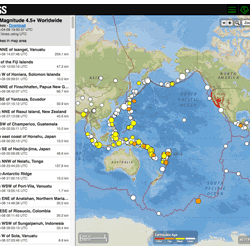
Where can I find current earthquake lists and maps for the world or for a specific area? Where can I find current earthquake lists and maps for the world or for a specific area?
The Earthquake Hazards Program Latest Earthquakes Map displays earthquakes in near-realtime and up to the past 30 days of earthquakes. The interface includes three panels: a list of earthquakes, a map, and a settings/options panel. You can pan and zoom the map to view specific areas. Click on an event on the list or map for additional information and a link to the event page with all the details...

Did I feel an earthquake? Can I report feeling an earthquake? Did I feel an earthquake? Can I report feeling an earthquake?
Report an earthquake experience or related observation through the Did You Feel It? citizen science webpage. The best way to do this is to click on the earthquake that you think you felt on one of the lists on the Earthquakes webpage, and then select the "Tell Us!" link. If you don't see the earthquake you think you felt, use the green "Report an Unknown Event" button on our Did You Feel It? page...

Why is the earthquake that was reported/recorded by network X, or that I felt, not on the Latest Earthquakes map/list? Why is the earthquake that was reported/recorded by network X, or that I felt, not on the Latest Earthquakes map/list?
The USGS Latest Earthquakes map and lists show events that have been located by the USGS and contributing agencies within the last 30 days. They should NOT be considered complete lists of all events in the U.S. and adjacent areas and especially should NOT be considered complete lists of all magnitude 4.5 and greater events that occur around the globe. In most cases, we locate and report an...

Why do some earthquakes disappear from the map/list? Why do some earthquakes disappear from the map/list?
The USGS and networks contributing to the Advance National Seismic System (ANSS) take great effort to provide accurate and timely earthquake information. Occasionally our systems produce erroneous information that is released to the public via our web pages or Earthquake Notification System. These mistakes are generally promptly identified by seismologists, removed from our web pages, and “delete”...

Why isn't the fault on which the earthquake occurred or the distance to the nearest fault provided? Why isn't the fault on which the earthquake occurred or the distance to the nearest fault provided?
Seismologists evaluate the hypocenter location and the focal mechanism of an earthquake to decide if the earthquake occurs on a named fault. Research shows that many earthquakes occur on small, un-named faults located near well-known faults. For example, most of the aftershocks of the 1989 M6.9 Loma Prieta earthquake occurred on small, subsidiary faults within a few hundred meters of the mainshock...

Can I get on a list to receive an email message when there is an earthquake? How do I sign up for earthquake notifications? Are there any Feeds I can subscribe to? Can I get on a list to receive an email message when there is an earthquake? How do I sign up for earthquake notifications? Are there any Feeds I can subscribe to?
Please go to the USGS Earthquake Notification Services (ENS) to sign up for free emails or text messages to your phone. Use the default settings or customize ENS to fit your needs. Also check out the many different Earthquake Feeds. ENS is NOT an earthquake early warning system. Messages issued by ENS will almost always arrive after you would feel any shaking. Learn more: How do I sign up for...
Related
Where can I find current earthquake lists and maps for the world or for a specific area? Where can I find current earthquake lists and maps for the world or for a specific area?
The Earthquake Hazards Program Latest Earthquakes Map displays earthquakes in near-realtime and up to the past 30 days of earthquakes. The interface includes three panels: a list of earthquakes, a map, and a settings/options panel. You can pan and zoom the map to view specific areas. Click on an event on the list or map for additional information and a link to the event page with all the details...
Did I feel an earthquake? Can I report feeling an earthquake? Did I feel an earthquake? Can I report feeling an earthquake?
Report an earthquake experience or related observation through the Did You Feel It? citizen science webpage. The best way to do this is to click on the earthquake that you think you felt on one of the lists on the Earthquakes webpage, and then select the "Tell Us!" link. If you don't see the earthquake you think you felt, use the green "Report an Unknown Event" button on our Did You Feel It? page...
Why is the earthquake that was reported/recorded by network X, or that I felt, not on the Latest Earthquakes map/list? Why is the earthquake that was reported/recorded by network X, or that I felt, not on the Latest Earthquakes map/list?
The USGS Latest Earthquakes map and lists show events that have been located by the USGS and contributing agencies within the last 30 days. They should NOT be considered complete lists of all events in the U.S. and adjacent areas and especially should NOT be considered complete lists of all magnitude 4.5 and greater events that occur around the globe. In most cases, we locate and report an...
Why do some earthquakes disappear from the map/list? Why do some earthquakes disappear from the map/list?
The USGS and networks contributing to the Advance National Seismic System (ANSS) take great effort to provide accurate and timely earthquake information. Occasionally our systems produce erroneous information that is released to the public via our web pages or Earthquake Notification System. These mistakes are generally promptly identified by seismologists, removed from our web pages, and “delete”...
Why isn't the fault on which the earthquake occurred or the distance to the nearest fault provided? Why isn't the fault on which the earthquake occurred or the distance to the nearest fault provided?
Seismologists evaluate the hypocenter location and the focal mechanism of an earthquake to decide if the earthquake occurs on a named fault. Research shows that many earthquakes occur on small, un-named faults located near well-known faults. For example, most of the aftershocks of the 1989 M6.9 Loma Prieta earthquake occurred on small, subsidiary faults within a few hundred meters of the mainshock...
Can I get on a list to receive an email message when there is an earthquake? How do I sign up for earthquake notifications? Are there any Feeds I can subscribe to? Can I get on a list to receive an email message when there is an earthquake? How do I sign up for earthquake notifications? Are there any Feeds I can subscribe to?
Please go to the USGS Earthquake Notification Services (ENS) to sign up for free emails or text messages to your phone. Use the default settings or customize ENS to fit your needs. Also check out the many different Earthquake Feeds. ENS is NOT an earthquake early warning system. Messages issued by ENS will almost always arrive after you would feel any shaking. Learn more: How do I sign up for...