



The Hydrologic Instrumentation Facility (HIF) launches national research and development program
Researchers, students, and partners from across organizations came together at the Hydrologic Instrumentation Facility (HIF) to conduct the facility's first coordinated research, development, and innovation activities, demonstrating the HIF’s role as a national platform for water science and technology development.
The Hydrologic Instrumentation Facility (HIF) recently completed its inaugural week of innovation activities, launching the national HIF Research, Development, and Innovation (R&D) Program. This milestone demonstrates the facility's growing role as a platform for applied water science, technology evaluation, and collaborative innovation across the USGS and partner organizations.
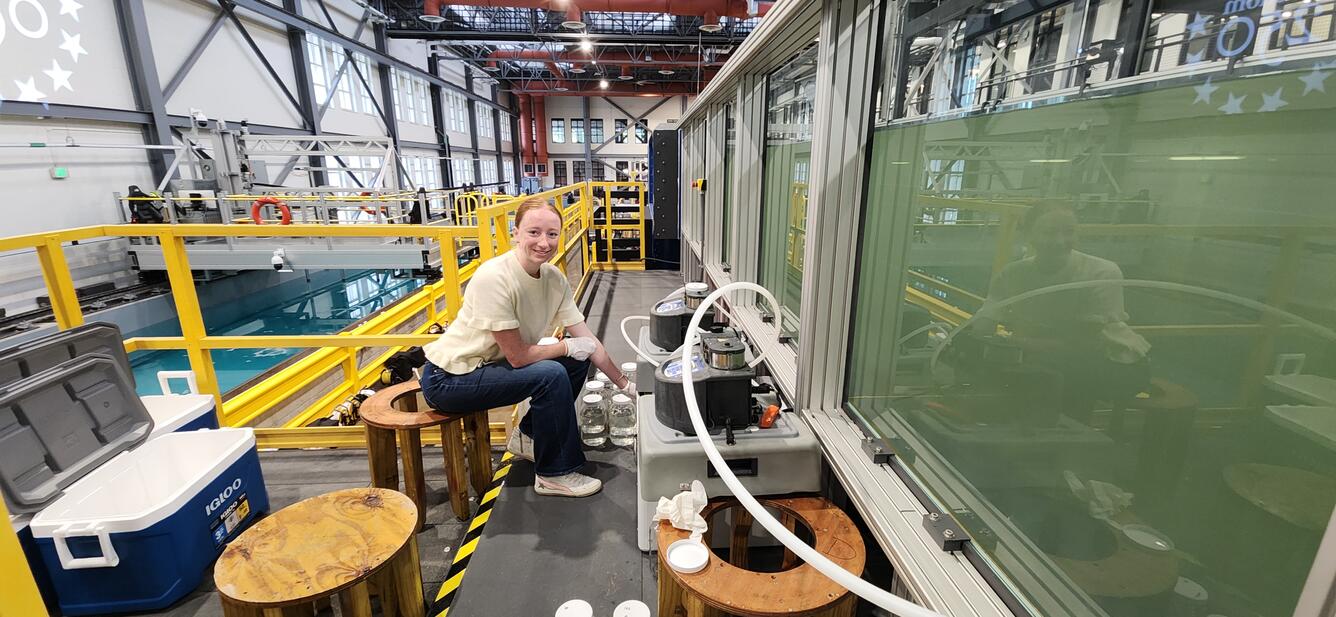
The initial effort brought together researchers and technical experts from multiple Water Mission Area divisions, a Water Science Center, and two university partners, the University of Maryland and the University of Alabama, to conduct several research projects simultaneously within the HIF's hydraulic testing infrastructure. The successful execution of concurrent projects highlighted the facility's ability to support interdisciplinary investigations while addressing real-world science and technology challenges.
The HIF Hydraulics Lab: Built to meet research needs
Three distinct research efforts were conducted concurrently within the facility, including testing of soil and sediment sampling technologies, investigation of 6PPD-Q and sediment transport processes under varying environmental conditions, and controlled road salt runoff experiments. These activities generated data to support future method development, field sampling approaches, and instrumentation evaluation.
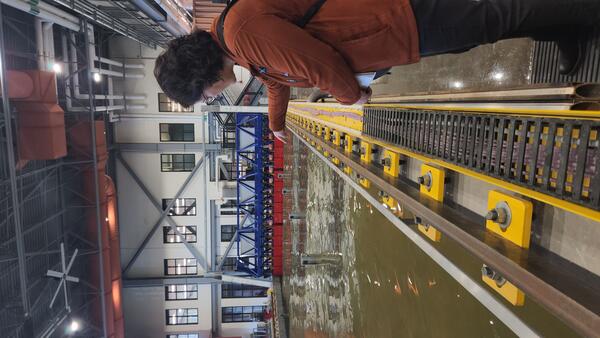
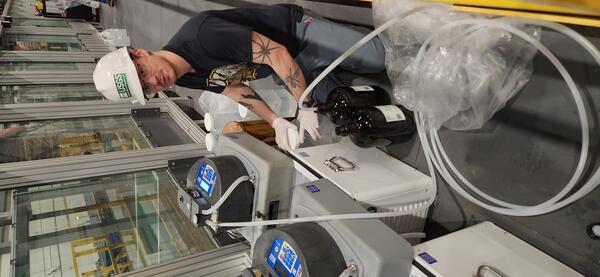
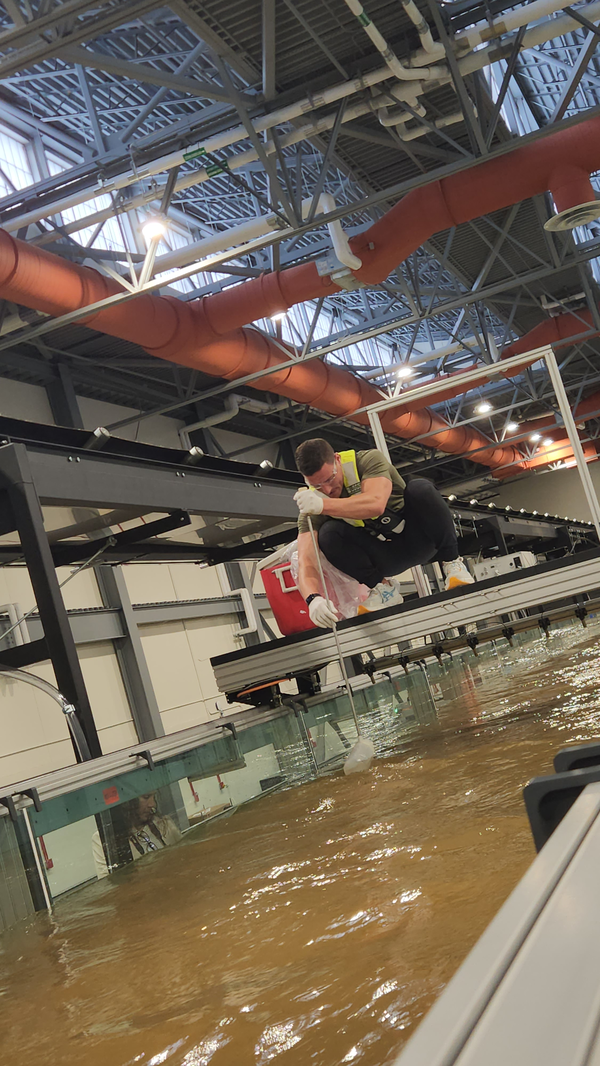
Researchers ran concurrent experiments in the Hydraulics Lab, demonstrating the HIF's capacity to evaluate technologies and environmental processes across a broad spectrum of flow conditions, including both routine and high-flow events. These capabilities position the HIF to support emerging scientific questions while advancing new monitoring approaches and technologies. The effort also demonstrated how the HIF can accelerate the development and evaluation of methods that support USGS science priorities and field operations.
A growing network of collaborators
Partnerships played a central role in the inaugural effort. Researchers from USGS, the University of Maryland, and the University of Alabama worked together throughout the week to complete the projects, including professors and students across multiple departments, strengthening research collaborations. Alabama Water Institute teams supported documentation of the work, and university leadership visited the facility to observe ongoing activities and discuss future collaboration. Interest in using the HIF as a research platform continues to grow, with discussions underway across mission areas, federal agencies, universities, and external partners to support future projects.
The HIF: A National Icon for research, provisioning, and training
In addition to the new Research and Development program, the HIF is a centralized hub for instrumentation evaluation and provisioning and supports a workforce pipeline for the USGS and its partners.
This is not just classic, academic hydrology. This is way beyond that -- way, way, way beyond that.
- USGS Director Ned Mamula, during visit to the Hydrologic Instrumentation Facility (HIF)

The HIF offers fee-for-service use of the facility and labs for research, evaluation, and development of innovative technologies. The facility sells, rents, repairs, calibrates, evaluates, and designs hydrologic equipment and instrumentation. Water monitoring instruments are evaluated to ensure devices meet the requirements of the USGS for hydrologic data collection. Staff and partners at the HIF have the ability to design and prototype new instrumentation applications for hydrologic data collection activities.
USGS HIF training courses are specifically designed to benefit USGS hydrologic technicians and hydrologists who operate streamgages and other automated hydrologic monitoring stations. The HIF has three dedicated training rooms with wet chemistry and electronics configurations for hands-on instrument training, plus a 150-person auditorium with 16-foot screen. Trainees at the HIF will have access to state-of-the-art features throughout the facility, including the hydraulics lab, fabrication shop, walk-in temperature chamber, and local field-testing sites.
Learn more about the HIF.
Related
Related Science

Hydrologic Instrumentation Facility (HIF)
Related
Related Science