



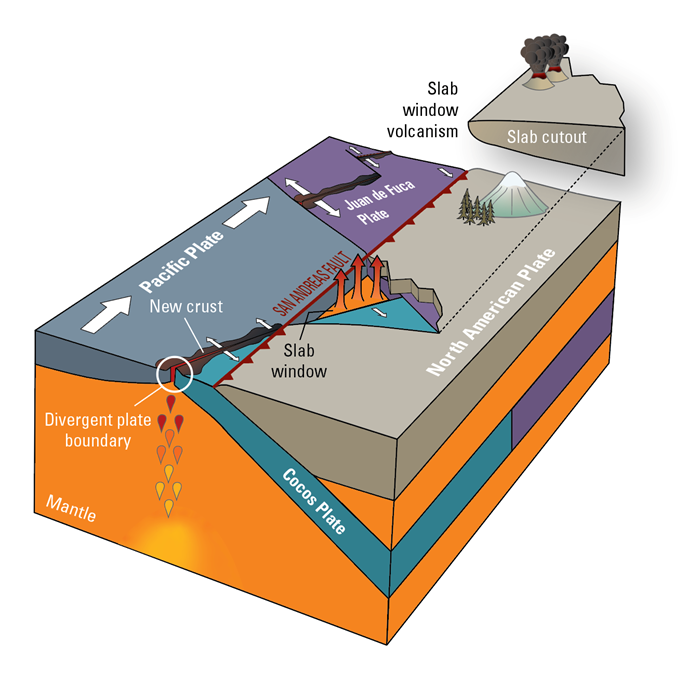
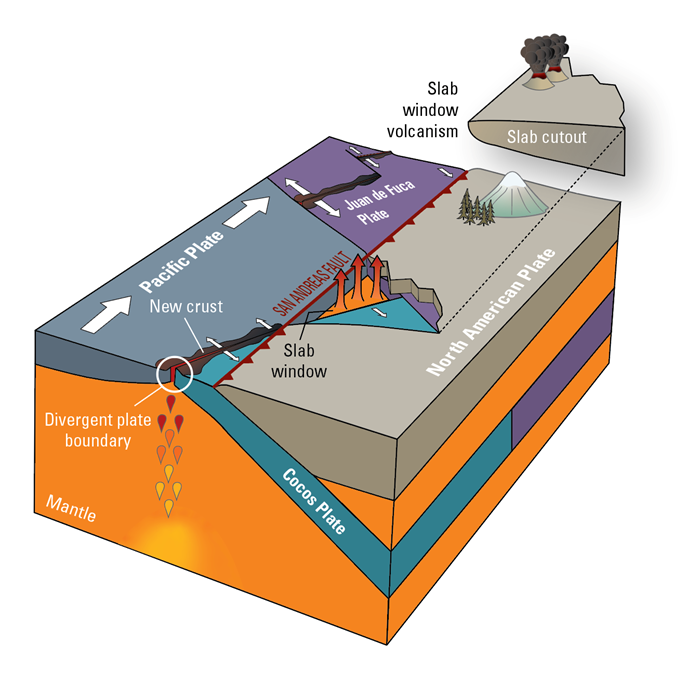
A tectonic slab window in three dimensions


Detailed Description
This figure shows an approximation of the tectonic plate geometry of western California as it existed roughly 20 million years ago. A piece of the North American tectonic plate has been cut out to show how a slab window is formed when a spreading ridge is subducted. As the spreading ridge separating the oceanic crust of the Cocos plate and continental crust of the Pacific plate is subducted, the leading edge falls away, leaving a gap, or window in the subducting oceanic crust beneath North America. Hot mantle material fills this gap and can melt the edges of the down-going plate or base of the overlying continental crust. If this magma erupts on the Earth’s surface, its chemistry and location near the transform boundary separating the North American and Pacific plates tells geologists that it wasn’t created in a typical subduction zone. Instead, it is the product of melting above a slab window The volcanic rocks and fields in western California result from a combination of spreading ridge subduction and melting above a slab window. USGS figure by S. Burgess in Burgess, S., 2025, Plate tectonics and volcanism in western California: U.S. Geological Survey Fact Sheet 2025–3013, 4 p., https://doi.org/10.3133/fs20253013.
Sources/Usage
Public Domain.