



From Maybe to Mineable: terms to describe mineral resources and reserves


Detailed Description
From Maybe to Mineable
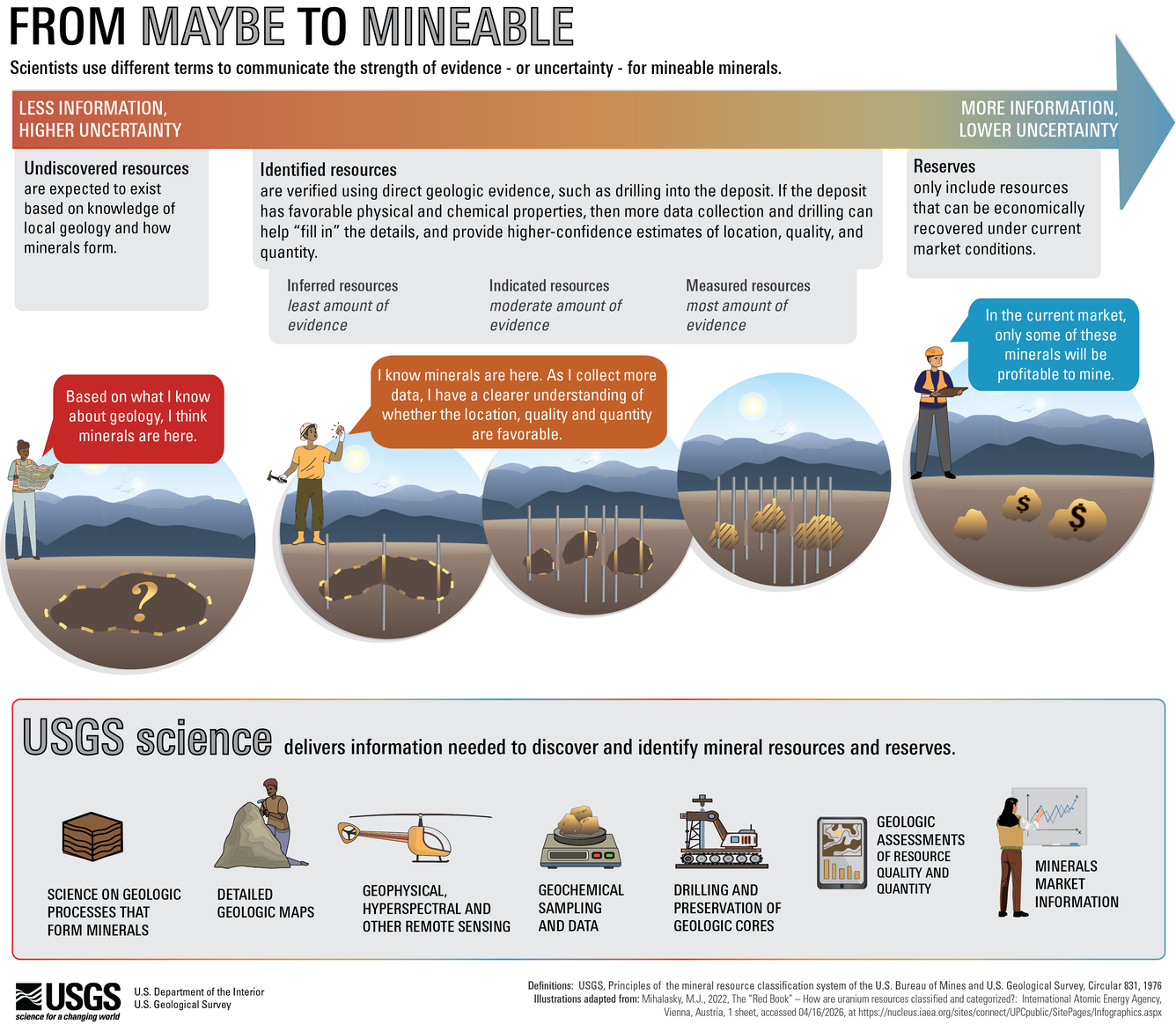
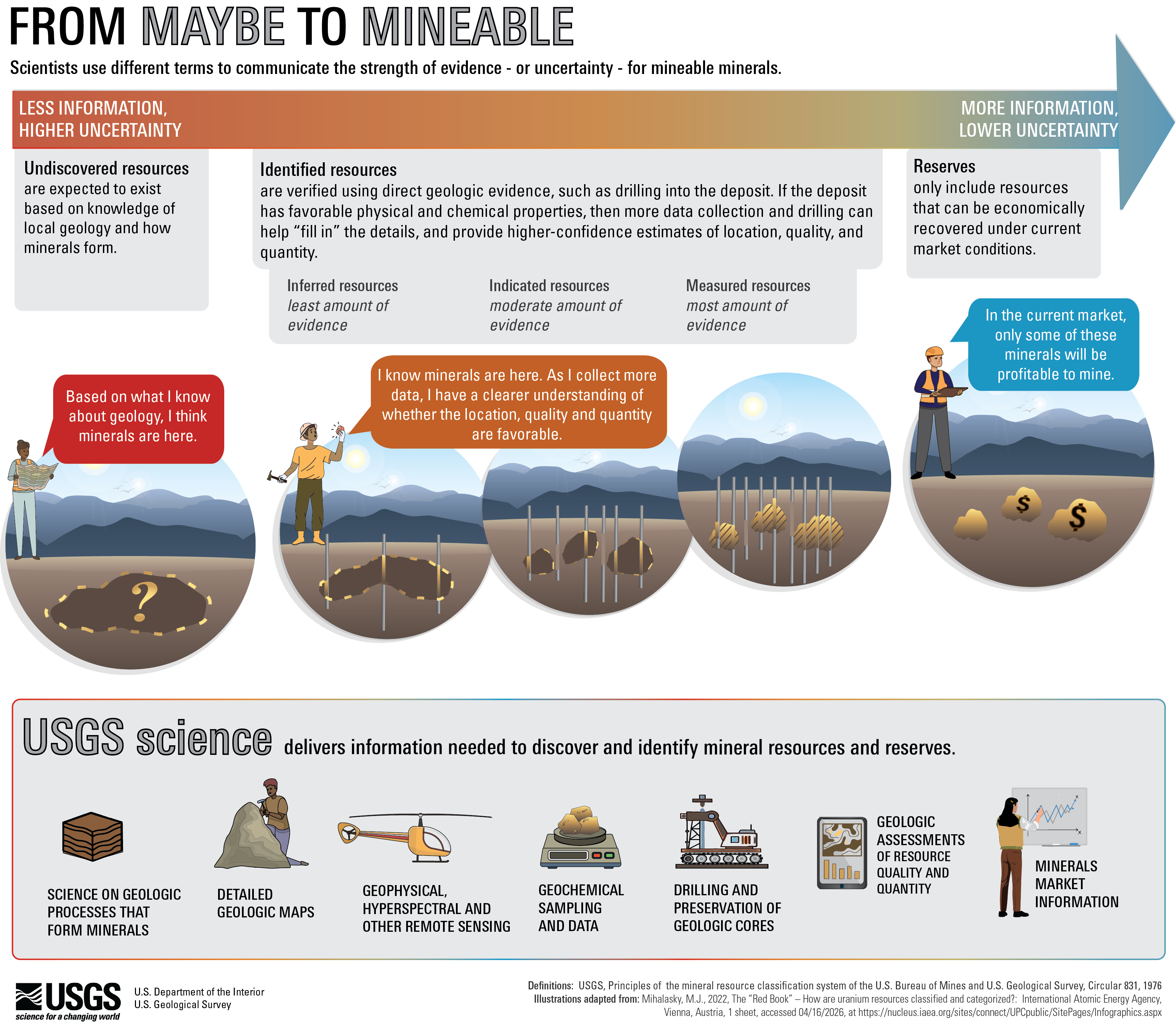
Scientists use different terms to communicate the strength of evidence - or uncertainty - for mineable minerals.
On a scale from less information and higher uncertainty to more information and lower uncertainty:
1. Undiscovered resources are expected to exist based on knowledge of local geology and how minerals form. A scientist might say "Based on what I know about geology, I think minerals are here."
2. Identified resources are verified using direct geologic evidence, such as drilling into the deposit. If the deposit has favorable physical and chemical properties, then more data collection and drilling can help “fill in” the details, and provide higher-confidence estimates of location, quality, and quantity. A scientist might say "I know minerals are here. As I collect more data, I have a clearer understanding of whether the location, quality, and quantity are favorable.
- Inferred resources have the least amount of evidence
- Indicated resources have a moderate amount of evidence
- Measured resources have a moderate amount of evidence
3. Reserves only include resources that can be economically recovered under current market conditions. A scientist might say "In the current market, only some of these minerals will be profitable to mine."
USGS science delivers information needed to discover and identify mineral resources and reserves:
- Science on geologic processes that form minerals
- Detailed geologic maps
- Geophysical, hyperspectral and other remote sensing
- Geochemical sampling and data
- Drilling and preservation of geologic cores
- Geologic assessments of resource quality and quantity
- Minerals market information
Definitions: USGS, Principles of the mineral resource classification system of the U.S. Bureau of Mines and U.S. Geological Survey, Circular 831, 1976
Illustrations adapted from: Mihalasky, M.J., 2022, The “Red Book” – How are uranium resources classified and categorized?: International Atomic Energy Agency,Vienna, Austria, 1 sheet, accessed 04/16/2026, at https://nucleus.iaea.org/sites/connect/UPCpublic/SitePages/Infographics…
Sources/Usage
Public Domain.