



USGS Updates U.S. Critical Mineral Deposits
1,271 known deposits across 41 states and Puerto Rico; one-third have no past production
RESTON, Va. — The U.S. Geological Survey has released an updated database showing known U.S. deposits of 59 critical minerals needed to strengthen the American economy and protect national security.
The database was produced to support the USGS Earth Mapping Resources Initiative, which is currently re-mapping the entire United States with cutting-edge airborne surveys. USGS staff compiled the 1,271 known deposits in 41 states and Puerto Rico to prioritize Earth MRI surveys. Of those, 412 or nearly one-third have recognized, documented critical mineral resources and no production — representing untapped potential for critical mineral production.
“The United States is abundant in many of the critical minerals needed to drive advanced manufacturing and protect our defense industrial base. For too long, America has relied on foreign sources for minerals for which we have the resources and expertise to develop here at home. This data shows that we have an extraordinary domestic mineral endowment. Nine of the ten critical minerals at greatest risk for supply chain disruption, including four rare-earth elements, are present in the U.S. Showing where critical minerals are in the United States helps the USGS map more new sources of critical minerals. Publishing that information in a map and a new interactive version puts important knowledge directly in the hands of industry, investors and the public,” Assistant Secretary of the Interior Andrea Travnicek said.
The updated database feeds into Earth MRI and is an important component of the USGS' ongoing effort to re-map the country. Earth MRI has re-mapped one-third of the United States, supporting the Nation’s efforts to assess domestic critical mineral resource potential by 2031. The effort began with Executive Order 13817 in 2017, which set the Interior Department and the USGS on a path to analyze reliance on imported minerals and map domestic resources. Under President Trump and Secretary Burgum’s leadership, the Department has renewed its focus on expanding American mineral production, strengthening domestic supply chains and reducing reliance on foreign sources. USGS has compiled and updated the U.S. List of Critical Minerals needed to drive the U.S. economy and national security, with a vulnerable supply chain. Earth MRI has supercharged nationwide mineral mapping using airborne geophysical and topographic surveys. Through a partnership with NASA, it has amassed the largest-ever trove of terrestrial hyperspectral data — a survey of light reflected from rocks on the earth’s surface — matched for geologic composition through comparison with the USGS library analyzing mineral reflections.
In addition to critical minerals, Earth MRI is modernizing the nation’s maps of geology and all mineral resources, while also providing data to identify energy and groundwater resources and natural hazards, in partnership with 45 states as well as academic institutions and industry. It has already mapped more than one third of the nation.
The Trump administration has also taken concrete steps to turn America's mineral resources into American production, including efforts to accelerate critical-mineral permitting through FAST-41 and to recover critical minerals from coal refuse, tailings and abandoned uranium mines.
“This updated database is part of the roadmap to regaining mineral independence with resources we have here at home, secure our supply chains for tech and defense, and grow the nation’s economy. Earth MRI, thanks to our strong partnership with state geological surveys, is drawing more of the map every day,” said USGS Director Ned Mamula.
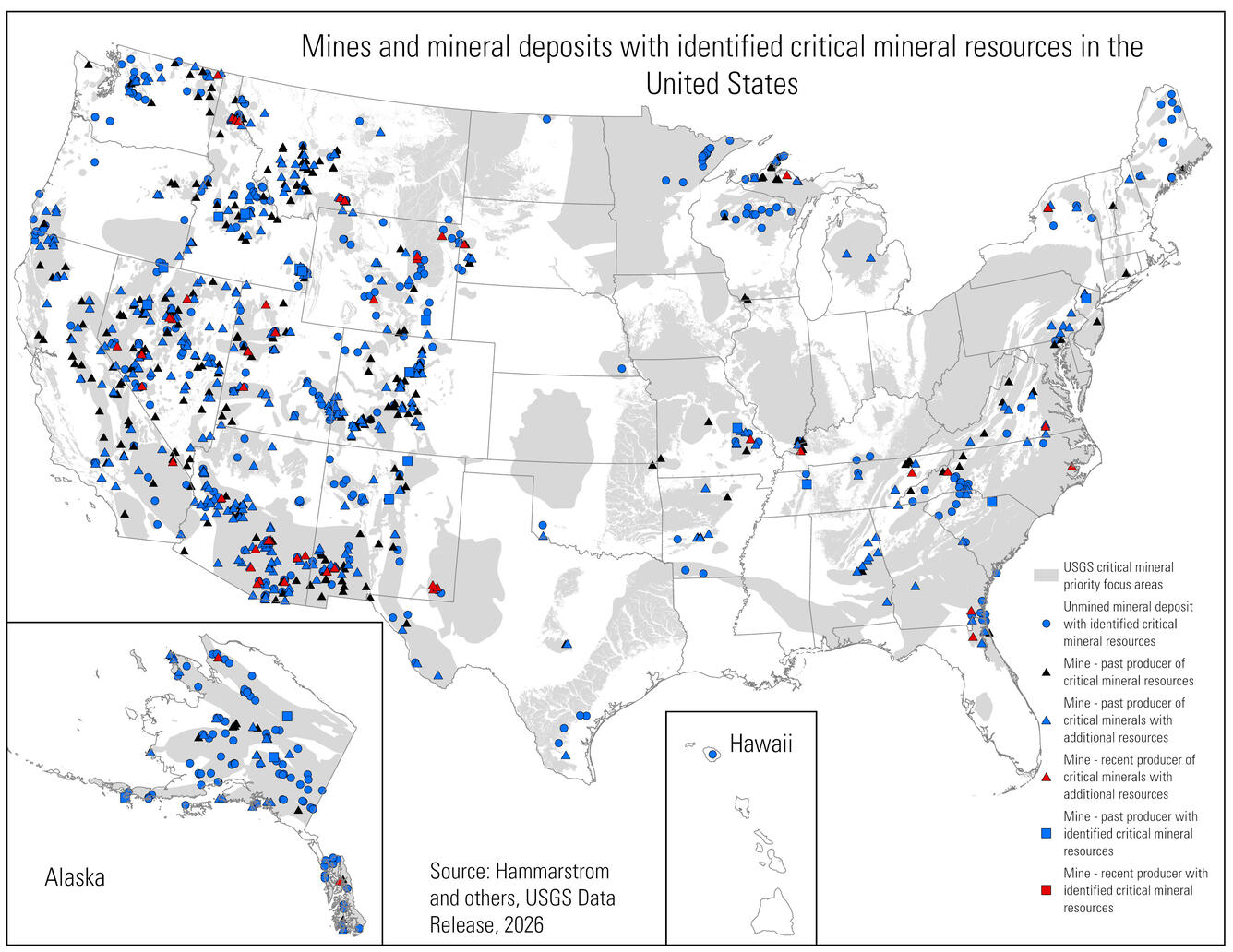
To compile the database of existing critical mineral resources, USGS staff compiled deposits from multiple databases, and classified them by mineral systems, deposit types, and the amount of published resources or reserves present, and past production totals, if any.
The database adds nine of the 10 minerals added to the 2025 List of Critical Minerals developed by the USGS: boron, copper, lead, phosphate, potash, rhenium, silicon, silver, and uranium. A tenth, metallurgical coal, is amply documented elsewhere and thus not included.
# # #
The USGS provides science for a changing world. Learn more at https://www.usgs.gov or follow us on Facebook @USGeologicalSurvey, YouTube @USGS, Instagram @USGS, or X at @USGS.