An official website of the United States government
Here's how you know
Official websites use .gov
A .gov website belongs to an official government organization in the United States.
Secure .gov websites use HTTPS
A lock () or https:// means you’ve safely connected to the .gov website. Share sensitive information only on official, secure websites.
A wide view of activity from the east rift zone to the summit. In the foreground, Pu‘u ‘Ō‘ō crater emits fume from numerous sources on the crater floor. One of these cones hosts a small lava pond, and can be seen at the far right edge of the photo, marked by a small bit of incandescence. Snow-covered Mauna Loa and Mauna Kea are in the distance (left and right sides of photo, respectively). In front of Mauna Loa, the plume from the summit lava lake in Halema‘uma‘u crater can be seen drifting west.
A closer view of the lava pond at the northeast spatter cone in Pu‘u ‘Ō‘ō crater. The pond is about 10 m (about 30 ft) wide, and was undergoing cycles of gas pistoning. The lava level would slowly and quietly rise a meter (yard) or more over about five minutes, and vigorous spattering would commence. As the gas was released, the lava level would drop to its previous level and the cycle would begin again.
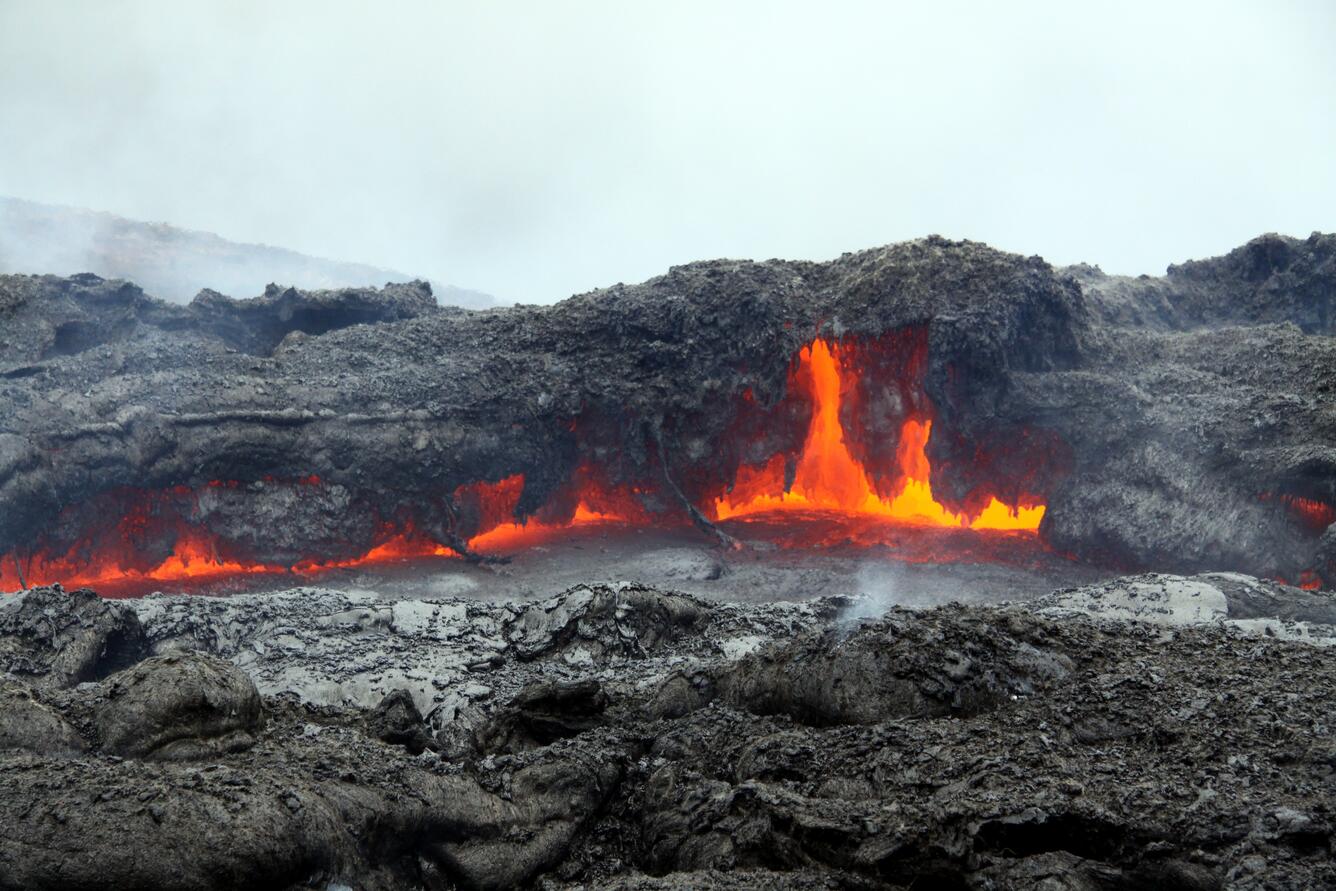
Pāhoehoe breakouts were scattered at the far end of the Kahauale‘a 2 flow today, as far as 6.9 km (4.3 miles) from the vent on Pu‘u ‘Ō‘ō. This photo shows some typical activity on the Kahauale‘a 2 flow, with snow-covered Mauna Kea in the distance.
A close-up view of the lava pond in Pu‘u ‘Ō‘ō crater. The lava surface was quietly rising when this photo was taken. When the lava reached a critical level, vigorous spattering would begin at the large area of incandescence seen here. The rim of the lava pond is covered in a thick coating of spatter from similar events.