An official website of the United States government
Here's how you know
Official websites use .gov
A .gov website belongs to an official government organization in the United States.
Secure .gov websites use HTTPS
A lock () or https:// means you’ve safely connected to the .gov website. Share sensitive information only on official, secure websites.
Due to a lapse in appropriations, the majority of USGS websites may not be up to date and may not reflect current conditions. Websites displaying real-time data, such as Earthquake, Volcano, LANDSAT and Water information needed for public health and safety will be updated with limited support. Additionally, USGS will not be able to respond to inquiries until appropriations are enacted. For more information, please see www.doi.gov/shutdown.
`Ohi`a tree at margin of sluggish, inflating west arm of Kohola flow. String of incandescent spots in background, visible only in large view, defines active surface flow coming down Pulama pali along main path of Mother's Day flow.
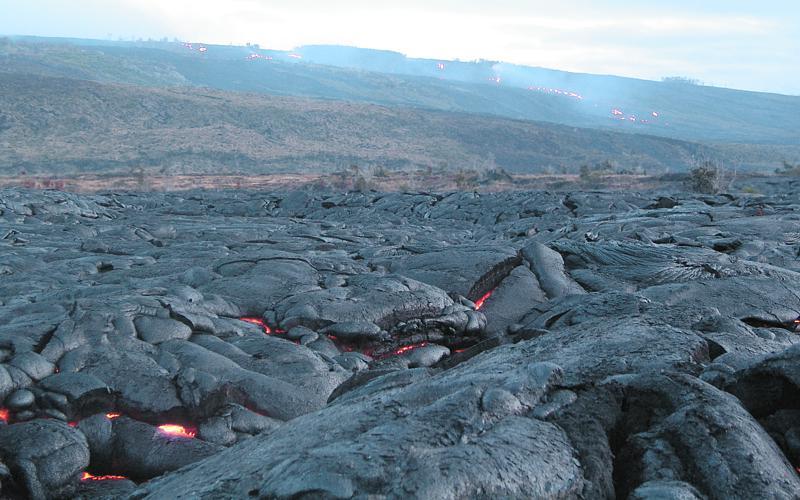
Looking across inflating west arm of Kohola flow to Pulama pali, where fume, some smoke, and incandescence (large view) come from long breakout in main Mother's Day flow spilling over top of pali and traveling almost to Paliuli (not shown).
Looking along margin of west arm of Kohola flow, which spreads across sparsely vegetated surface. In background is Pulama pali, where fume, some smoke, and incandescence (large view) come from long breakout in main Mother's Day flow spilling over top of pali and traveling almost to Paliuli (not shown). Lava in Kohola flow comes from tube within dark flow field visible in upper center of image below fuming flow.
Crust on inflating tongue of lava is cracking, and lava is just starting to well out. Note ash from burned grass littering crust; grass is burned at flow front and picked up as lava oozes from under the crust.