



Is California going to "lose" a threatening volcano?
It's National Preparedness Month, and USGS geologists are currently reassessing the list of young and threatening volcanoes in California and Nevada. The total is likely to drop - so what changed and why?
The California Volcano Monitor is a weekly column written by scientists and collaborators of the California Volcano Observatory. This week's contribution is from Mark Stelten, research geologist with the U.S. Geological Survey.
A key component of the California Volcano Observatory’s work is monitoring and studying young, threatening volcanoes in California and Nevada. When we say "threatening", we consider not only the age of a volcano, but what kinds of hazards it produces and whether it can impact people and property. Knowing which volcanoes or volcanic fields in California and Nevada fit this description requires collaboration with state geologists, other government agencies, and academic colleagues. These groups use the most recent geologic evidence to figure out the age of each volcanic system and the types of eruptions they have had, to determine whether they should be considered threatening.
The last threat assessment for all U.S. volcanoes published by the USGS was done in 2018 and listed 13 threatening volcanoes in California and Nevada based on geologic evidence available at the time. However, research into these volcanic systems is still happening, and new data have provided reasons to make changes to this list. For example, the Golden Trout volcanic field, which consists of basalt cinder cones and lava flows about 16 miles (25 km) south of Mount Whitney in the Sierra Nevada mountains was on the list of young and threatening volcanoes in 2018. However, new research shows that the most recent eruption at the Golden Trout volcanic field was about 55,000 years ago and is likely not active today. In this case, USGS scientists are proposing the removal of the Golden Trout volcanic field from the list of young and threatening volcanoes because the field is not in fact young.
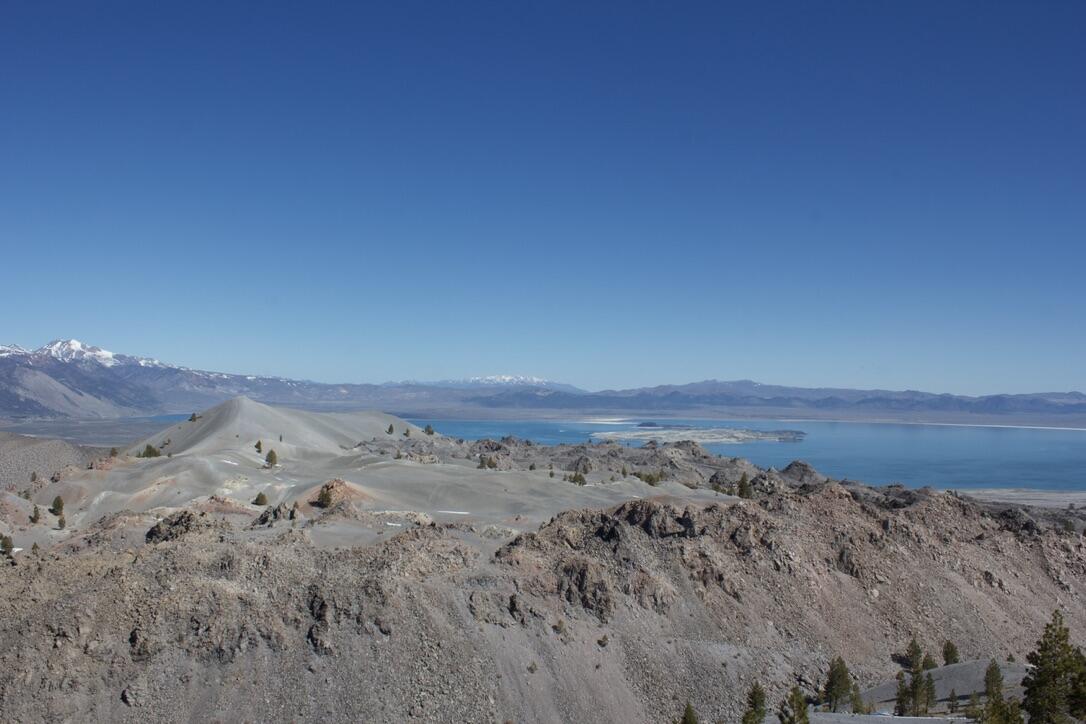
Other situations are not so simple. A good example of this is the Mono Lake Volcanic Field and the Mono-Inyo Chain, located on the eastern side of the Sierra Nevada mountains along US-395. The Mono-Inyo Chain consists of a 16-mile- (25-km-) long group of over 30 rhyolitic lava domes, lava flows, and tephra rings extending from Long Valley caldera to Mono Lake. The Mono Lake Volcanic Field consists of rhyodacite and basaltic volcanic vents within Mono Lake and on its north shore. In the past, geologists thought these areas had different magmatic systems because the chemical compositions of their lavas were different. However, radiometric dating has shown that both volcanic fields have been active over the past 20,000 years, often around the same time. Given the similar timing of eruptions and the fact that they are geographically adjacent, USGS scientists are proposing that these volcanic systems should be treated as a single, Mono-Inyo volcanic field. This better reflects the potentially linked magmatic systems beneath them and alerts geologists to the fact that activity could happen simultaneously in multiple parts of this volcanic region.
So don’t worry, California’s volcanoes aren’t going anywhere. As we learn more about the character of each volcano, we can categorize them better, and sometimes we learn that two volcanoes we thought were different may not be so different after all.