



Exploring lava tubes at Medicine Lake volcano
If you didn’t know that volcanoes can form their own caves, follow along to learn more about lava tubes!
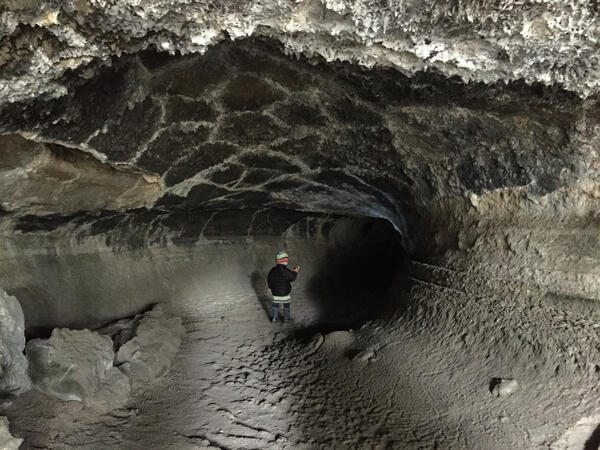
Lava tubes are found in many basaltic lava flows at Medicine Lake volcano in northern California. The volcano is part of the Cascades Volcanic Arc and is considered a high threat volcano because it has erupted many times in the last 10,000 years, its most recent eruption was just 950 years ago. Although the youngest eruption was rhyolitic, several basaltic eruptions also occurred within the last three thousand years.
The lava tubes in these basalt flows transported lava long distances from vents on the mid-flank of the volcano. We know these tubes exist and where they went because of roof collapses that have occurred over time, allowing access to an extensive underground network. Lava Beds National Monument hosts hundreds of lava tube caves, some of them stretching as far as 25 km (15.5 mi) from vents and some even having multiple stacked levels.
How do we know the processes that formed these tubes? Scientists have observed them forming in real-time at Kīlauea Volcano in Hawaii. Lava tubes form when the upper surface of the lava flow cools and forms a roof over the interior lava, insulating it and keeping it fluid and moving. In many such eruptions, the flow of lava through the tube is unsteady, allowing tubes to drain and refill. This leaves ”high lava marks” such as those on the walls of the postglacial Valentine Cave in Lava Beds National Monument (photo to the right, https://www.usgs.gov/publications/geologic-field-trip-guide-medicine-lake-volcano-northern-california-including-lava). These marks record the levels of lava, with the final pulses forming the floor of the tube. Because the lava carried in the tube is more recent than the chilled early lava that forms the tube, this is one of the rare cases when the geologic “law of superposition” is violated and the older lava overlies the younger lava.
To read more about Medicine Lake’s lava tubes, check out USGS Bulletin 1673 (https://pubs.usgs.gov/publication/b1673) or the geologic map of Medicine Lake volcano (https://pubs.usgs.gov/sim/2927/).