



Photo & Video Chronology — Kīlauea summit overflight and fieldwork
By Hawaiian Volcano Observatory
August 28, 2026
On Thursday, August 27, 2026, USGS Hawaiian Volcano Observatory (HVO) staff spent much of the day digging volcanic gas monitoring sites out of the tephra deposit from the ongoing Kīlauea summit eruption. On Friday, August 28, 2026, HVO staff conducted a morning overflight of the north, south, and west vents on the western side of Halemaʻumaʻu crater at the summit of Kīlauea.
Media
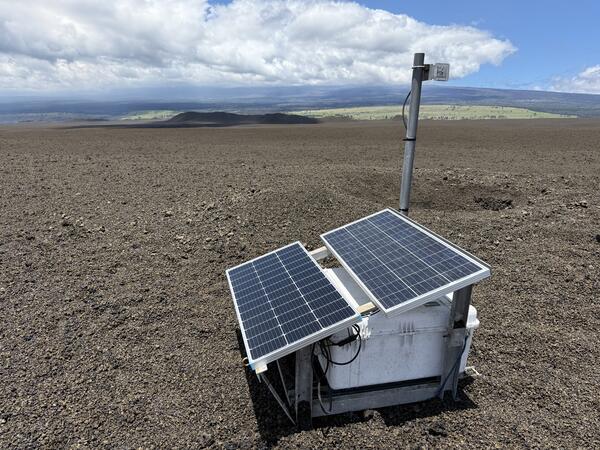
On August 27, 2026, USGS Hawaiian Volcano Observatory staff spent much of the day digging volcanic gas monitoring sites out of the tephra deposit from the ongoing Kīlauea summit eruption. This station was moved out of a hole, seen to the right in the background of this image, and onto the top of the tephra deposit. USGS photo by L. DeSmither.
Sources/Usage: Public Domain. View Media Details
Media
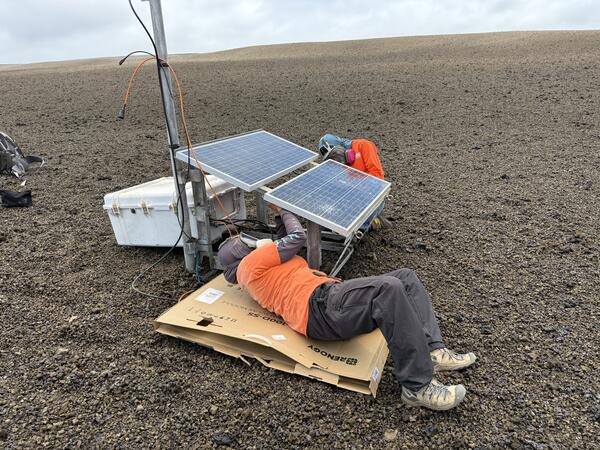
After digging out and removing this volcanic gas monitoring site from a hole in the tephra deposit at Kīlauea summit, USGS Hawaiian Volcano Observatory (HVO) field technicians make repairs to the station including changing a solar panel that was cracked from tephra (volcanic rock fragments) impacting it. Tephra from the ongoing episodic Kīlauea summit eruption, which began on December 23, 2024, blankets the ground in this photo and has buried many volcano monitoring stations downwind of the summit, requiring HVO staff to dig out the sites and often make repairs. USGS photo taken on August 27, 2026, by L. DeSmither.
Sources/Usage: Public Domain. View Media Details
Media
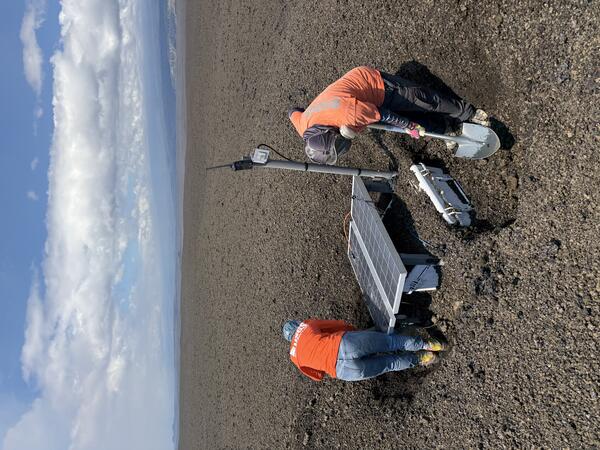
USGS Hawaiian Volcano Observatory staff dig out infrastructure from one of several volcanic gas monitoring stations that were buried by a thick tephra deposit at Kīlauea summit that has accumulated since the episodic lava fountaining eruption began in December 2024. These sites, which are downwind of the eruptive vents from the ongoing Halema‘uma‘u eruption, have been covered by tephra (volcanic rock fragments) from multiple high fountaining episodes. This monitoring station is part of an array of instruments used to monitor Kīlauea summit gas emission rates that have been offline since the sites were buried. USGS photo taken by L. DeSmither on August 27, 2026.
Sources/Usage: Public Domain. View Media Details
Media
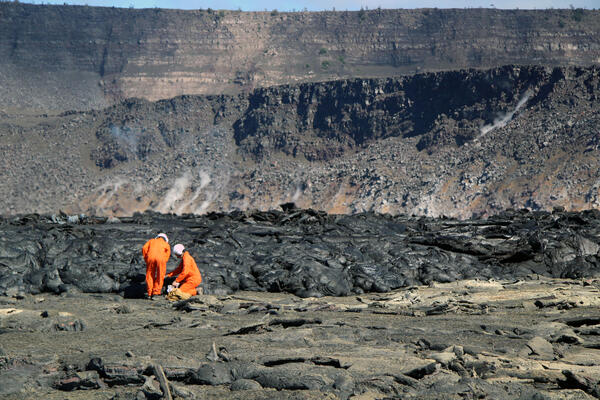
Sample collection and analyses are an important part of understanding the state of Kīlauea, and the USGS Hawaiian Volcano Observatory (HVO) manages to collect samples of tephra and lava flows after almost every episode. Here, HVO staff are collecting a sample of cooled pāhoehoe lava emplaced from the north vent during lava fountaining episode 54 that occurred in Halema‘uma‘u on August 25. Sampling in this culturally sensitive area is down with permission from Hawai‘i Volcanoes National Park. USGS photo by Y. Brien-Miller.
Sources/Usage: Public Domain. View Media Details
Media
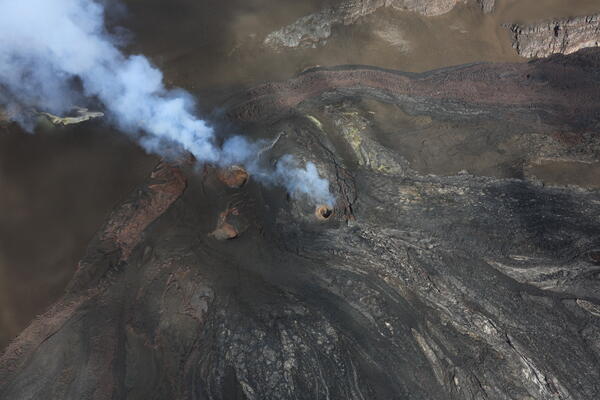
Another view of Kīlauea summit north, south, and west vents during a USGS Hawaiian Volcano Observatory monitoring helicopter overflight on Friday, August 28, 2026. Tephra and lava that filled in the south vent during lava fountaining episode 54 on August 25 is very noticeable here, whereas the north and west vents remain open and degassing. USGS photo by P. Dotray.
Sources/Usage: Public Domain. View Media Details
Media
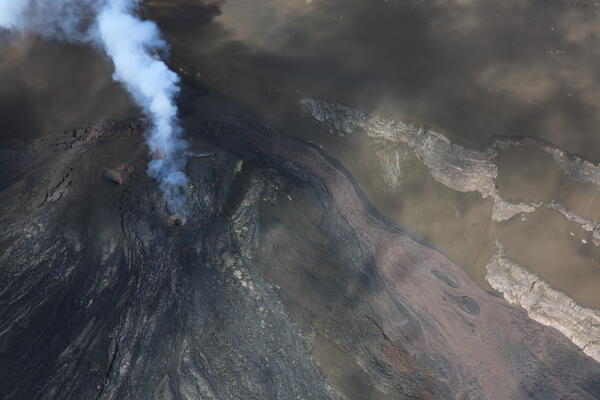
On Friday, August 28, 2026, USGS Hawaiian Volcano Observatory staff conducted a morning overflight of the north, south, and west vents on the western side of Halemaʻumaʻu crater at the summit of Kīlauea. Flames and weak glow could be seen in the livestream videos overnight, but during the overflight no glow or incandescence was visible from the north or west vents. The south vent appeared to be completely blocked with lava and tephra from episode 54 of lava fountaining that occurred on August 25. USGS photo by P. Dotray.
Sources/Usage: Public Domain. View Media Details