



Volcano Watch — “Stick Season” in Hawaii? What Happened to the Leaves around Kīlauea Summit?
As you walk along Crater Rim Trail from Wahinekapu (Steaming Bluffs) heading towards the Uēkahuna overlook in Hawaiʻi Volcanoes National Park, you’ll notice far less green vegetation and foliage than usual.
Volcano Watch is a weekly article and activity update written by U.S. Geological Survey Hawaiian Volcano Observatory scientists and affiliates. Today's article is by Mike Cappos, a gas field engineer with HVO.
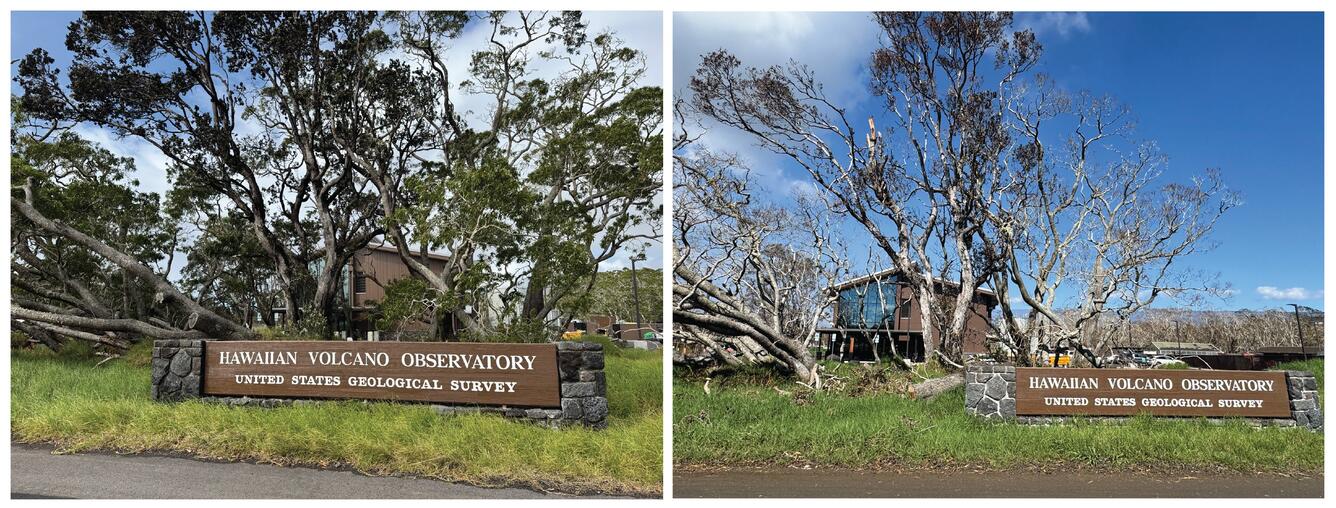
Commonly, in the Northeastern United States after all the leaves have fallen off the trees during the Fall months, you’ll hear it referred to as “stick season,” which means ski season is right around the corner! Here in the Hawaiian Islands, the seasons are far more subtle, and vegetation doesn’t usually shed leaves in preparation for Winter. So, what’s going on here? The large eruptive plumes produced by the ongoing summit eruption of Kīlauea, which contain high concentrations of volcanic gases and tephra, and wind direction hold the key to this answer.
The ongoing summit eruption of Kīlauea volcano began on December 23, 2024, and continues to have spectacular high lava fountaining episodes, 48 in total at the time of this writing. During most of these high fountaining episodes, the island’s dominant Northeast trade winds have carried the hazardous eruption plumes to the Southwest into the Kaʻū Desert, away from the public viewing areas in Hawaiʻi Volcanoes National Park and communities near the summit of Kīlauea. However, winds shift during Winter months, bringing “Kona” winds, which emanate from the South. From January through April 2026, the State of Hawaii weathered through multiple intense Kona Low storm systems, which pushed Kīlauea’s eruptive plume towards the North, impacting areas of Hawaiʼi Volcanoes National Park and surrounding communities.
During Kona winds, vegetation needs to endure long periods of exposure to elevated levels of sulfur dioxide gas (SO2) as it is continuously being released from the active summit vents. Sulfur dioxide is a highly acidic gas which forms dilute sulfuric acid when it reacts with water, whether it be in the form of rain, fog, or morning dew. Water samples collected downwind of Kīlauea’s summit during the lava lake days from 2008-2018 showed acid rain with a pH of 4 or less, with normal rainwater having a pH of around 7. This acid rain will ‘burn’ the foliage, turning it brown. To make things worse, vegetation also needs to breathe. When SO2 is brought into the plant through its stomata (the tiny breathing pores in their leaves) it reacts with the water within the leaves themselves and further damages the plant.
One tree found in abundance around the summit of Kīlauea has a secret weapon to help combat this. Native ʻōhiʻa lehua trees are highly adapted to survive in the volcanic environments of the Hawaiian Islands. They have the amazing capability to close their stomata, so the trees can "hold their breath" when toxic volcanic gases are blown their way. This helps reduce the internal impact SO2 has on the trees. However, even ʻōhiʻa need to breathe eventually, and prolonged exposure to high concentrations of gas can still cause damage to these hearty native trees.
In the Kīlauea summit area, particularly around the Kilauea Military Camp and Volcano Golf Course community, vegetation was hit hardest as this area was “staring down the barrel” of the eruptive plume during Kona winds. Tephra fall in this area from high fountaining episodes between January-April 2026 was not inconsequential. As light as tephra seems to us because it floats on water, when it falls out of the eruptive plume it has enough energy to strip the foliage right off the trees. Combine this tephra fall with a very strong Kona Low, like the one that hit the State of Hawaii in March 2026 during episode 43, and vegetation was devastated, looking very similar to what happened around Kīlauea Iki during its eruption in 1959. This is how the Devastation Trail in Hawaiʼi Volcanoes National Park got its name! Vegetation needed to endure both tephra fall and exposure to sulfur dioxide, a one-two punch.
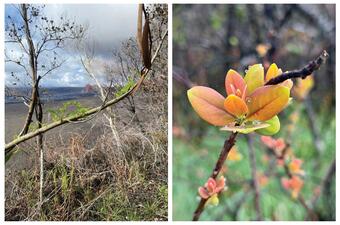
With late Spring and Summer upon us, thankfully the trade winds have returned which at last is giving the vegetation around the summit area a reprieve. There are already signs of renewed foliage starting to pop out. Although it may take some time to get back to the lush greenery this area is used to, the healing process has begun!
Volcano Activity Updates
Kīlauea has been erupting episodically within the summit caldera since December 23, 2024. Its USGS Volcano Alert level is ADVISORY.
Episode 48 of summit lava fountaining happened for 9 hours on June 1. Summit region inflation since the end of episode 48 indicates that another fountaining episode is possible. Models currently indicate that episode 49 is most likely to begin 10-15 days from now. No unusual activity has been noted along Kīlauea’s East Rift Zone or Southwest Rift Zone.
Mauna Loa is not erupting. Its USGS Volcano Alert Level is at NORMAL.
One earthquake was reported felt in the Hawaiian Islands during the past week: a M4.6 event 6 km (3 mi) WNW of Kahaluu-Keauhou at 34 km (21 mi) depth on June 2 at 5:58 p.m. HST.
HVO continues to closely monitor Kīlauea and Mauna Loa.
Please visit HVO’s website for past Volcano Watch articles, Kīlauea and Mauna Loa updates, volcano photos, maps, recent earthquake information, and more. Email questions to askHVO@usgs.gov.