



15,000 years of change in Yellowstone's Lower Geyser Basin
Recent collaborative research into past climate of Yellowstone’s Lower Geyser Basin has revealed some surprises about how the area has changed over the past many millennia. And it has lessons for how the region might continue to change in the future.
Yellowstone Caldera Chronicles is a weekly column written by scientists and collaborators of the Yellowstone Volcano Observatory. This week's contribution is from Cathy Whitlock, Regents Professor Emerita at Montana State University; Steve Hostetler, Research Scientist in the College of Earth, Ocean, and Atmospheric Sciences at Oregon State University; and Chris Schiller, Research Associate with the Burke Museum of Natural History and Culture at the University of Washington.
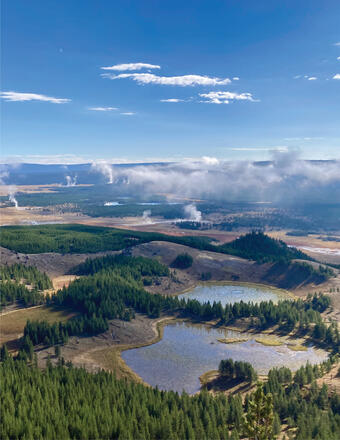
In paleoenvironmental studies (research into past environments), proxies are used as a substitute for direct measurements that are impossible to get. For example, weather-station records in Yellowstone go back to 1894 and discontinuous written observations extend decades farther, but we have no direct measurements from 500 or 5000 years ago! Instead, we turn to physical or biological proxies from the fossil record that can provide clues about ancient environmental and climatic conditions. In Yellowstone, this information comes from the proxies preserved in tree-rings, lakes, and geologic deposits.
Sediment cores from Yellowstone lakes commonly extend to the end of the last glaciation, 14,000–15,000 years ago, or when the lakes first formed. The pollen grains buried in the sediments came from plants that were growing around the lake, and that information on past vegetation gives us clues about past climate (for example, cold-adapted plants probably grew in a cold climate). Likewise, layers with abundant charcoal particles indicate times of ancient wildfires—mostly large events that produced a lot of wood charcoal. The algal composition of sediments reveals changing conditions within the lake, such as in fluctuations in lake level and nutrient loads.
Although proxy data have been used to reconstruct the climate history of Yellowstone, it is easy for the logic to become circular. For example, a period dominated by alpine herbs and grass pollen is usually interpreted as a time of tundra vegetation and thus cold temperatures. In turn, the insight of cold climate is used to explain the pollen evidence of tundra vegetation. In this case, there is no independent evidence of climate to support the interpretation—the pollen record is used to infer the climate, and the inferred climate is used to explain the vegetation! Bringing multiple proxy records to bear somewhat reduces the circularity of the argument. For example, several independent lines of evidence pointing to tundra conditions give strength to the interpretation of a colder climate.
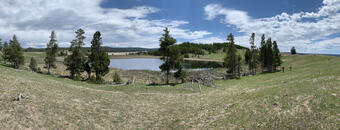
This limitation in paleoecology makes the recent collaboration to understand the history of Lower Geyser Basin in Yellowstone National Park noteworthy (https://doi.org/10.1073/pnas.2613422123) and here, we follow-up on our preliminary report from 2024 with new findings. The project had one group analyze the sediments, pollen, charcoal, and diatoms (brown algae) from small freshwater lakes to reconstruct the environmental history, and a second group independently developed high-resolution paleoclimate model simulations for the Yellowstone region to infer past climate in comparison to the pre-Industrial present (PI=conditions immediately prior to widespread fossil-fuel use, about 1850–1900). This approach meant that the proxy records could be used to document physical and biological changes in the geyser basin through time, while the models could provide understanding of why those changes occurred.
What did we learn? Comparison of the data and model output shows that the long-term environmental history of Lower Geyser Basin was governed initially by deglaciation and then by slowly varying changes in the seasonal cycle of solar radiation (insolation) caused by cyclical variations of the Earth’s orbit around the sun.
The five study lakes in Lower Geyser Basin formed at different times since the last ice age, including two that formed just as the glaciers were melting, likely after hydrothermal explosions. Pulses of arsenic in the sediments register changing levels of hydrothermal input following lake creation. Hydrothermal inputs were greatest when the climate model indicates wet periods and lowest during drier intervals when there was less snowpack to feed the hydrothermal plumbing system. This relationship between climate and hydrothermal activity is consistent with evidence for periods of no eruptions at Old Faithful Geyser in the mid-13th to the mid-14th century and Steamboat Geyser in the 15th–17th centuries during decades of drought.
When summer insolation was 8% greater than PI between 12,000–6000 years ago, July–September temperatures were 2.6–2.7 oC (4.7–4.9 oF) warmer, and effective moisture (precipitation minus evaporation) was 36-54% lower. July–September vapor pressure deficits (VPD, which measures the amount of moisture in the air versus what the air can hold when saturated—the “thirstiness” of the atmosphere) at this time were 29–56% greater than PI, setting the stage for the large fires evident in the charcoal record. In addition, the lakes were shallower and depleted in nutrients at this time, based on the types of diatoms in the sediments.
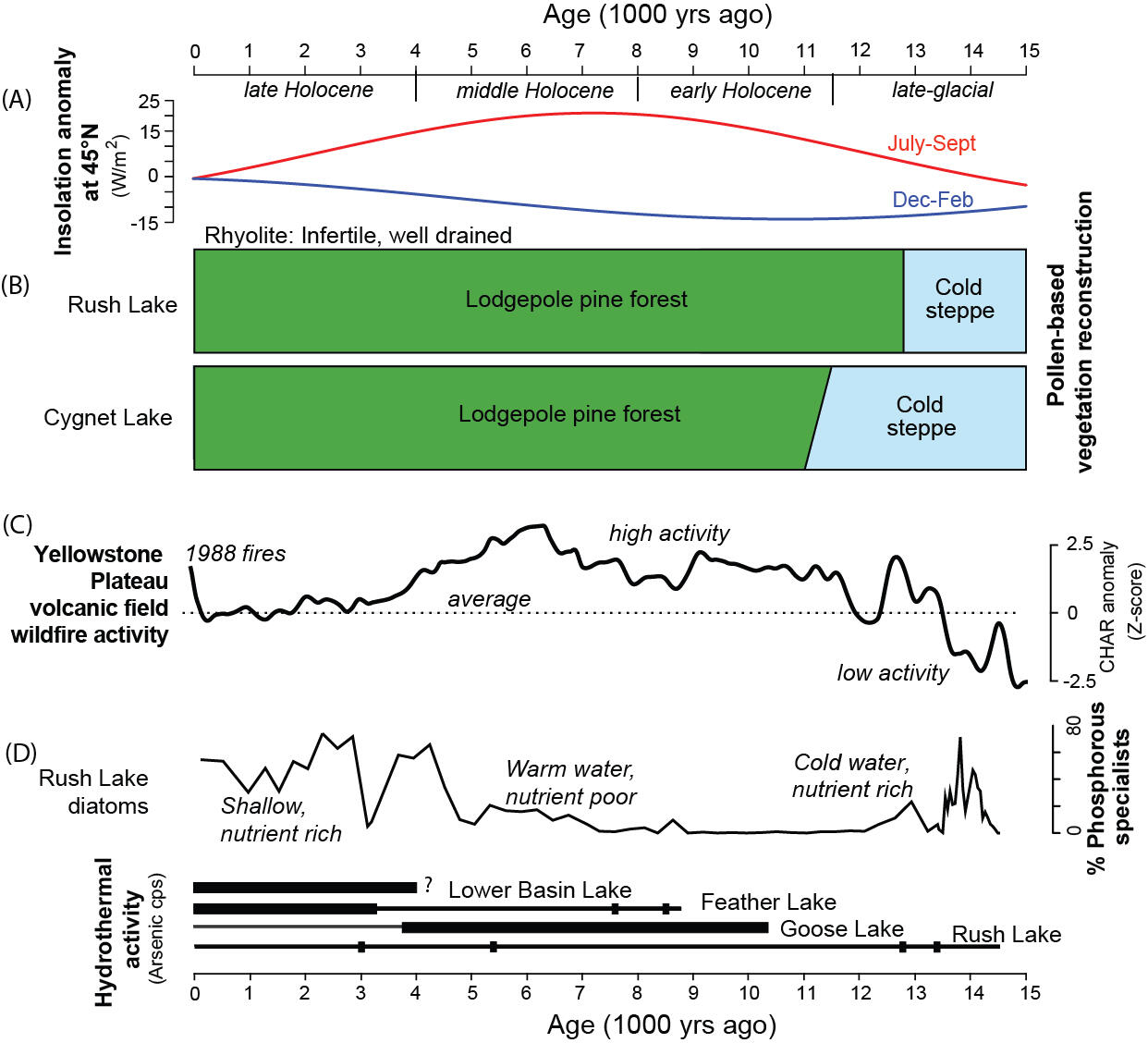
In contrast to the dynamic hydrothermal and fire history, forests within and around Lower Geyser Basin have changed little since their establishment 11,500 years ago. While climate models indicate periods of warmer, drier conditions, and the charcoal and diatom data show periods of extreme aridity and fire, pine forests remained stable on the infertile rhyolite substrates of central Yellowstone. The history of lodgepole pine forest serves as a remarkable example of ecological resilience to climate change, not observed in areas of Yellowstone underlain by different rock types.
Although the research indicates that the climatic and hydrothermal controls that maintain Lower Geyser Basin today have operated over millennia, these interactions are currently stressed by ongoing climate change from anthropogenic greenhouse gases. The Greater Yellowstone Climate Assessment suggests that temperatures 2–3 °C (3.6–5.4 °F) warmer today will reduce snowpack by 30% by 2050, resulting in significant late-summer drought and wildfires. Reduced snowpack will likely dampen hydrothermal recharge as it did in the past, and wildfires will be more prevalent. A yet-unanswered question is whether the lodgepole pine forests, which have been present for millennia, will continue to persist as the climate changes in the decades ahead.
FURTHER READING
S. Hostetler, et al., “Greater Yellowstone climate assessment: past, present, and future climate change in greater Yellowstone watersheds” (Montana State University, Institute on Ecosystems, 2021). 258 pp. https://doi.org/10.15788/GYCA2021.
S. Hurwitz, et al., Yellowstone’s Old Faithful Geyser shut down by a severe thirteenth century drought. Geophys. Res. Lett. 47, e2020GL089871 (2020), https://doi.org/10.1029/2020GL089871.
S. Hurwitz, et al., The relation between decadal droughts and eruptions of Steamboat Geyser in Yellowstone National Park, USA. Geochem. Geophys. Geosyst. 24, e2023GC010988 (2023), https://doi.org/10.1029/2023GC010988.
C. Whitlock et al., Postglacial ecosystem development of a hydrothermal landscape in Yellowstone National Park. Proc. Natl. Acad. Sci. U.S.A. e2613422123 (2026), https://doi.org/10.1073/pnas.2613422123.