



Beyond Yellowstone’s boardwalks: A glimpse into the remote caldera systems of Alaska
Where in the U.S. can you find the highest concentration of recently (<12,000 years ago) formed calderas? Hint: it’s not in Yellowstone, or even the contiguous United States!
Yellowstone Caldera Chronicles is a weekly column written by scientists and collaborators of the Yellowstone Volcano Observatory. This week's contribution is from Behnaz Hosseini, postdoctoral researcher, and Carly Ross, graduate student, both in the Department of Earth Sciences at Montana State University.
Caldera systems like Yellowstone exist around the globe, varying in size, eruption frequency, and patterns of unrest. But we don’t have to look globally to find a diversity of calderas—it exists right here in the United States.
When people in the U.S. hear the word caldera, they likely think of iconic and relatively accessible volcanoes like Yellowstone, or perhaps Long Valley (California) and Valles (New Mexico). The term caldera-forming eruption often brings to mind Yellowstone’s three supereruptions, which occurred 2.1 million, 1.3 million, and 631,000 years ago.
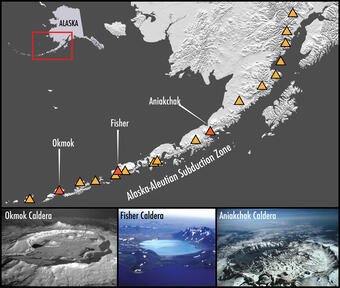
But these are not the only, nor the most recent, caldera-forming eruptions in the U.S. Far from the lower 48 and from any boardwalks, numerous calderas lie along the remote Alaska-Aleutian subduction zone. These calderas formed during eruptions that occurred much more recently in geologic time; in fact, Alaska hosts 12 calderas that formed in the last 12,000 years!
So what makes Alaska’s caldera systems different from Yellowstone? And how do their eruptions compare to Yellowstone’s colossal eruptions?
The primary difference is tectonic setting. Yellowstone is a volcano formed above a hotspot, where the North American continent moves steadily over a relatively fixed source of melting that may be rooted deep in the Earth. In contrast, the Alaska-Aleutian arc is a subduction zone extending almost 3,000 kilometers (~1,850 miles) from the Alaska Peninsula to Kamchatka, Russia, where the Pacific plate is slowly diving beneath the North American plate. This fundamental difference in setting influences everything from how magma is generated at depth to how it is supplied to the overlying volcano.
The Alaska-Aleutian arc hosts dozens of active volcanic systems that produce eruptions with a wide range of styles, sizes, and magma compositions. Among them are several notable calderas along an ~800-kilometer (~500-mile) segment of the arc.
Aniakchak on the Alaska Peninsula is one of Alaska’s most active volcanoes that experienced a caldera-forming eruption about 3,500 years ago, termed Aniakchak II. This eruption, ranked on the Volcanic Explosivity Index (VEI) as a 6–7, produced ~100 km3 of magma, which is about 10% the size of Yellowstone’s most recent caldera-forming eruption that produced the Lava Creek Tuff. In contrast to the high-silica (rhyolitic) composition of Yellowstone’s caldera-forming eruptions, Aniakchak II magma had more of an intermediate composition with a lower silica content. The impacts of the Aniakchak II eruption were far-reaching, including tsunamis, depopulation of the central Alaska Peninsula, and effects on global climate.
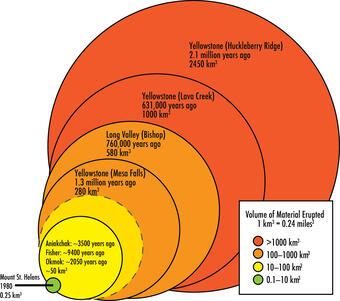
Farther west, on Unimak Island, sits Fisher Caldera, one of the largest calderas in the Alaska-Aleutian arc. Measuring 11 km (7 mi) wide by 18 km (11 mi) long—about a quarter of the size of the modern-day Yellowstone Caldera—Fisher formed during a VEI 6 eruption ~9,400 years ago. In contrast to Yellowstone, Fisher erupted a significant amount of basalt, a magma type typically associated primarily with pre- and post-caldera activity in Yellowstone. This eruption was powerful enough that pyroclastic flows (fast-moving currents of hot ash, gas, and rock) reached the Pacific Ocean 8 kilometers (~5 miles) to the southeast and traveled partway up the slopes of neighboring volcanoes.
Continuing west along the arc, we reach Okmok Caldera on northeastern Umnak Island. Okmok produced a VEI 6 eruption ~2,050 years ago, known as Okmok II. This eruption was characterized by a wide range of erupted magma compositions, including rhyodacite (high silica) through basaltic-andesite (low silica). The Okmok II eruption is thought to have triggered widespread climate disturbances that affected regions as distant as Ancient Rome, already in the throes of political instability, by causing crop failures and famine.
While Yellowstone may be among the most famous calderas in the U.S., it represents only one example of caldera systems that are found in the country. Looking beyond the boardwalks of Yellowstone reveals a rich and varied spectrum of calderas, including systems that erupt more frequently, produce different types of magma, and pose different hazards. By studying these diverse systems, scientists gain a more complete understanding of how calderas form and evolve in different tectonic environments, and how Yellowstone fits into this broader geologic context.