



Crystal clues: The case of the Lava Creek Tuff’s missing members
Recent studies are changing the way geologists think about the Lava Creek Tuff—the deposit that was created during the formation of Yellowstone Caldera 631,000 years ago. That eruption seems to have been even more complex than originally thought.
Yellowstone Caldera Chronicles is a weekly column written by scientists and collaborators of the Yellowstone Volcano Observatory. This week's contribution is from Stacy Henderson, Ph.D. candidate in the Department of Earth Sciences at Montana State University.
“The present is the key to the past.” -- Charles Lyell
Imagine using the same map for decades, only to discover that one of the lines on it never really existed. That’s essentially what a new study suggests about the Lava Creek Tuff, the deposit left behind by Yellowstone’s 631,000-year-old supereruption.
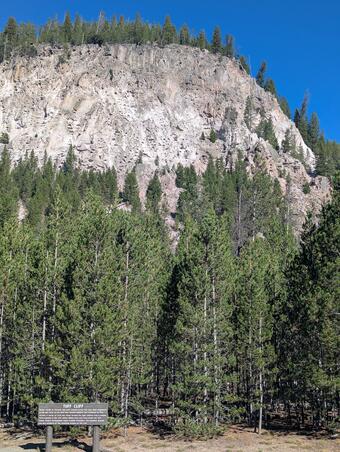
The Lava Creek Tuff (LCT) is made up of more than 1,000 km³ (240 mi³) of material that was ejected during the formation of Yellowstone Caldera—an eruption that spread ash across much of North America. Since it was initially mapped as an ash flow in the 1960s, the Lava Creek Tuff has been divided into two units known simply as member A and member B. The main distinguishing feature of LCT-A was the presence of the mineral amphibole, which was not found in the rocks of LCT-B. This evidence implied that two different magma bodies fed the eruption, providing important insights for volcanologists as to how melt was situated in the crust prior to these catastrophic events.
For decades, the two-member framework served as the cornerstone for describing and interpreting the Lava Creek Tuff, shaping how scientists understood the eruption and magma system that produced it. However, several recent studies began to uncover Lava Creek Tuff deposits that did not fit neatly into either member A or member B. Recent work has shown that rocks in the Sour Creek dome previously mapped as the 2.1-million-year-old Huckleberry Ridge Tuff are actually part of the Lava Creek eruption, and many of these rocks do not fit neatly into either the member A or member B classification. These findings raise an important question: if some Lava Creek Tuff deposits cannot be classified as either member, is the two-member model still the best way to divide Yellowstone’s most recent supereruption?
To find out, geologists at Montana State University (MSU) started an immense project: a fresh look at the entire Lava Creek Tuff eruption. This required sampling deposits stretching from Warm River, Idaho, to Greybull, Wyoming, as well as climbing up and down canyons, over scree slopes, and sometimes (when they were lucky) flying to the most remote parts of Yellowstone National Park. Researchers focused on mapping amphibole occurrence and comparing deposits to the newly recognized Sour Creek dome units. MSU scientists also analyzed chemical compositions of the mineral sanidine from each sample. These crystals preserve a chemical fingerprint that can test whether the Lava Creek Tuff truly divides into two distinct members.
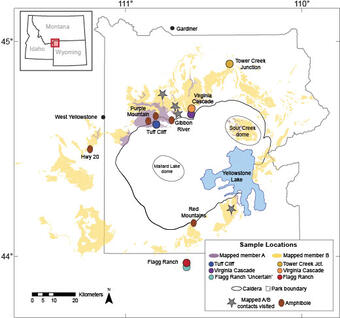
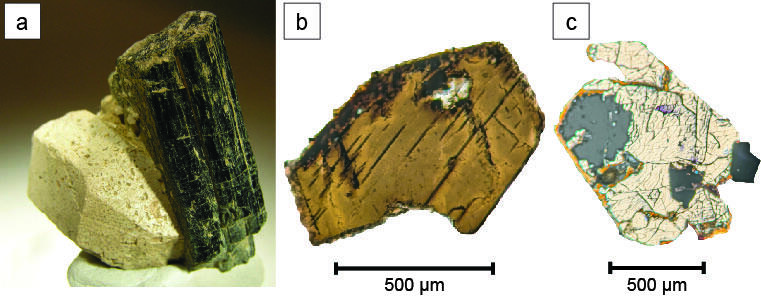
To start, researchers made thin slices of each of the collected rocks, examining more than 100 samples under the microscope. Despite this extensive search, only 13 amphibole crystals were identified, mostly from a small region near Madison Junction, and three of those crystals came from deposits mapped as member B. This immediately blurs the traditional distinction between the two members. Even more intriguing, half the crystals identified were found within a small deposit along the Gibbon River that turned out to be 140,000 years older than the Lava Creek Tuff eruption. This means one of the key amphibole-rich deposits used to define member A is not part of the Lava Creek Tuff at all. If amphibole is rare, occurs in both members, and one of the amphibole-rich examples isn’t even LCT, how strong is the two-member framework really?
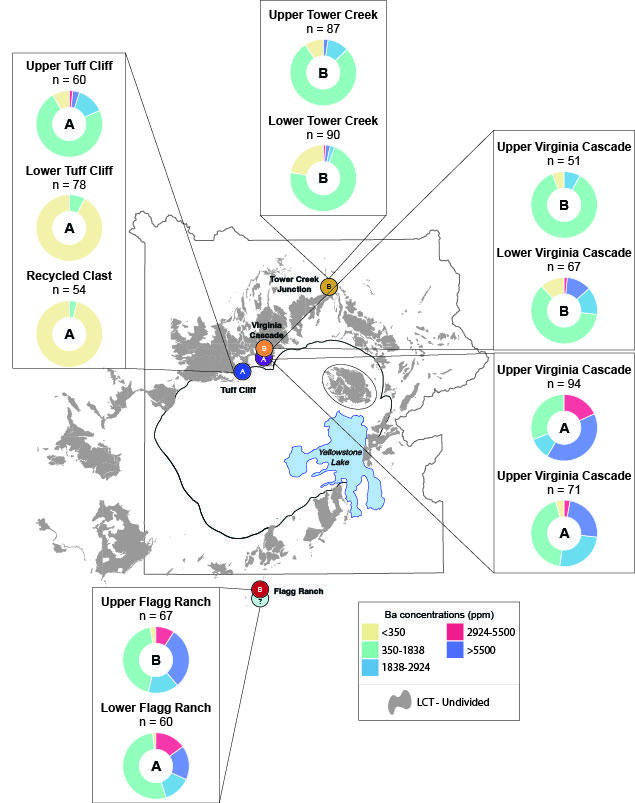
The next clue came from sanidine crystals. Scientists analyzed the barium content in sanidine from deposits mapped as both members A and B. If the two-member framework reflected a real division within the eruption, the crystal chemistry should match, and there would be two separate populations of crystals. Instead, the sanidine chemistry shows that the same barium chemistry occurs in both mapped members. Essentially, all methods tested failed to find clean division between LCT-A and LCT-B.
So, what does this all mean for the Lava Creek Tuff? The evidence from both amphibole and sanidine chemistry points to the same conclusion: the LCT deposits do not naturally separate into member A and member B. Instead, the LCT appears to record a more complex eruptive story than the traditional two-member framework suggests. Moving forward, scientists will need to rethink how the deposit is divided, draw new lines on the map, and revisit previous interpretations of the eruption and the magmas that produced it.
(These new results were recently published in Journal of Volcanology and Geothermal Research, at https://doi.org/10.1016/j.jvolgeores.2026.108753.)