



You may have heard that throwing rocks, sticks, or other items in hot springs in Yellowstone is a bad idea (and also illegal), but have you ever wondered what it takes to remove them?
Yellowstone Caldera Chronicles is a weekly column written by scientists and collaborators of the Yellowstone Volcano Observatory. This week's contribution is from Tara Cross and Jeff Cross, researchers with the Geyser Observation and Study Association (GOSA), and Margery Price, Physical Scientist with the Yellowstone National Park Geology Program.

Since Yellowstone National Park was established in 1872, park managers have worked to prevent and repair the damage caused by heavy visitation. Hats, gum wrappers, and tissues blown away on windy days, and rocks and sticks thrown into hot springs, all spoil the natural beauty of the Park. Keeping Yellowstone’s hot springs clean requires constant effort!
Damage from vandalism can be substantial. Minute Geyser, which once erupted as high as 60 feet in Norris Geyser Basin, stopped erupting in 1947 when a rock was thrown into its vent and could not be dislodged. Visitors have tossed countless coins, rocks, sticks, and other debris into Morning Glory Pool, one of Yellowstone’s most popular features. Morning Glory has since cooled and changed color, probably because of this damage. Microbes now grow in the crater, dulling the delicate blue color that made it famous. To date, more than 6,574 coins have been removed from Morning Glory. Handkerchief Pool, in Black Sand Basin, also suffered severe damage. Early visitors learned that the spring’s circulating waters could carry dropped handkerchiefs deep into the vent, then quickly return them. Following decades of people dropping their linen in the feature, Handkerchief stopped working in 1927, and it was 20 years before the spring recovered.
George Marler, Yellowstone National Park geologist, recognized in the 1940s that rocks, logs, and other rubble had been thrown by visitors into hot springs, filling some features to their rims. A cleaning project initiated by Marler in 1942 removed so much debris from the hot springs that pickup trucks were sometimes needed to cart it all away! Marler pointed out that many visitors to Yellowstone stay for only a day or two before moving on, and the time available to educate them on park laws is limited. Today, over 4 million visitors must be educated every year—a demanding task for park personnel!
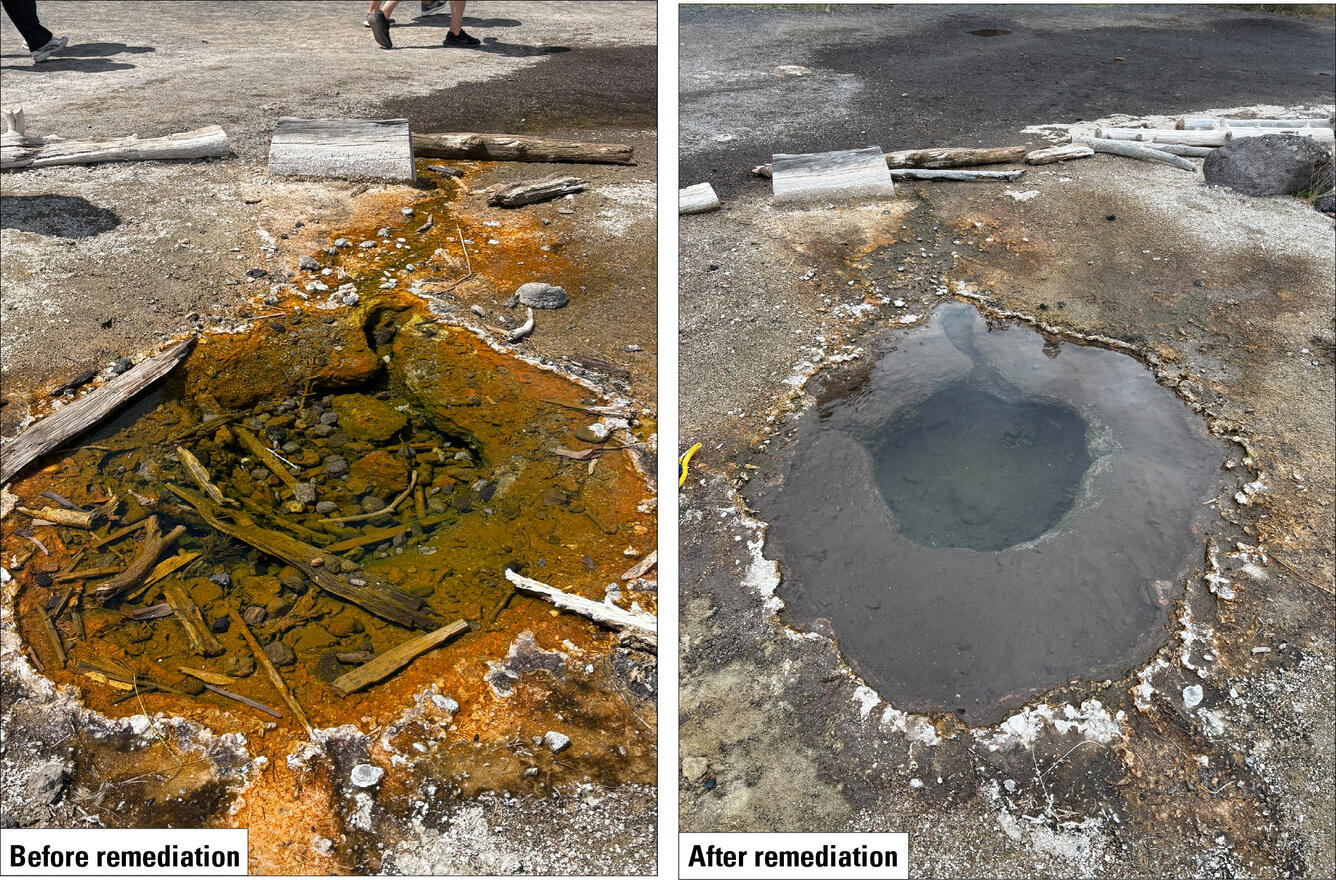
Today, Yellowstone National Park’s Geology Program cleans the hot springs. The team passes through the geyser basins with special tools, collecting debris and remediating vandalism (including carvings into bacterial mats) and other damage. One small hot spring near the Grand Prismatic Overlook was found in 2025 to be filled to its rim with sticks and rocks thrown in by visitors. The feature had been remediated in 2020, meaning that it only took five years for debris to fill the spring back up. In summer 2025, Geology Program team members removed over 6,000 items (mostly rocks, sticks, and chunks of old asphalt) from the feature. After the remediation, the spring’s water flow and temperature increased—both signs that the debris removed had been blocking the vent and damaging the spring.
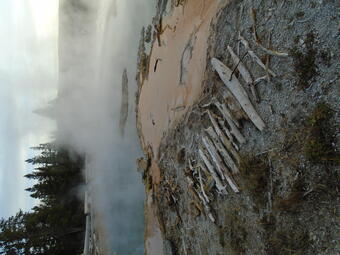
There are other stories of success, too. A cleaning project at Solitary Geyser in 2021 removed at least 15 logs, the heaviest weighing up to 90 pounds, as well as rocks the size of basketballs and hundreds of smaller pieces of debris. Much of this material was cemented in place by silica sinter and required special effort to remove. Other hot springs cleaned in 2021 yielded 16 entire trees, 5 tree stumps, and thousands of other objects thrown in by visitors, including religious figurines, a crystal ball, a football, and an unopened bottle of beer.
Cleaning hot springs is hard work! Some remediations, like the Grand Prismatic Overlook trail spring, require shovels, strainers, and grabber tools. The cleaning of Solitary Geyser, however, required a hook with a 16-foot extendable handle to remove large objects within the interior parts of the pool and hand rakes to collect the hundreds of wood splinters that had been thrown into the splash basins around the pool margin.
Yellowstone’s stunning and unique landscapes contain more than 10,000 hydrothermal features, many of them near boardwalks and trails for us all to enjoy. What can park visitors do to help keep these beautiful features healthy? Leave rocks and sticks where they are, throw trash into trash cans, and never throw anything into a hot spring or geyser.