



No longer in the dark: Shining a light on Yellowstone’s hydrothermal explosions
Determining the ages of hydrothermal explosions in Yellowstone is difficult because traditional dating methods often don’t work on those deposits. But an emerging application of a technique called luminescence dating literally sheds new light on this important problem.
Yellowstone Caldera Chronicles is a weekly column written by scientists and collaborators of the Yellowstone Volcano Observatory. This week's contribution is from Karissa Cordero, graduate student at the University of Texas at Arlington.
The Yellowstone Plateau volcanic field is an active, ever-changing landscape with a long history of very large eruptions—some of the largest known on Earth! Yet much of the terrain is also marked by relatively small craters formed during hydrothermal explosions. These violent events are not related to volcanic activity but rather triggered by sudden reductions in pressure that cause boiling water to flash to steam.
Unlike magmatic eruptions, hydrothermal explosions often occur with little to no warning. That unpredictability makes them especially important from a hazards perspective. At the same time, these events provide valuable insights into subsurface temperature and pressure conditions, as well as hydrothermal fluid circulation across Yellowstone.
A recent hydrothermal explosion at Biscuit Basin in July 2024 highlighted the importance of better understanding these systems. The explosion sent steam, debris, and rock fragments hundreds of feet into the air and damaged nearby boardwalks. Although this event was relatively small by geologic standards, it serves as a reminder that Yellowstone has produced far larger hydrothermal explosions in the past. The park hosts the largest known hydrothermal explosion crater in the world, Mary Bay, stretching 2.8 kilometers (1.7 miles) across. Despite the scale of these events, their timing and frequency remain poorly known. One reason for this is that dating hydrothermal explosion deposits is notoriously challenging. These deposits often lack suitable material for common geochronologic techniques, are subject to ongoing hydrothermal alteration, and are frequently reworked after deposition.
Recent advances in luminescence dating are beginning to overcome some of these challenges. Luminescence dating methods determine the last time sediment grains were exposed to geothermal heat or sunlight. This process can be compared to a rechargeable battery. Exposure to heat or light resets the signal to zero, like draining a battery. Burying those grains allows the signal to rebuild over time as natural radiation accumulates, just as if you were to plug your batteries in to charge them.
In the context of hydrothermal explosions, this means the luminescence signal can record the timing of the explosion itself. Before an explosion, these grains were constantly heated by the hydrothermal fluids flowing around them keeping the signal at zero—similar to a fully drained battery. But after an explosion, grains were ejected out onto ground surface, cooling them to air temperature marking the point at which the luminescence signal begins to build, like batteries beginning to charge. The luminescence signal that builds up after an explosion will not reset unless the grains are re-exposed to geothermal fluids or sunlight. This is typically the case for explosion deposits, where grains are ejected from the source area and then buried.
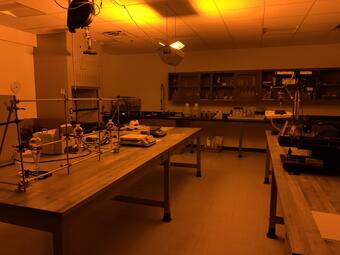
To measure the time since the explosion, researchers collect sediment samples from explosion deposits and analyze them under light-safe conditions in the laboratory. Luminescence labs use dim amber lighting that emits wavelengths that do not significantly damage the luminescence signal, preserving the stored energy within the samples. Researchers then stimulate this stored signal using light or heat, causing the grains to emit a small amount of light known as luminescence. The intensity of this light corresponds to the radiation absorbed since the explosion. This natural luminescence signal is compared to results from laboratory irradiation experiments, where the grains are exposed to known amounts of radiation. This process helps determine the amount of radiation needed to reproduce the natural signal, known as the equivalent dose. The environmental radioactivity at the sample site, known as the environmental dose rate, is also measured to determine the rate at which the luminescence signal accumulates. The age of the explosion deposits is calculated by dividing the equivalent dose by the environmental dose rate. This age corresponds to the last time the grains were heated up—in the case of Yellowstone deposits, that’s the age of the hydrothermal explosion!
Applying this approach to explosion features in Yellowstone provides an opportunity to directly constrain events that were previously difficult to date. An example is Pocket Basin, which is one of the largest hydrothermal explosion craters in Yellowstone National Park. Located in the Lower Geyser Basin and spanning approximately 365 by 800 meters (1200 by 2600 feet), Pocket Basin was originally interpreted as the result of a glacial outburst flood towards the end of the most recent ice age, called the Pinedale Glaciation.
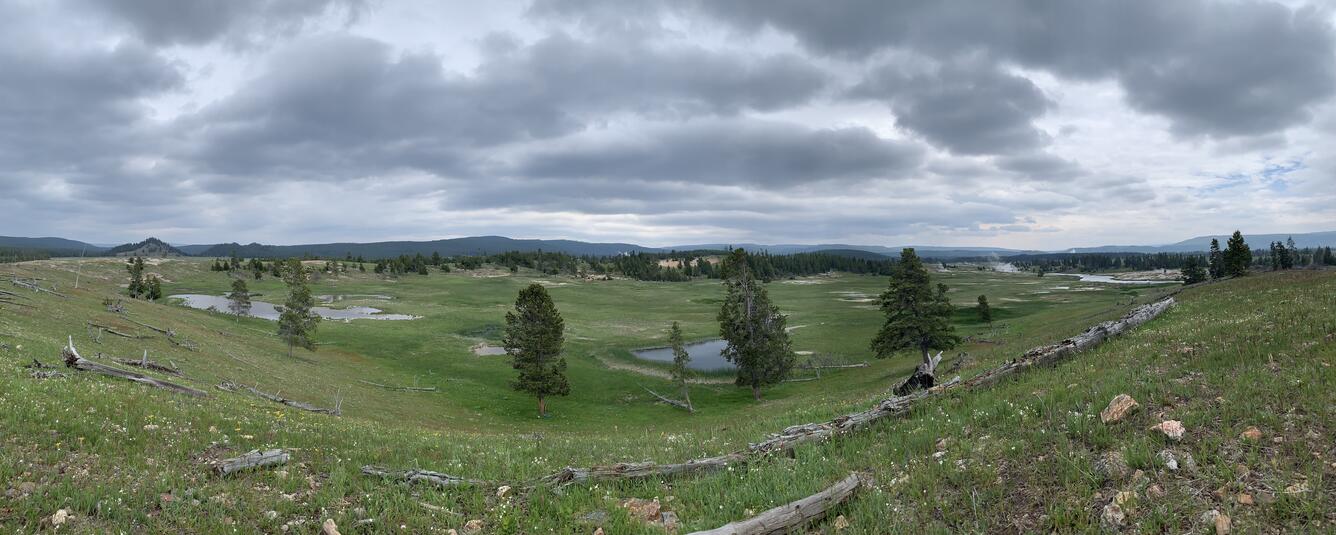
Luminescence dating results help to refine this story. Results from grains extracted from many samples taken around this crater rim suggest that the explosion took place 13,900 years ago (with an error of about 3,900 years), which is consistent with the time of deglaciation following the Pinedale period. This timing suggests that changing surface conditions associated with glacial retreat may have influenced the hydrothermal system, potentially triggering explosive activity.
Establishing when hydrothermal explosion events occurred across Yellowstone provides critical context for understanding the processes that drive them. In a system where future explosions remain difficult to predict, constraining the timing and causes of past events is important to improve our ability to assess future hazards. As luminescence techniques continue to develop, they offer a promising new tool for determining the dates of hydrothermal explosions—not only in Yellowstone, but in volcanic systems worldwide.