



Picturing the Unimaginable: Two Artists’ Early Journey into Yellowstone's Untamed Wonders
How can a landscape of vividly colored hot springs and erupting geysers be conveyed when it defies imagination? As part of Ferdinand Hayden’s 1871 survey of Yellowstone, artist Thomas Moran and photographer William Jackson brought Yellowstone’s unimaginable wonder to the world through their paintings and photographs.
This week’s Yellowstone Caldera Chronicle is written by Dr. Alexandra Ziegler, art historian and curator at the University of Wyoming Art Museum, and Dr. Ken Sims, Geology and Geophysics Professor at the University of Wyoming and National Advisory Board Member of the University of Wyoming Art Museum.
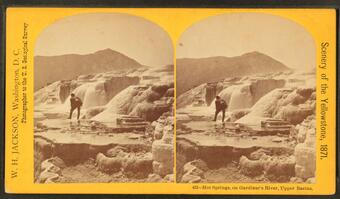
When Thomas Moran traveled to the Yellowstone region with Ferdinand V. Hayden’s geological survey in 1871, he encountered a landscape that defied established modes of representation. Geysers erupted from the earth, brilliantly colored hot springs punctuated the terrain, and mineral terraces formed seemingly otherworldly structures. But how could he observe, record, and communicate Yellowstone’s unusual features to people who had never seen them?
The landscape itself was not unknown. Indigenous peoples had lived in, traveled through, and developed knowledge of the Yellowstone region for thousands of years before nineteenth-century government expeditions arrived. The Hayden Survey marks a particular moment in the history of Euro-American scientific investigation, when federally sponsored expeditions sought to survey, classify, and document the American West.
Moran joined that effort as an artist, traveling alongside photographer William Henry Jackson. The two worked in close proximity and represented many of the same sites.
Their resulting images are often discussed for their role in introducing Yellowstone’s spectacular scenery to East Coast audiences and building support for the establishment of Yellowstone National Park. Moran’s images did more than convey the emotional experience of encountering an extraordinary landscape, however. Viewed alongside Jackson’s photographs, they reveal how different forms of representation could record—and interpret—different kinds of information.
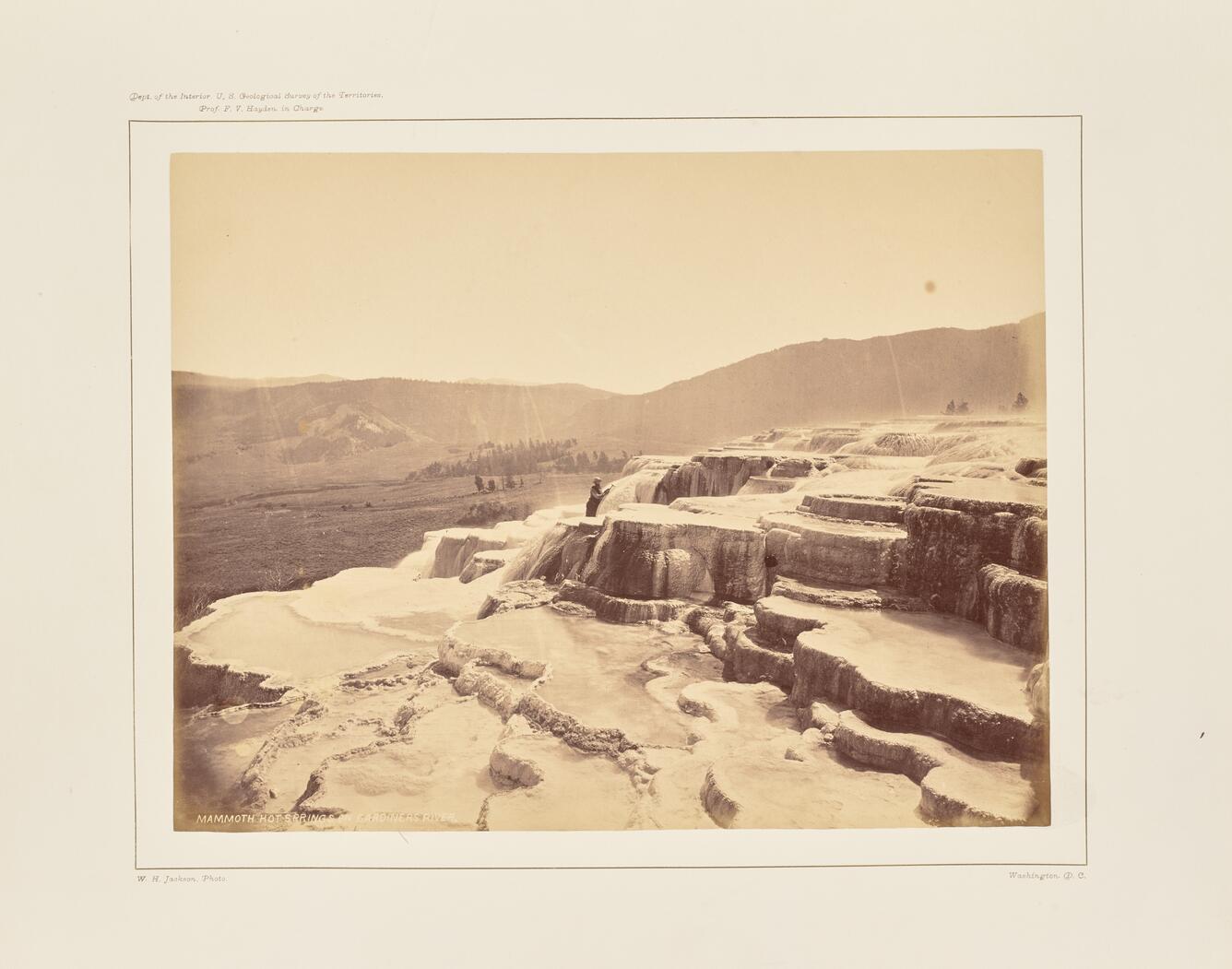
Jackson’s photographs carried a particular authority—a photograph could seem to offer direct evidence of a landscape that many viewers had never encountered or even imagined. Jackson chose his viewpoints, framed his subjects, selected his exposure, and decided when to photograph, all within the technical limits of nineteenth-century photography. His albumen prints recorded Yellowstone’s forms, textures, and spatial relationships with extraordinary detail, but they could not record its color.
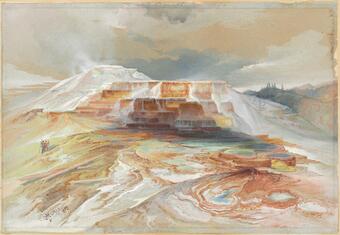
Moran’s images preserved a different category of visual information. His paintings were more overtly interpretive: he could synthesize observations, adjust compositions, heighten contrasts, and translate his experience of the landscape through color. At Yellowstone, color was not merely an expressive embellishment. It could also convey information about the physical and biological processes shaping the landscape.
Mammoth Hot Springs provides a striking example. Jackson photographed the terraces during the 1871 expedition and even photographed Moran among them. Moran likewise studied the springs firsthand, and his 1875 chromolithograph Hot Springs of Gardiner’s River, Yellowstone shows white terraces interrupted by reds, oranges, yellows, and blues. Small human figures provide scale, but color commands the image.
That distinction is more than aesthetic. At Mammoth Hot Springs, color can reveal something about the landscape itself. The brilliant white terraces are the mineral travertine, and bands of orange, brown, green, and cream can come from communities of heat-loving microorganisms called thermophiles. Different thermophiles thrive under different conditions, so these changing colors can offer clues about the hot spring’s temperature, chemistry, and activity. Moran’s paintings thus preserved a category of visual information that Jackson’s photographs could not, and the reproducible medium of chromolithography—a painstaking process used to make color prints—allowed that color, and the information it conveyed, to be circulated to a wider audience.
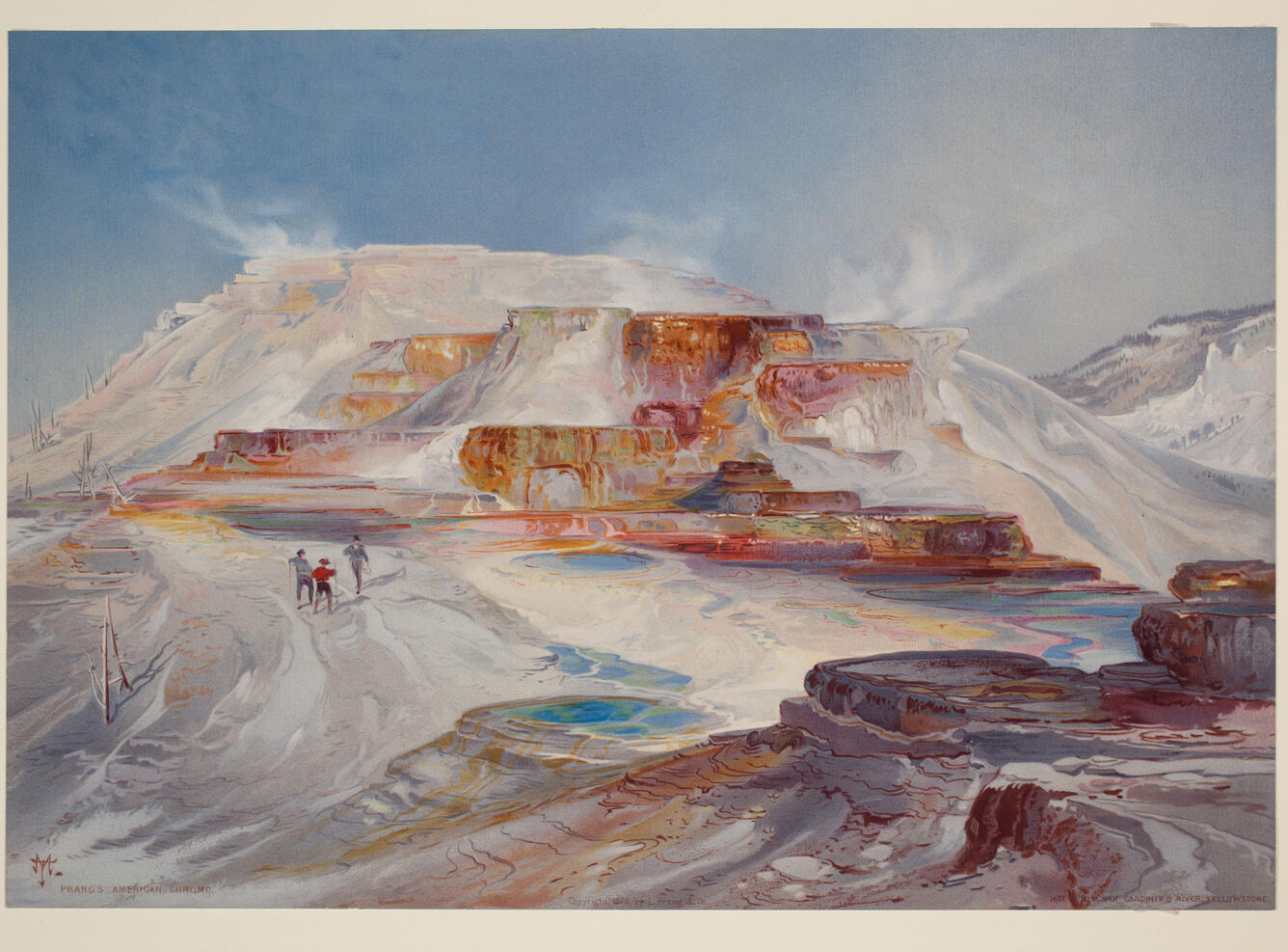
The comparison makes it clear that Jackson was more than just a documentarian, and Moran was more than simply an artist. Jackson’s photographs may have carried a stronger appearance of objectivity, while Moran’s landscapes openly announced their artistic interpretation. Yet both men selected, framed, and translated what they observed, and their respective media preserved different kinds of evidence. If Jackson’s photographs made Yellowstone’s extraordinary forms reproducible, Moran’s chromolithographs made its extraordinary color reproducible.
Today, geologists and biologists can read Yellowstone’s landscape using knowledge unavailable to Moran, Jackson, and their contemporaries. Looking again at Moran’s images through our refined lens of enhanced scientific knowledge reveals something easily obscured by their beauty. Moran did not simply show nineteenth-century viewers why Yellowstone was worth seeing. His images also preserved observations of the landscape that other contemporary forms of documentation could not capture. Geology can help us understand what Moran saw. Art history can help us understand how he made that information visible.