



Was that Yellowstone earthquake volcanic or tectonic?
There are lots of earthquakes in the Yellowstone region. How do scientists know if they are volcanic events, driven by magma, or tectonic events, caused by fault motion?
Yellowstone Caldera Chronicles is a weekly column written by scientists and collaborators of the Yellowstone Volcano Observatory. This week's contribution is from David Shelly, seismologist with the U.S. Geological Survey.
Yellowstone has a lot of earthquakes. Although almost all of these earthquakes are too small to be felt by humans, detailed seismograms recorded at stations around the Park often provide a window into active processes happening several miles beneath the surface. Understanding such processes helps us to understand the current state of the Yellowstone system and potentially to anticipate what may happen in the future.

A variety of processes can generate earthquakes. Globally, tectonic earthquakes are generated on faults that are often relatively distant from active volcanoes. Other times, earthquakes are clearly generated by volcanic processes, such as magma movement in the subsurface. But things can get more complicated in areas such as Yellowstone, where both tectonic and volcanic processes are active simultaneously.
Although Yellowstone is most famous as a volcanic and geothermal system, and it is far from traditional plate boundaries, it lies within a broad, active seismic zone known as the Intermountain Seismic Belt (ISB). The ISB extends more than 800 miles north from Arizona all the way to Montana, separating the relatively stable Colorado Plateau to the east from more active tectonic province to the west. Rather than localizing into a few narrow structures like some plate bounding faults, the ISB is a very broad, complex zone of heightened faulting and seismicity, up to 120 miles wide. Within this zone, notable historical earthquakes have occurred in the greater Yellowstone area, including the 1959 magnitude 7.3 Hebgen Lake earthquake and the 1975 magnitude 6.0 Norris earthquake. Somewhat farther from Yellowstone but still within the ISB were the 1934 magnitude 6.9 Hansel Valley (Utah) and 1983 magnitude 6.9 Borah Peak (Idaho) earthquakes.
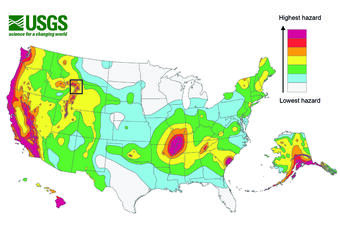
As many people know, earthquakes near volcanoes can sometimes be precursors to heightened volcanic activity. Thus, when an earthquake occurs at Yellowstone, it’s natural for people to ask, “Was that earthquake volcanic, or tectonic?”
In order to begin to answer this question, we need to understand how the particular earthquake (or sequence of earthquakes) was generated, including factors like the source of stress (the energy driving the earthquake) and also the trigger (why the earthquake happened when it did).
The source of stress could be volcanic, either because of large-scale deformation caused by fluids (water, gas, or magma) in the volcanic system, or more rarely, directly by magma movement. Alternatively, the stress could come from the slow accumulation of tectonic forces. Meanwhile, the trigger could be small changes in either stress or fault strength induced by volcanic processes, or it could be the accumulation of tectonic stress simply reaching the breaking point of the fault.
But what happens at places like Yellowstone when volcanic and tectonic processes become intermixed? For example, many earthquake swarms at Yellowstone and elsewhere are generated when slowly accumulated tectonic stress is suddenly released due to water-rich fluids infiltrating the faults and weakening them by reducing their clamping force. At Yellowstone, these water-rich fluids are often derived from the deeper volcanic system. Thus, we have earthquakes generated by a combination of volcanic and tectonic processes!

To add further complication, these “volcanic” fluids may counterintuitively be released as part of the ongoing cooling of magma deep beneath Yellowstone, rather than when it is heating up. As magma cools, water-rich fluids that were originally incorporated in the chemical structure of the magma may be released. The natural pressure gradient leads these water-rich fluids to episodically make their way towards the surface, and as they do so, they may trigger earthquakes and even earthquake swarms as they interact with existing tectonic faults.
To recap: Mother Nature doesn’t always conform to simple categories. Long-term investments in seismic monitoring and research have shown us that earthquakes at Yellowstone are often generated by complex (but fascinating!) combinations of tectonic and volcanic processes. Therefore, it’s often not possible to simply label these events as “tectonic” or “volcanic” — the answer to the question may be: “both!” And to make matters even more confusing, the “volcanic” contribution to these events may be water-rich fluids that are released by cooling magma deep beneath the Yellowstone system, rather than magma that’s heating up and getting closer to an eruption.
As future earthquakes occur, scientists will examine them using data from Yellowstone’s seismic network to try to understand the active processes many miles beneath the surface. Over time, these constraints can be integrated with other datasets from geology, geodesy, geochemistry, heat flow, seismic imaging, and more, to improve models of the Yellowstone system. And as the models get better, scientists can continue to improve the ability to translate future observations into an understanding of active processes beneath Yellowstone and how they are likely to evolve over time.