



Get to Know a Scientist Emeritus—Walter Guidroz
This is the latest in a series of Get to Know posts highlighting and celebrating the contributions of exemplary Scientists Emeriti. Their work, experience, and contributions are essential to the mission of the USGS.
How long did you work at the USGS and what did you do?
I worked for the USGS for just over five years and served as the Program Coordinator of the USGS Energy Resources Program, which is housed in the Geology, Energy & Minerals Mission Area (GEMMA).
What work are you doing as an emeritus?
I presently serve on an ad hoc committee convened by the National Academies of Science, Engineering and Medicine to provide advice to Department of the Interior Orphaned Wells Program Office on regulatory, technical, scientific, and economic considerations for plugging and remediating orphaned and abandoned oil and natural gas wells across the United States. Orphaned wells can present a risk to the environment and public by emitting methane, contaminating groundwater, and/or impacting ecosystems, hence the importance of this activity! Our work has been ongoing for about 18 months and should conclude this spring.
How frequently do you work?
My work schedule varies quite a bit — sometimes I work several full days in a row on the National Academies study and other times I may go a week or more without spending much time on it. However, I’m also an adjunct professor at both George Washington University (GWU) in Washington, D.C. as well as at the University of Mississippi. I teach classes on geology and energy resources at both universities, which keeps me busy and tied to a regular schedule.
What is the scope of your duties?
Most of my current emeritus work involves serving on the National Academies committee I described above. However, I’ve also done work to support GEMMA — I’ve served on interview panels for several key job roles and also prepared an early draft of a proposed international strategy.
How did you get involved as an emeritus?
I wanted to remain active and continue contributing to the mission of the USGS.
How has your work as an emeritus contributed to the greater good?
Our National Academies work will hopefully help provide future guidance on how orphaned and abandoned wells can be mitigated, thereby reducing the threats they pose to society at large. I’m also passionate about working with and mentoring the next generation, which is why I teach at GWU and the University of Mississippi.
What are your personal reasons/satisfactions for doing it?
I know it’s a cliché, but I really mean this — I’m inspired to try and make a difference in people’s lives and to make the world a better place, and that gives me great satisfaction. I think often about the mentors in my early career, both in academia as well as in the workplace — life would have been so much tougher without their guidance and support, and I’m forever grateful for that!
Before your retirement, what was your favorite part of your job?
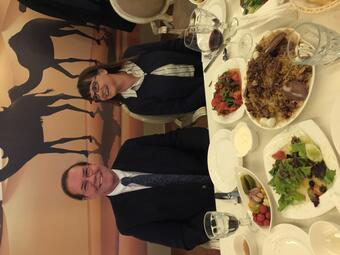
I enjoyed the international travel associated with my role – I was incredibly fortunate to represent the USGS in far-flung locales ranging from Greenland to Bosnia-Herzegovina to Romania to Uzbekistan. I often traveled jointly with the State Department to help support their work from a geological or energy resource perspective — doing that made me feel proud, like I was helping to advance the interests of the U.S. on a broader scale.
What, if any, prior career experience did you have?
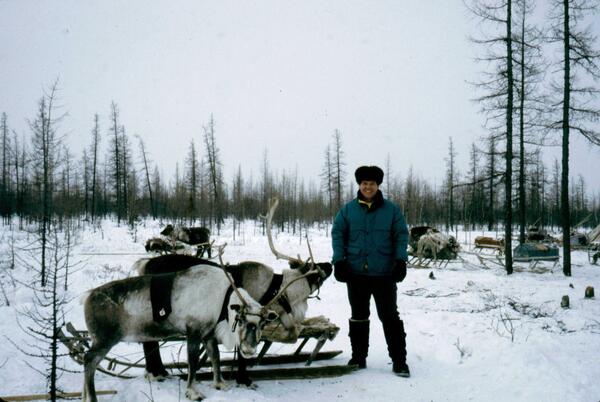
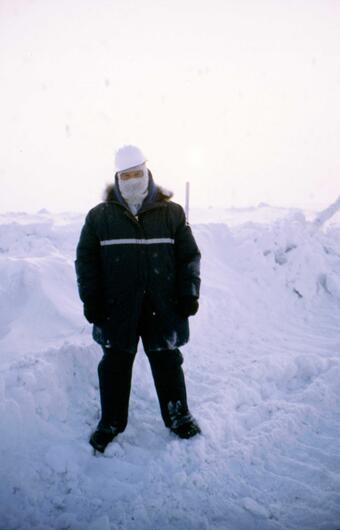
I worked for 35 years as a geoscientist at Amoco and later as a geoscientist and manager at BP, which acquired Amoco in 1999. I began my career in New Orleans, LA, but moved to Houston, TX, when Amoco consolidated many of its offices there. I worked on projects in the U.S. as well as internationally, including about six years on various projects in western Siberia in Russia in the early 1990s, which was eye-opening to say the least! It was there that I experienced my record low temperature while on Russia’s Yamal Peninsula – minus 52 degrees Fahrenheit.
What was the last (or favorite) book you read?
Even though it’s been a while since I’ve read it, Rising Tide: The Great Mississippi Flood of 1927 and How it Changed America by John Barry remains one of my favorite books. Barry did a phenomenal job in weaving together the scientific, political, and societal changes wrought by the flood. And as a native of southern Louisiana, the book holds special meaning to me — the stories about the flood that were told to me as a child continue to resonate with me to this day.
If you could travel on a time machine to any era in time, what would it be and why?
Geologically, I’d travel back to the late Permian Period (about 250 million years ago) to search for trilobites before they became extinct. Historically, I’d travel back to 17th Century Switzerland and 18th Century Louisiana to meet some of my family’s early ancestors and experience what their lives were like. And futuristically, I’d travel forward to the 24th Century to see if warp drive had really been invented by then — if so, then a leisurely jaunt to Proxima Centauri would be fun...