An official website of the United States government
Here's how you know
Official websites use .gov
A .gov website belongs to an official government organization in the United States.
Secure .gov websites use HTTPS
A lock () or https:// means you’ve safely connected to the .gov website. Share sensitive information only on official, secure websites.
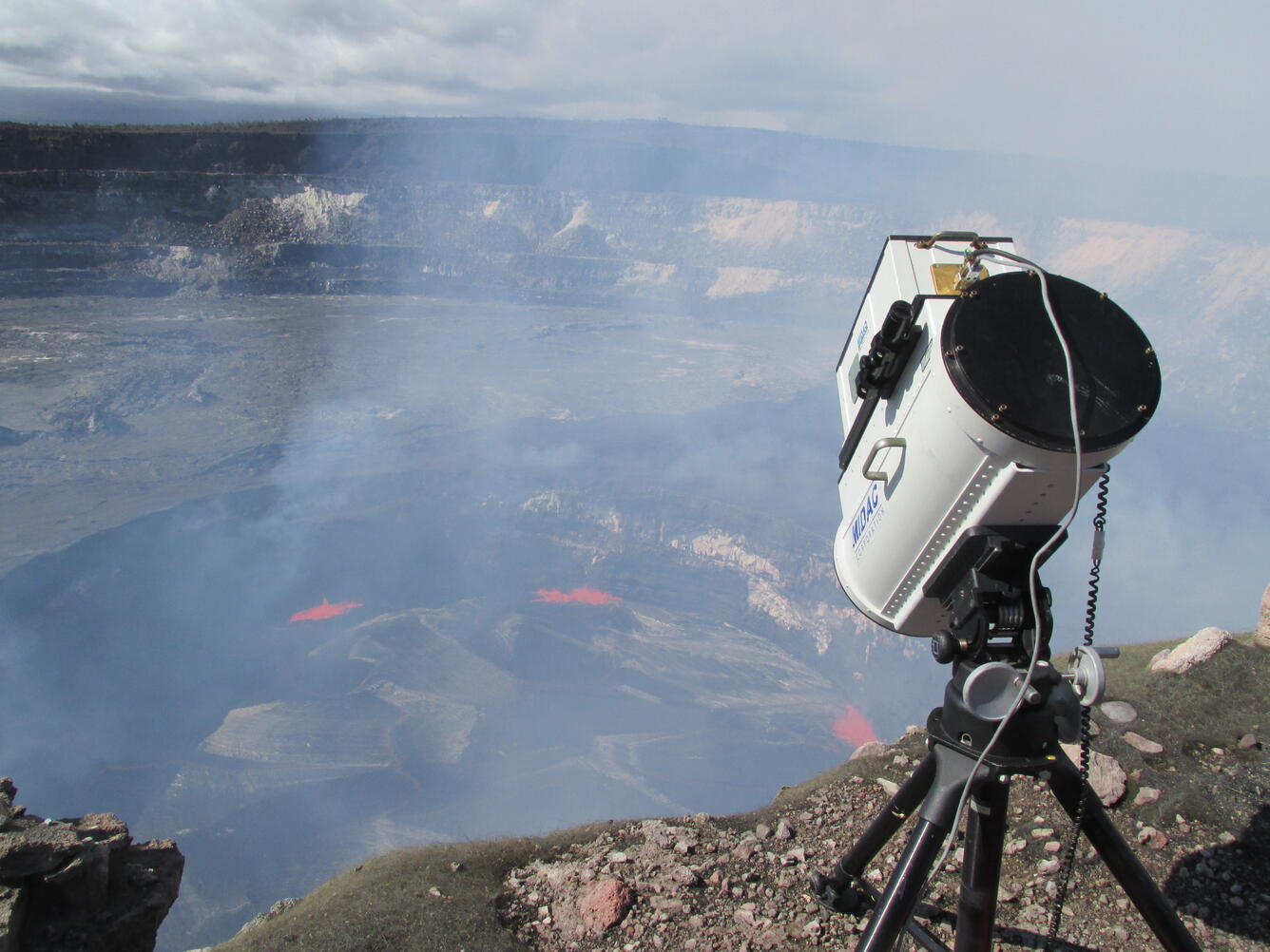
An FTIR instrument is set up on the rim of Halema‘uma‘u Crater to measure volcanic gases from the summit lava lake. The open-path Fourier transform infrared (FTIR) spectrometer continuously measures the gases in a volcanic plume, measuring the relative abundance of each. Most of the gas emitted during a volcanic eruption is water vapor (H2O), carbon dioxide (CO2), and sulfur dioxide(SO2).
HVO's geochemist uses a Fourier Transform Infrared Spectrometer (FTIR) instrument to track volcanic gases emitted from the lava lake with Halema‘uma‘u Crater. These measurements help detect changes in gas composition, which can provide insight into the inner workings of Kīlauea Volcano.
View of the lava lake within Halema‘uma‘u Crater from the FTIR spectrometer monitoring location. At Hawaiian volcanoes, magma ascends from the mantle more than 60 km (about 40 mi) below the surface, to a reservoir less than 2 km (about 1.2 mi) deep. As the pressure decreases, the gases dissolved in the magma bubble out and escape. Magma continues to rise through a shallow conduit to the Halema‘uma‘u lava lake, where it continues to degas (the blue haze is indicative of sulfur gases).