An official website of the United States government
Here's how you know
Official websites use .gov
A .gov website belongs to an official government organization in the United States.
Secure .gov websites use HTTPS
A lock () or https:// means you’ve safely connected to the .gov website. Share sensitive information only on official, secure websites.
New flows on the floor of Pu‘u ‘Ō‘ō crater over the past few weeks threatened cameras positioned on the crater's north rim. Two cameras—a thermal camera observing the crater and a regular webcam observing the active Kahauale‘a 2 flow in the distance—were moved to a safer location partway up the steep northwestern flank of Pu‘u ‘Ō‘ō cone. Another webcam, regularly capturing a panorama of the crater floor, was left in place to maintain a consistent view of the crater. Poor weather and winds prevented the power systems for the cameras that were moved from being put into place until today (May 5, 2014). The cameras are now operational, and are visible in the background of this photo, beyond a spatter cone on the north side of the crater floor.
New flows on the floor of Pu‘u ‘Ō‘ō crater over the past few weeks threatened cameras positioned on the crater's north rim. Two cameras—a thermal camera observing the crater and a regular webcam observing the active Kahauale‘a 2 flow in the distance—were moved to a safer location partway up the steep northwestern flank of Pu‘u ‘Ō‘ō cone. Another webcam, regularly capturing a panorama of the crater floor, was left in place to maintain a consistent view of the crater. Poor weather and winds prevented the power systems for the cameras that were moved from being put into place until today (May 5, 2014). The cameras are now operational, and are visible in the background of this photo, beyond a spatter cone on the north side of the crater floor.
Lava flow from South spatter cone; Pu‘u ‘Ō‘ō's south flank slowly being buried
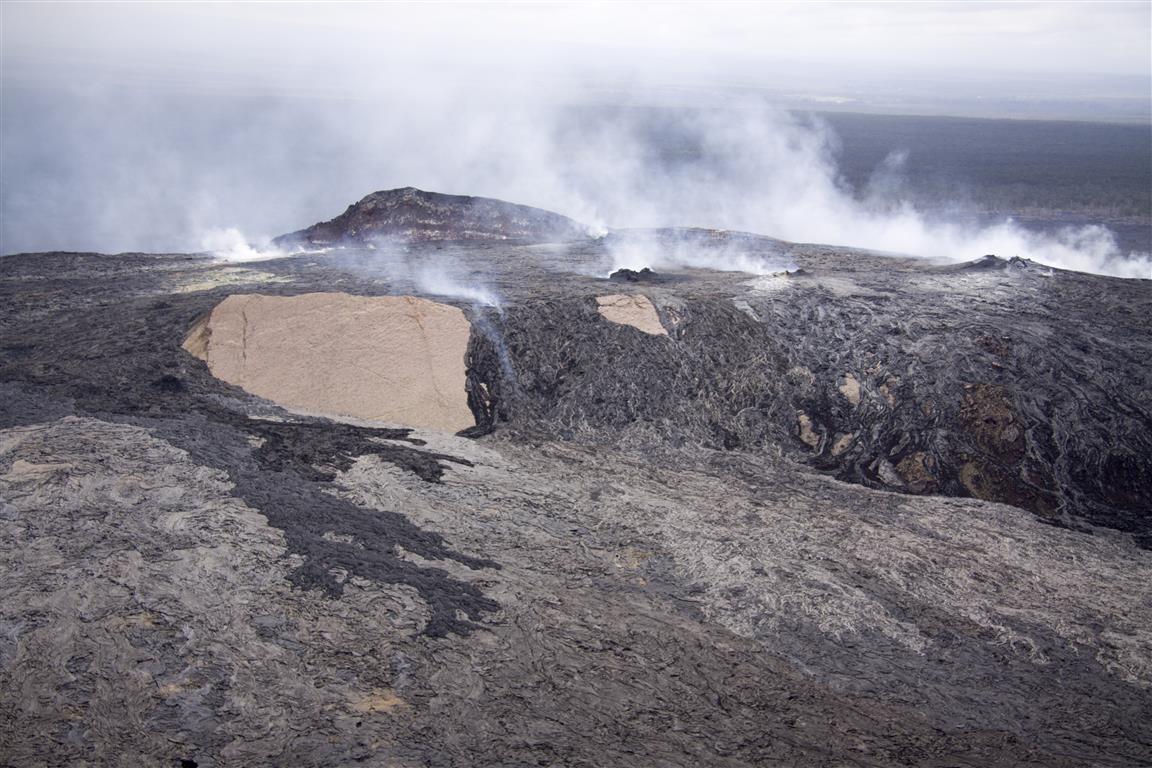
A lava flow fed from a spatter cone on the south part of Pu‘u ‘Ō‘ō's crater floor (the South spatter cone) continues to advance toward the east-southeast, and is about 700 m from its vent. The flow is the silvery lava that crosses the center of the photo.
The flow from the South spatter cone has buried part of the southern flank of Pu‘u ‘Ō‘ō cone, leaving little of the original tephra that composes the cone visible. Compare this photo to the one taken just a few months ago, on March 7. The South spatter cone, feeding the flows that have blanketed the south flank of Pu‘u ‘Ō‘ō, is the prominent, fuming spatter cone just to the right of the center of the image, directly behind where the cone has been covered.