



A True Halloween Story Treat: The dirt on Oppy’s demise!
Sorry. We are currently out of Mars candy bars.
On Launch Complex 17-B, Cape Canaveral Air Force Station, the Delta II Heavy launch vehicle jetted toward Mars on 7 July 2003 at 11:18:15 PM, Eastern daylight time. A robotic rover formally named Opportunity, and dearly nick-named “Oppy” was a passenger on the rocket. Oppy’s profession was a robot geologist on assignment for NASA to find water and evidence for past life on Mars.
Before Oppy left:
NASA’s Jet Propulsion Lab created Oppy: She was six-wheeled, solar-powered, and stood 1.5 meters (4.9 ft) high, 2.3 meters (7.5 ft) wide and 1.6 meters (5.2 ft) long with a mass of 185 kilograms (408 lbs.). She had cameras, computers, batteries, gadgets, programs, and the skills to prove herself in the harsh, alien environment. The science community, Oppy’s creators, and space enthusiasts were already in love.
Before departing Earth, Oppy’s solar panels had their final checks. They were able to absorb the sunlight that would be needed to sustain health on the Red Planet. Caltech’s Jet Propulsion Laboratory (JPL) had provided a bill of health to NASA for Oppy to conduct this investigation. She could expect to remain healthy over her full 90-sol lifespan (a “sol” is a Mars day, a little longer than an Earth day), if she remained positioned toward the sun.
A space enthusiast fantasy for Oppy
Like most trips to otherworldly places, there might be time left to explore more of the target’s surface. What if she could travel all over Mars? If so, wouldn’t it have been nice to visit her twin, Spirit, who was working on the other side of the planet? Spirit left for Mars four months prior on 2003 January 10. What if there was time to visit Sojourner’s grave, the first rover to ever rove on Mars, to pay her ancestral respects? And since Mars would be her permanent home, what if she could find a space to park, so that from time to time she could get off work and get a good night’s rest?
Oppy lands on Mars with a bounce
After a long, six-month ride, Oppy survived the turbulent landing and showed no signs of jetlag upon arrival. The humans back home were wildly celebrating and cheering. The Martian landscape stretched endlessly, a vast expanse of crimson dust and rocky outcrops, bathed in the cold light of a distant sun. Oppy was unafraid of the high radiation, the cold temperatures, the thin atmosphere, the lower gravity, and the red carpet of toxic dust, which would bully her human friends had they been there unprotected.
The airbag system in the lander had bounced her into a small crater called “Eagle.” So, Oppy began scouting for clues about ancient water and looking for hints that it ever supported life. She spent more than a month there, revealing rocky outcrops on the rim. Some of the rocks included concretions that were nicknamed “blueberries,” which provided evidence that water flowed over the surface of Mars and soaked the subsurface of the area in the past.
“Good job, Oppy,” Mission Control said.
They were excited and head over heels of her accomplishments and discoveries so far, and then they drove down into another crater named “Endurance” to examine a sequence of rock layers, Oppy becoming the first stratigrapher on Mars.
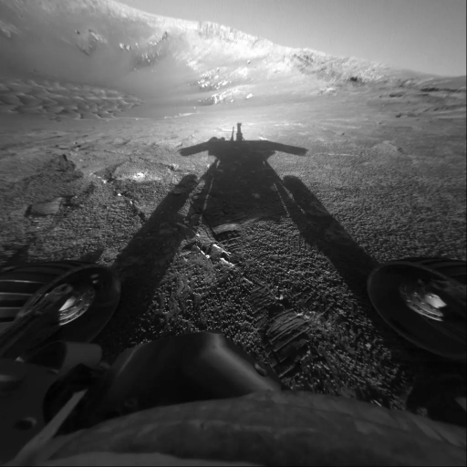
Feeling the adrenaline of the mission, the rover team decided to explore “Victoria” crater next, but it was tens of kilometers away and littered with dunes of windblown sand, but they went anyway.
Sometime on April 26, 2005, while at Meridiani Planum, a sand ripple that the team dubbed “Purgatory”, sunk all Oppy’s wheels about four inches into the sand and wouldn’t release them. Getting her unstuck wasn’t easy. It took five nail-biting weeks of strategy, testing, and defensive driving techniques to drive Oppy out of the sand.
Despite problems along the way, the Earthlings always seemed to figure how to bail Oppy out, no matter the time of day or night. They wanted Oppy to continue sending home pictures and information they could use to learn more about Mars.
An evil global storm arrived
One winter day, as Oppy was working in Perseverance Valley, a dust storm started brewing. As the wind picked up, gritty sand and dust began to settle and adhere to her solar panels. It really didn’t alarm Earth’s commanders at first because in 2007 she had survived a similar dust storm.
Now, it was 14 going on 15 years after landing, much longer than the predicted 90-sol tour! This storm had put Oppy under the weather. It was similar to Earth doctors telling humans ailing from a common cold that all Oppy needed to do was take it easy, minimize draining work, and conserve enough energy until the airways were clear.
She would be fine.
But the airway on Mars became more clouded with fine red dust, making it harder for her to breathe, by choking out her circuits from lack of exposure to the sun.
Oppy knew that she felt unusually unwell. Besides the humans back home did not know everything: they didn’t know she had met the god of war firsthand; however, they DID know she was unprepared to defend herself against such a powerful, wicked storm.
All she could do was hunker down in that bastardly storm and try to outlast it. The thicker the dirt collected on her panels, the more sun exposure she would urgently need, like vampires' need for blood when their energy runs low.
But nothing could stop the violent red dust that continued accumulating on Oppy and clouding out her solar panels. That choking dust was violently sweeping over the whole planet.
Soon a mass of darkness crept upon her and quietly settled over her location, disabling her from work.
Oppy’s power started to dwindle.
She grew too weak to wrestle against shutdown as the glimpse of the landscape passed through her circuits. The storm continued its rage for days, and once it subsided, Mission Control again tried desperately to contact Oppy.
But Oppy didn't answer.
“Do you copy, Oppy?” asked Mission Control.
No answer.
Still no answer on Sol 5111, February 13, 2019, after Mission Control had issued “more than a thousand commands” to speak with beloved Oppy again.
It was the global dust storm that murdered her, though a Martian lawyer would argue that it was unintentional.

Rest in Peace Opportunity (2004–2019)