



Eat or Be Eaten
By Marlene Dodson
October 28, 2019
Adult pallid sturgeon are large river predators and an important portion of their diet consists of other small fishes. Few other fish pose a threat to adult pallid sturgeon. Newly hatched pallid sturgeon, on the other hand, are at risk of being eaten by most all other fishes. Predation is one of many factors that affects survival of young fishes. Although it is a normal process, some species may be more vulnerable to predators when habitats are altered. Large mainstem dams have reduced the turbidity in many segments of the pallid sturgeon’s former habitat. For a species, like the pallid sturgeon, that evolved to drift long distances downstream as a free embryo, a less turbid, clearer river might allow predators to prey on them easier.
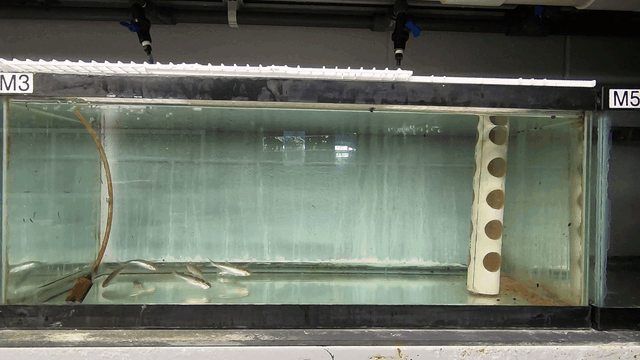
In the spring of 2019, Comprehensive Sturgeon Research Project scientists conducted preliminary studies to determine if the emerald shiner, a sight-feeding predator that often increases in rivers when turbidity declines, could effectively eat young sturgeon. Predation trials were conducted with 0–7 days post-hatch shovelnose sturgeon and adult emerald shiners. Shovelnose sturgeon are used as a surrogate for pallid sturgeon in some of our studies since the two species are similar during the during the free-embryo and larval stages. A minimum of 25 shovelnose sturgeon free embryos were placed in a tank daily with seven emerald shiners beginning on the day of hatch up until the emerald shiners failed to show interest in eating the young sturgeon. Predation attempts by emerald shiners were recoded using a video camera placed in front of the tank. Adult emerald shiners were able to effectively capture and ingest young sturgeon until they reached about eight days post hatch. The video shown below is of shovelnose sturgeon at three days post hatch.