



USGS Expertise Informs Design and Construction of New Eel Ladder at Maryland’s Eden Mill Dam
A new eel passage at Eden Mill Dam reconnects vital habitat, strengthens local ecosystems, and supports the recovery of a declining species.
Scientists and engineers from the U.S. Geological Survey’s Eastern Ecological Science Center worked with Harford County, the Maryland Department of Natural Resources, and the U.S. Fish and Wildlife Service to restore upstream access for American eels at Eden Mill Dam on Deer Creek. Together they designed and built a new eelway that now allows juvenile eels to safely bypass the barrier.
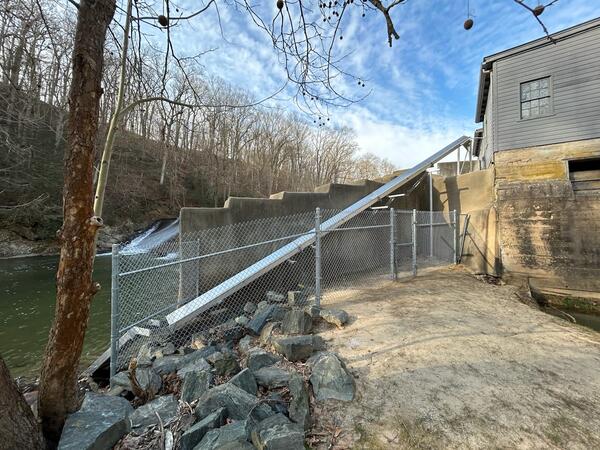
Scientists and engineers from the U.S. Geological Survey’s Eastern Ecological Science Center (EESC) at the S.O. Conte Research Laboratory collaborated with Harford County, Maryland, the Maryland Department of Natural Resources (MDNR), and the U.S. Fish and Wildlife Service (USFWS) to design a new eel passage system at the Eden Mill Dam on Deer Creek in Pylesville, MD. The technical expertise provided by USGS was central to planning and constructing this new eelway that will enhance the safe and successful upstream migration of American eels (Anguilla rostrata).
Restoring Passage for a Species in Decline
The American eel is both economically and ecologically significant along the Atlantic coast. Managed by the Atlantic States Marine Fisheries Commission, the species supports commercial and recreational interests and plays a key role in river ecosystem health.
However, eel surveys across Maryland show declining populations. Barriers such as dams limit juvenile eels’ access to upstream habitats and can injure or obstruct downstream‑migrating adults. Eden Mill supports some of the highest American eel populations in the state, and Maryland resource managers have identified the Eden Mill Dam as a critical barrier to address.
How Eel Passage Supports Water Quality and Ecosystem Health
The American eel is a catadromous species meaning the adults spawn in the ocean, and juveniles migrate into freshwater where they feed and grow. Therefore, having access to upstream habitat is essential for their survival and reproduction.
Eels also serve as the primary host fish for the eastern elliptio mussel (Elliptio complanata), a freshwater species that filters algae and sediment from rivers, an important process that improves water clarity and quality. Mussel larvae must attach to the gills of a host fish for several weeks before settling into streambed sediments.
Declines in eel populations can therefore contribute to losses of eastern elliptio mussels. For watersheds like Eden Mill, improving eel passage is an important step in restoring this ecological partnership.
Partnership in Action
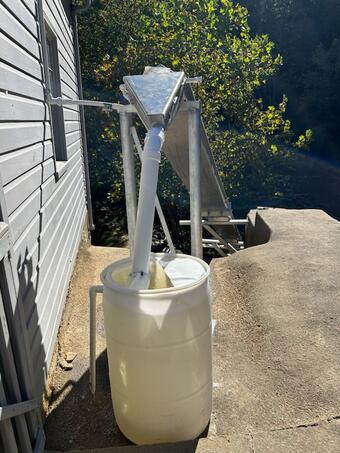
To improve eel access above the dam, Harford County sought to build a specialized upstream passage structure—a climbing ramp or ladder‑style eelway—to help juvenile eels safely and efficiently bypass the barrier. An eel ladder was donated by the USFWS from another Maryland site. The county partnered with them and the USGS fish passage design specialists Kevin Molongoski and Brett Towler, who conducted site surveys and developed detailed eelway design plans.
These technical designs incorporated site‑specific hydrology, engineering requirements, and eel biology to ensure safe and timely passage. The design package also allowed Harford County to obtain necessary permits and proceed with construction.
USGS worked alongside Harford County and project partners including MDNR, USFWS, and the Maryland Fish and Wildlife Conservation Office, to guide design and construction. Construction occurred from September through October 2025 with funding support from BGE and the National Fish and Wildlife Foundation.
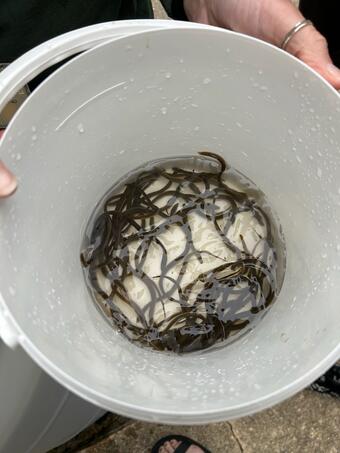
The eelway is fully operational in time for this year’s migration season. Harford County and MDNR will monitor system performance, while Eden Mill Nature Center staff will collect, count, weigh, and release eels and record data. As of May 19, 2026, the Eden Mill Nature Center has been seeing and recording eels at the site. USGS and partners will meet regularly to evaluate success and refine operations. A year‑end report will summarize passage outcomes and the number of eels successfully transported upstream in the first year.
With the completion of this project, there are now three dams in Maryland that support American eel passage: Eden Mill Dam, Daniels Dam, and Conowingo Dam.
Learn more about fish passage research at EESC here.