



Combining Field and Laboratory Studies to Understand Viral Ecology in Avian Species
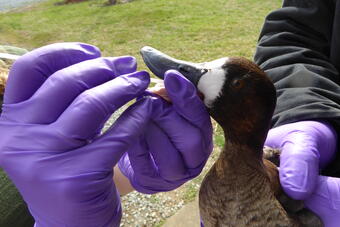
USGS researchers are pairing field and laboratory studies to gain deeper insights into the role of Lesser Scaup (Aythya affinis) in the spread and persistence of avian influenza viruses.
What is the issue?
Lesser Scaup, like other diving ducks, were traditionally believed to have limited exposure to avian influenza. However, USGS researchers and partners recently discovered that Lesser Scaup have a high prevalence of antibodies to avian influenza viruses, indicating they have a high rate of exposure to these viruses. The wide diversity of antibody subtypes documented in Lesser Scaup demonstrates that these birds are exposed to a wide variety of viral strains, but despite the prevalence of avian influenza antibodies, this species has still suffered several large-scale mortality events following the 2021 incursion of highly pathogenic avian influenza (HPAI) into the United States.
What is at stake?
The discovery that Lesser Scaup have high rates of exposure to avian influenza viruses challenged assumptions that dabbling ducks, such as the Mallard (Anas platyrhynchos), are the most important vectors to study to improve understanding about avian influenza spread, prevalence and persistence and has led to an expansion of the waterfowl species sampled as part of the U.S. national surveillance strategy. However, the role of an individual bird species in the spread and persistence of avian influenza viruses is driven by the species’ pathobiology, immune history, movement ecology, abundance, and more. A systems-based approach is needed to address these disparate components and develop robust understandings of how specific species impact the broader disease ecology of avian influenza to help anticipate outbreaks, implement biosecurity measures, and protect poultry systems and food supply chains.
What is our approach?
By combining field and laboratory research, USGS is helping to advance understanding of the drivers of Lesser Scaup mortality associated with the currently circulating H5N1 viral strains. USGS is collaborating on a range of research projects including studies into pathobiology, viral genetics, and explorations of changes in antibodies in wild Lesser Scaup populations pre- and post-outbreak, including those described below:
- Field research. To better understand how infection impacts the movements of wild birds, USGS researchers, state and federal agencies and university partners collected disease samples from Lesser Scaup that were being marked with transmitters for a separate species ecology project in the Chesapeake Bay. While birds were marked without knowing disease status at the time of capture, this effort resulted in the first movement data collected from a bird actively infected with HPAI in North America. Telemetry data showed the infected Lesser Scaup greatly reduced movements prior to dying but still encountered numerous other marked scaup, presenting the opportunity for disease transfer.
- Laboratory research. The high prevalence of antibodies observed in wild Lesser Scaup matches with findings from challenge studies conducted by USGS and partners, in which captive-reared Lesser Scaup were inoculated with HPAI and studied in bio-secure laboratories to identify important factors such as viral shedding rates, infection duration, and recovery versus mortality. One study found that all exposed Lesser Scaup became infected with H5N8. However, Lesser Scaup shed lower viral amounts and for a shorter period of time than has been observed in dabbling duck species such as the Mallard. Similar results were observed with highly pathogenic H7 viruses, further confirming that Lesser Scaup is susceptible to HPAI.
What are the benefits?
USGS research on avian influenza in Lesser Scaup provides critical insights into how this species contributes to the spread and persistence of HPAI, helping decision makers better anticipate and reduce risks. By integrating field movement data with laboratory studies of viral infection and immunity, this work strengthens national biosurveillance and advances predictive, data-driven disease response.
<< Back to Avian Influenza Research at EESC

USGS researchers are pairing field and laboratory studies to gain deeper insights into the role of Lesser Scaup (Aythya affinis) in the spread and persistence of avian influenza viruses.
What is the issue?
Lesser Scaup, like other diving ducks, were traditionally believed to have limited exposure to avian influenza. However, USGS researchers and partners recently discovered that Lesser Scaup have a high prevalence of antibodies to avian influenza viruses, indicating they have a high rate of exposure to these viruses. The wide diversity of antibody subtypes documented in Lesser Scaup demonstrates that these birds are exposed to a wide variety of viral strains, but despite the prevalence of avian influenza antibodies, this species has still suffered several large-scale mortality events following the 2021 incursion of highly pathogenic avian influenza (HPAI) into the United States.
What is at stake?
The discovery that Lesser Scaup have high rates of exposure to avian influenza viruses challenged assumptions that dabbling ducks, such as the Mallard (Anas platyrhynchos), are the most important vectors to study to improve understanding about avian influenza spread, prevalence and persistence and has led to an expansion of the waterfowl species sampled as part of the U.S. national surveillance strategy. However, the role of an individual bird species in the spread and persistence of avian influenza viruses is driven by the species’ pathobiology, immune history, movement ecology, abundance, and more. A systems-based approach is needed to address these disparate components and develop robust understandings of how specific species impact the broader disease ecology of avian influenza to help anticipate outbreaks, implement biosecurity measures, and protect poultry systems and food supply chains.
What is our approach?
By combining field and laboratory research, USGS is helping to advance understanding of the drivers of Lesser Scaup mortality associated with the currently circulating H5N1 viral strains. USGS is collaborating on a range of research projects including studies into pathobiology, viral genetics, and explorations of changes in antibodies in wild Lesser Scaup populations pre- and post-outbreak, including those described below:
- Field research. To better understand how infection impacts the movements of wild birds, USGS researchers, state and federal agencies and university partners collected disease samples from Lesser Scaup that were being marked with transmitters for a separate species ecology project in the Chesapeake Bay. While birds were marked without knowing disease status at the time of capture, this effort resulted in the first movement data collected from a bird actively infected with HPAI in North America. Telemetry data showed the infected Lesser Scaup greatly reduced movements prior to dying but still encountered numerous other marked scaup, presenting the opportunity for disease transfer.
- Laboratory research. The high prevalence of antibodies observed in wild Lesser Scaup matches with findings from challenge studies conducted by USGS and partners, in which captive-reared Lesser Scaup were inoculated with HPAI and studied in bio-secure laboratories to identify important factors such as viral shedding rates, infection duration, and recovery versus mortality. One study found that all exposed Lesser Scaup became infected with H5N8. However, Lesser Scaup shed lower viral amounts and for a shorter period of time than has been observed in dabbling duck species such as the Mallard. Similar results were observed with highly pathogenic H7 viruses, further confirming that Lesser Scaup is susceptible to HPAI.
What are the benefits?
USGS research on avian influenza in Lesser Scaup provides critical insights into how this species contributes to the spread and persistence of HPAI, helping decision makers better anticipate and reduce risks. By integrating field movement data with laboratory studies of viral infection and immunity, this work strengthens national biosurveillance and advances predictive, data-driven disease response.
<< Back to Avian Influenza Research at EESC