



FORT Science in Action 2026, Part 5: Helping communities adapt to wildfire
The Wildfire Research (WiRē) Team works in close collaboration with partners to collect data and develop community-focused programs for reducing wildfire risk. This year, they replicated a study evaluating agreement between trained assessors’ and homeowners’ wildfire risk perceptions, and they published five new installments of their Living with Wildfire series.
Mismatch in perceptions of wildfire risk between homeowners and trained assessors
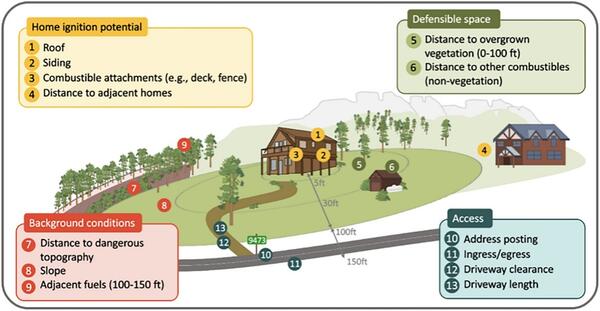
Wildfire risk mitigation on private property is central to reducing community wildfire vulnerability. A recent study from the WiRē team examined parcel-level wildfire risk perception in 38 wildland-urban interface communities across the Western United States, using paired data from household surveys and trained assessors. This research replicates and expands on a study from 2015, which examined a single Colorado community and found a significant gap in risk perception between homeowners and trained assessors.
In this new study, researchers again found that homeowners and assessors often perceive parcel characteristics differently. For instance, homeowners generally underestimated overall parcel wildfire risk compared to trained assessors. Results also indicated that, even if motivated to reduce their own wildfire risk, homeowners may lack the specific knowledge necessary to undertake meaningful actions. Wildfire practitioners can use this information about homeowners’ perceptions of risk to target educational programs addressing areas where homeowners should be taking further mitigation measures.
Additions to the Living with Wildfire Series
WiRe’s Living with Wildfire Series is an on-going series of Rocky Mountain Research Station "Research Notes" that detail Wildfire Research (WiRē) Team projects with fire departments and communities. These projects encourage wildfire risk mitigation on private properties by empowering local communities to collect and synthesize data for local wildfire risk education programs. Each report describes the partner-driven data collection process and provides a detailed summary of findings for communities to use in outreach products. Below are five Living with Wildfire reports published in the last year:
Lake County, Colorado
Cooper Landing, Kenai Peninsula Borough, Alaska
Nikiski, Kenai Peninsula Borough, Alaska
Funny River, Alaska
Santa Fe, New Mexico
More FORT Science in Action
This September, FORT is highlighting how our science projects support sound decision-making. Each day, we will highlight a new project and its applications. To see more, follow the tabs below.
FORT Science in Action, Part 4
FORT Science in Action, Part 6
Related

Economics of Wildland Fire

The Wildfire Research (WiRē) Team
Related
Economics of Wildland Fire