



USGS Powell Center Releases New Guidance for Managing Ecosystems Amid Rising Climatic Novelty
The USGS Powell Center has released new guidance to help land and natural-resource managers navigate a future where climate-driven environmental conditions increasingly diverge from historical norms.
A new manuscript from the U.S. Geological Survey’s Powell Center offers a forward‑looking framework for understanding and managing ecosystems as climate‑driven environmental conditions move further away from historical norms. The work, led by researchers at the St. Petersburg Coastal and Marine Science Center, synthesizes emerging ecological and climatological research to address a pressing question for natural resource managers: What happens when resisting ecological change is no longer feasible, and ecosystem reassembly becomes inevitable?
The manuscript developed by the “Ecosystem Stability Drivers” Working Group, draws on two years of collaborative analysis by USGS scientists, federal partners, and academic experts. By examining data from terrestrial and marine systems around the world, the group sought to identify the mechanisms that support ecosystem resilience in the face of “abiotic shocks,” such as heatwaves and droughts, which are expected to intensify in the coming decades.
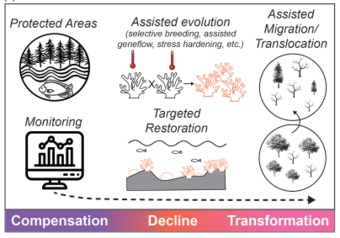
In the essay published in Conservation Biology, the authors outline the range of ecological transitions that may occur as climatic conditions diverge from historical baselines. These transitions may include shifts in dominant species, declines in ecosystem structure and function, or even the conversions to an entirely different system (Forest to grassland conversions, for example) as ecosystems reorganize under unprecedented environmental pressures.
Rather than viewing these changes solely as losses, the manuscript encourages managers to recognize ecosystem reassembly as a realistic and increasingly common outcome of climatic novelty. By shifting focus from restoring past conditions to planning for future ones, the authors argue that managers can better enhance ecosystem resilience and maintain critical ecological functions.
The paper concludes with practical guidance to help managers anticipate ecological transitions and design strategies that “future‑proof” management actions. This includes tools for predicting when and where transitions are likely to occur and approaches for optimizing functional outcomes even as ecosystems reorganize.
The manuscript represents the first major publication from the Powell Center working group and sets the stage for continued research into the drivers of ecosystem stability in a rapidly changing world.