



Nature Center vs. Visitor Center
Since we started collecting visitor centers, there’s been some justified confusion around the distinction between visitor centers and nature centers. Are they the same thing? Should nature centers be collected? How do you tell the difference? Let’s break it down!
Are nature centers and visitor centers the same thing?
The short answer is no. Visitor centers and nature centers generally serve different purposes.
VISITOR CENTERS
Visitor centers, such as the Grand Junction Visitor Center in Colorado and the City of Rocks State Park Visitor Center in New Mexico, exist to provide information to the public about a place. They generally provide amenities such as brochures, maps, bathrooms, water fill stations, or souvenirs, and have staff or volunteers knowledgeable about the local area, sites, events, activities, and businesses.
COLLECT? Yes, TNMCorps is collecting these structures.
NATURE CENTERS
Nature centers, such as the Bluff Lake Nature Center in Colorado and the Idyllwild Nature Center in California, also exist to provide information to the public about a place, but their emphasis is on education about the natural environment, ecology, biology, and local flora and fauna.
COLLECT? No, TNMCorps is not collecting these structures.
EXCEPTIONS
Occasionally you might encounter a facility that serves as both a visitor center for a place, and a nature center. The Starsmore Visitor and Nature Center in Colorado is a good example of such a facility.
COLLECT? Yes. Since they self-identify as both visitor and nature center and provide services to the public typically offered by visitor centers, this facility can be collected as a visitor center.
The quickest way to determine if a nature / visitor / welcome center should be collected as a visitor center is if they self-identify as such. Having “Visitor Center” in an official name is a good indicator that it is a structure we are collecting.
Another way is to look at an official map to see if the location has any facilities labeled “visitor center”. The Antelope Valley Indian Museum State Historic Park in California for example, is not a feature we would collect (we are not collecting parks), but they do have a visitor center marked on their official park map, which can be collected.
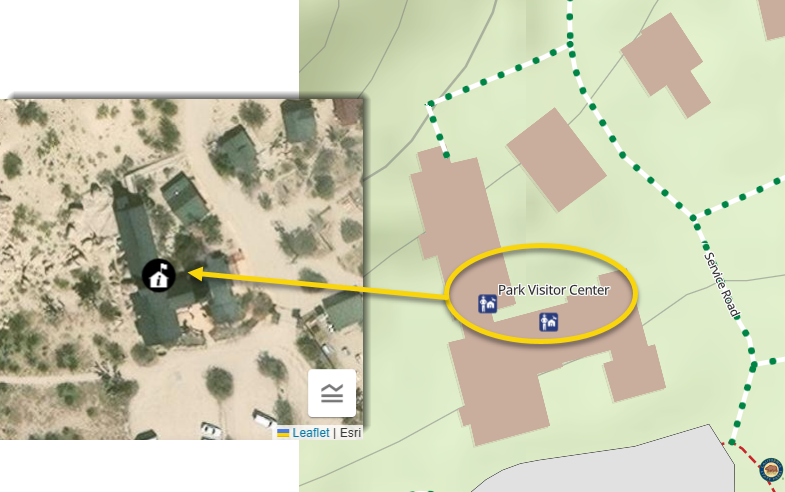
In cases like this, where a park visitor center may not have a specific name, we recommend using the park name + “Visitor Center” (e.g., Antelope Valley Indian Museum State Historic Park Visitor Center). Including “Visitor Center” in the name makes it more descriptive of the type of structure being collected. We are collecting visitor centers, not parks.
What about chambers of commerce?
These can be handled similarly to nature centers. If a chamber of commerce location also identifies itself as a visitor or tourist information center, and / or it fits our collection criteria, then it can be collected as a visitor center.
Of course we don’t recommend collecting features based on name alone, so make sure to do additional research to ensure that the structure also meets our Visitor / Information Center collection criteria.
And if you encounter a structure that you’re still just not sure about, you can always reach out to us at nationalmapcorps@usgs.gov!
Related
The National Map Corps January 2026 Newsletter - Vol. 12 | Issue 1 The National Map Corps January 2026 Newsletter - Vol. 12 | Issue 1
Related