



Capability
The Michigan Bacteriological Research Laboratory (MI-BaRL) uses a wide array of traditional and modern molecular approaches to evaluate microbial pathogens and antimicrobial resistance pathways in the environment.
The scientists use these approaches to advance the understanding of how environmental contaminants affect microbial processes and influence the health of the Nation's aquatic resources, and consequently, the wildlife and humans using those resources. The MI-BaRL continues to optimize new tools and assays to work with a variety of environmental matrices, including water, sediment, manure, biosolids, biofilms, plant material, and animal tissue.
Media
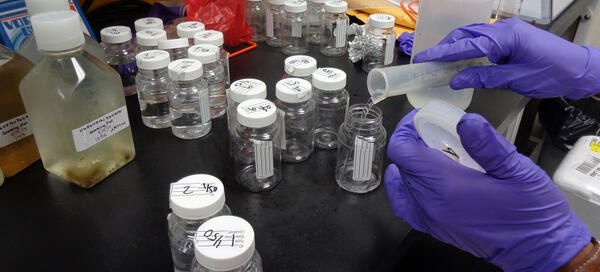
Michigan Bacteriological Research Laboratory — Lansing, Michigan. A U.S. Geological Survey (USGS) microbiologist prepares a water sample for enterococci testing. After 24 hours incubation, the microbiologist will be able to determine whether enterococci is present in the water and at what concentration.
Sources/Usage: Public Domain. View Media Details
Media
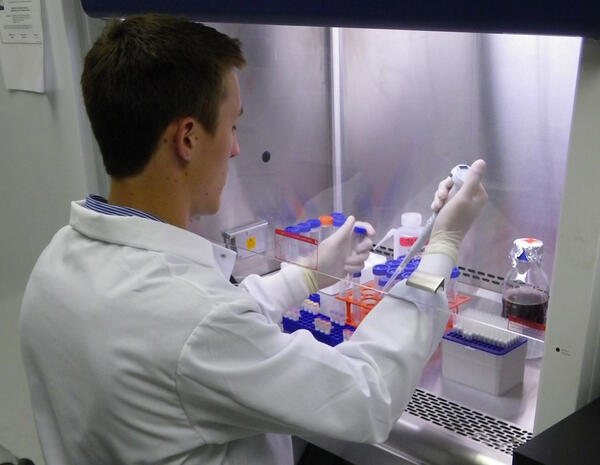
Michigan Bacteriological Research Laboratory — Lansing, Michigan. A microbiologist prepares a reaction in a Biological Safety Cabinet. These cabinets are frequently used in laboratories to protect the scientist, the lab environment, and prevent contaminating a sample.
Sources/Usage: Public Domain. View Media Details
Media
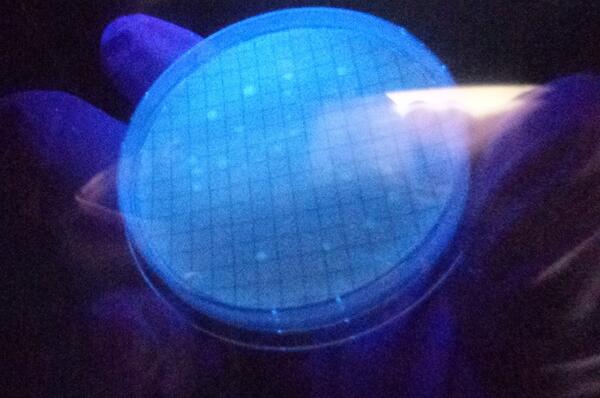
Michigan Bacteriological Research Laboratory — Lansing, Michigan. Counting total coliforms is an easy task when plating on the selective media, MI agar. The MI agar method is a membrane-filtration method for the detection of Escherichia coli and total coliforms. Total coliforms fluoresce blue under ultraviolet (UV) light.
Sources/Usage: Public Domain. View Media Details
Key Analytical Capabilities
- Culturing and plating methods for enumeration and isolation of bacteria, including antibiotic resistant bacteria
- IDEXX enumeration methods for water quality monitoring
- Polymerase Chain Reaction (PCR) and quantitative PCR (qPCR) for pathogen and antimicrobial resistance genes
- Sequencing and identification of bacterial isolates
- Microbial community profiling (next generation sequencing) for microbial community composition and functional capabilities
- Bioinformatics for sequencing data sets
Key Instrumentation
- Biosafety Level 2 (BSL2) laboratory with:
- DNA/RNA automated extraction workstation
- Liquid handling transfer workstation for automated PCR/qPCR set-up and culture transfer
- Three thermal cyclers for PCR
- 3 real-time PCR systems for qPCR
- Fluorometer for quantitation of DNA
- Phase Contrast and Epifluorescence Microscope
- Bioanalyzer for sizing, quantification, and quality control of DNA and RNA
Media
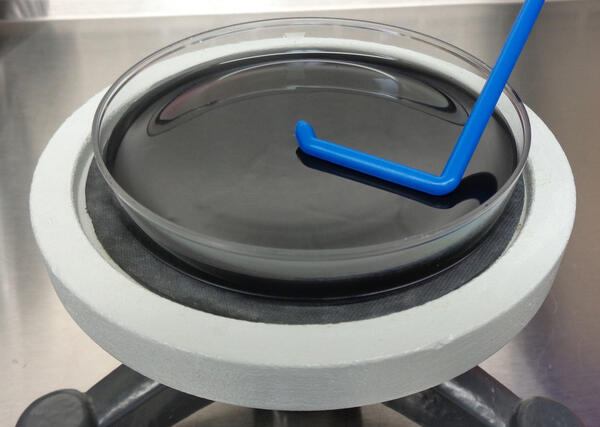
Michigan Bacteriological Research Laboratory — Lansing, Michigan. A disposable, sterile L-spreader, or "hockey stick," is used to plate a tapwater sample on selective media for Legionella—the bacterium which causes Legionnaire's disease.
Sources/Usage: Public Domain. View Media Details
Media
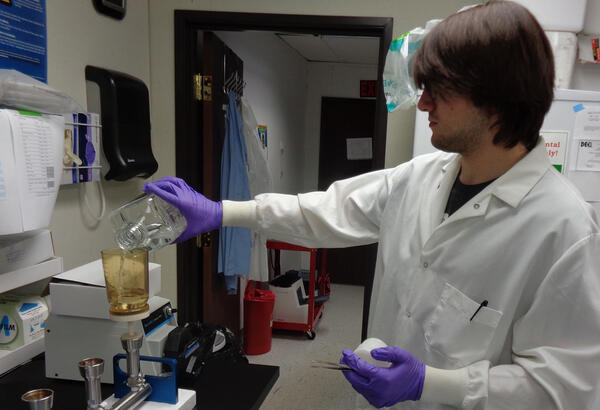
Michigan Bacteriological Research Laboratory — Lansing, Michigan. A USGS microbiologist pours a groundwater sample into a sterile filter cup. This water sample will be pulled through a 0.2 micron filter, and will ultimately be used to characterize what bacteria are present within the groundwater sample.
Sources/Usage: Public Domain. View Media Details