USGS Selenium Research Laboratory
The USGS Selenium Research Laboratory's mission is to support state of the science research into selenium and other contaminants. We strive to achieve the lowest selenium detection limits on the smallest possible sample masses while working to improve methods and techniques.
What is selenium and why do we care about it?
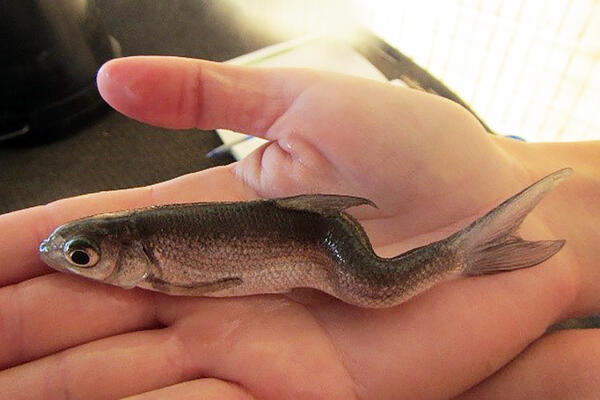
For animals, selenium is the goldilocks element—too little or too much is a bad thing. When there is too much selenium in an ecosystem it can biomagnify, increasing in concentration from insects and algae at the bottom of the food chain to top predator species such as fish and birds. Fish and birds exposed to high selenium levels may have offspring born with lethal deformities or are constrained by slower growth and worse reproductive success. There are many potential sources of excess selenium to ecosystems including local geology, agricultural runoff, mining waste, and discharge from oil and gas activities. Why some species and ecosystems are vulnerable to selenium while others are not is complicated by different selenium uptake rates between predator and prey, changing animal diets, and selenium biogeochemistry.
Sample Analysis and Equipment
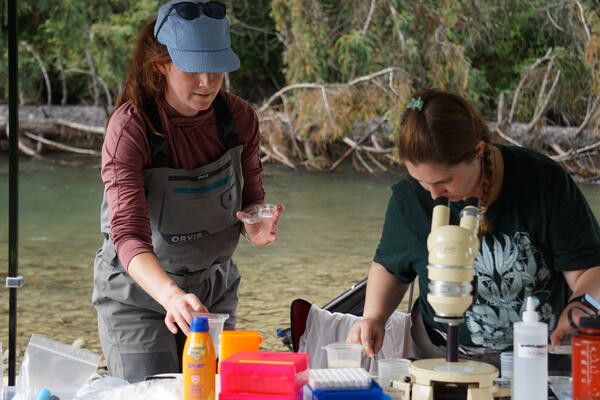
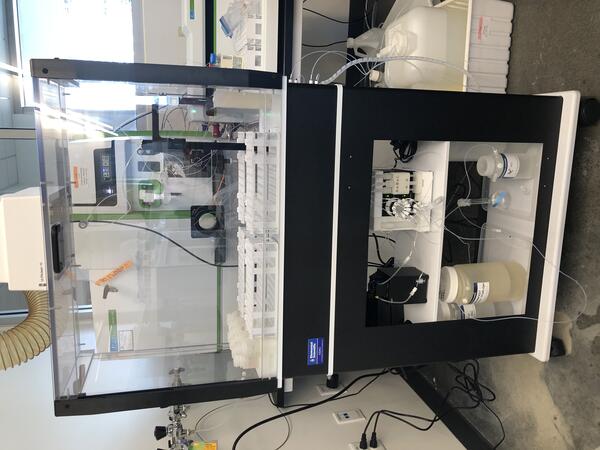
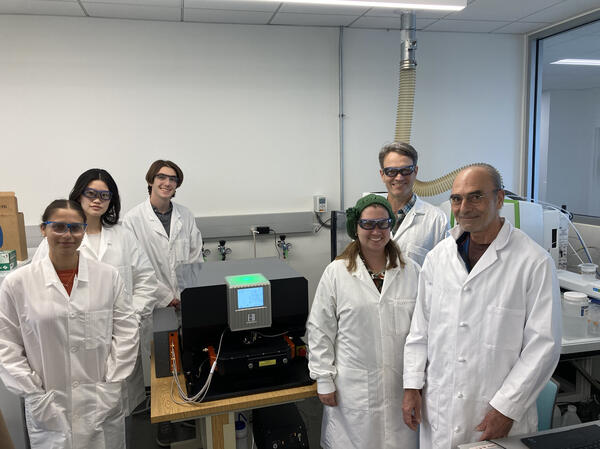
Our laboratory can analyze most biotic and water matrixes for selenium and help with strategic project planning. For invertebrates, we use a microscope and dichotomous key to separate into family or even species prior to analysis. For fish, we can analyze whole body or specific organs or parts such as ovaries and eggs. We can also determine low level selenium in sediments and algae. Our main analytical method utilizes hydride generation-isotope dilution-inductively coupled plasma-mass spectrometry (HG-ID-ICP-MS) for selenium concentration. This method requires only 5–10 mg of dried sample allowing researchers to collect fewer invertebrates and non-lethal fish tissue plugs. We are also working on laser ablation methods to analyze fish fin rays, otoliths, bivalve shell growth rings, and produce elemental heat maps of microtome sliced biotic samples. Other research we are engaging in includes developing methods to decipher microplastic types and heavy metal content using simultaneous laser induced breakdown spectroscopy/laser ablation-inductively coupled plasma-mass spectrometry (LIBS/LA-ICP-MS).