U.S. flag

An official website of the United States government

USGS Southwest Region Sample Repository

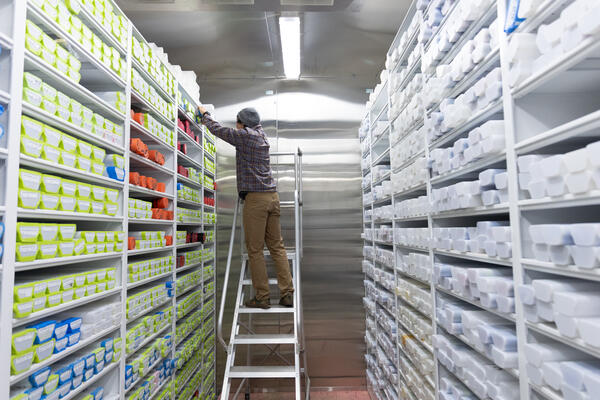
We store sediment cores, along with other sediment, plant, and microfossil samples, in a large, walk-in refrigerated room that features library-style rolling shelving for efficient storage and easy access to all cores. All samples are cataloged and cross-referenced to their field activity ID, which provides the metadata about the samples. 

The USGS Southwest Region Sample Repository at the Pacific Coastal and Marine Science Center is co-located alongside the Core Scanning Lab and the Core Splitting Lab.


Media
A woman pushes a cart with a long, narrow tube on it, in through a large metal door.
At the USGS Pacific Coastal and Marine Science Center in Santa Cruz, CA, we take most of the sediment cores and samples, collected from the field, straight from the loading dock into a large walk-in refrigerator (about 780 square feet). There, samples are kept at the international core curation standard of 4° C plus or minus 2° C. Each core and sample must be labeled with an identifier and metadata, which follows the material through processing and analysis.
Media
A woman wearing a lab coat lifts a long thin sediment core from a shelf.
In the cold storage room at the USGS Pacific Coastal and Marine Science Center, we store cores on large racks that can hold about 4,500 full sized cores or D-tubes with split cores, up to 1.5 meters long.
Media
A woman wearing a lab coat and rubber gloves holds a rotating handle on the wall of a rack that runs on a track.
These track-mounted racks pack together to save space. Cranking a handle moves the aisle between racks for core access.
Media
Scientist retrieving a sediment core from the refrigerated core repository
Retrieving a core sample from the refrigerated storage racks.
Media
A woman wearing a lab coat wheels a tray, with a sediment core resting on top, out through a big metal door.
The back door of the refrigerator connects to our core and sample processing labs.

Radiocarbon Picking

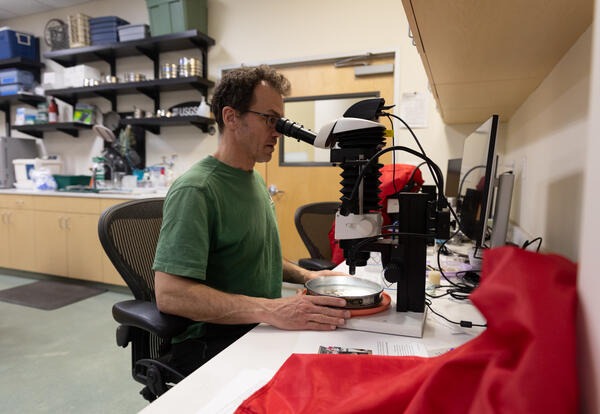
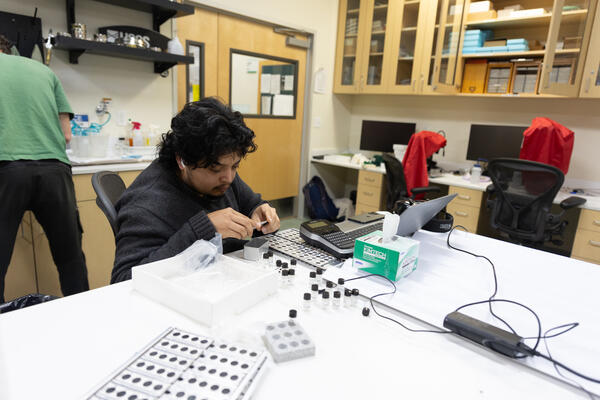
The Core Lab offers radiocarbon preparation for plant macro fossils and paleo micro fossils. After submitting a radiocarbon picking request form, a lab technician will sub-sample a core or will process intervals provided by a P.I. These samples are sorted then analyzed using our microscope station. All sample intervals alongside any plant macro fossils or paleo micro fossils of interest are picked out and recorded in an Excel file and photos of sample contents are taken with the microscope’s camera system. The lab technician follows rigorous quality assurance and quality control guidelines ensuring samples and records of samples are accurate. Samples are shipped to an AMS lab of choice. 
 

Media
Scientists analyzing material extracted from sediment cores
Sorting macro and micro fossils extracted from sediment cores.
Media
Scientists analyzing material extracted from sediment cores
Analyzing macro and micro fossils extracted from sediment cores under a microscope.
Was this page helpful?