



A stratigraphic scanning electron microscope tour showing the evolution of manganese-oxide mineralization of host sediment

Detailed Description
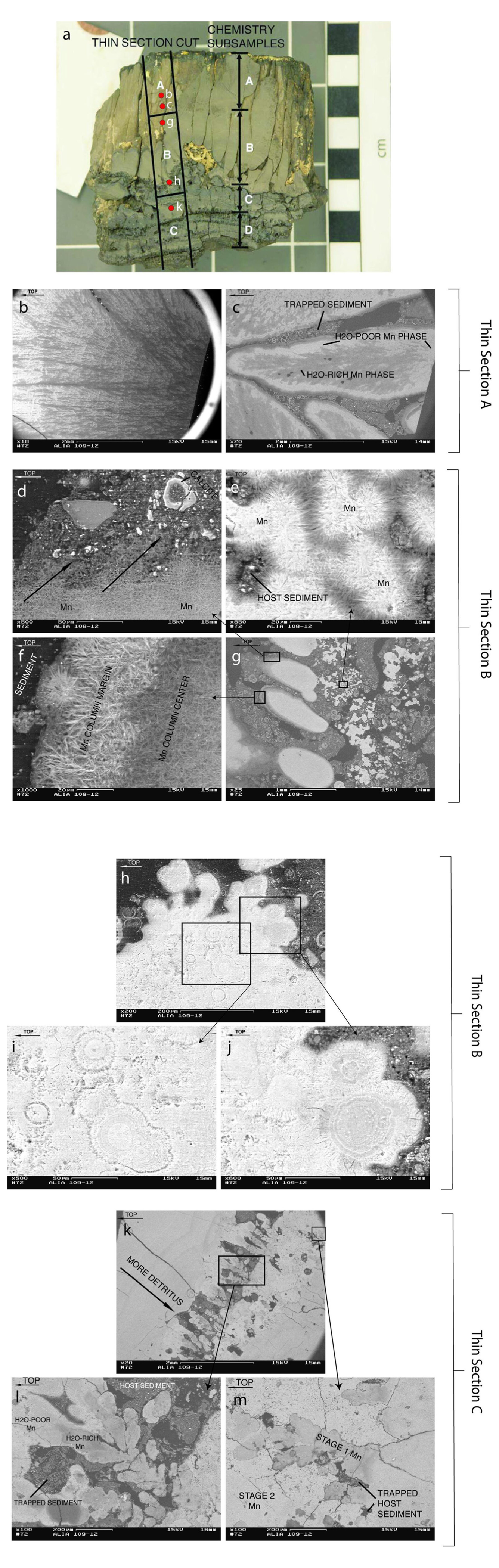
A stratigraphic scanning electron microscope tour showing the evolution of manganese-oxide mineralization of host sediment. Mn mineralization shows a multipronged process of formation including growth of Mn columns in soft sediment, cementation and then partial to complete replacement of the host sediment, Mn grain growth, Mn recrystallization, and late-stage void-fracture fill. (a) Intervals analyzed for chemistry, U-series dating, and three thin sections, starting at the top with thin section A, and age increases from the top to the base (thin section C). The red dots indicate location of SEM photos presented in panels (b, c, g, h, and k); (b) Fan texture within (middle area) 40 mm tall columns; fan texture is produced by growth laminae between dendrites; (c) Carbonate sediment trapped between columns with dendritic texture; (d) margin of a “floating” column with Fe, Si, Al increasing and Mn decreasing in direction of the arrows; (e) replacement of host sediment by Mn oxide which grew outward from nucleation centers (radial-fibrous growth) until Mn merged into nearly continuous replacement; (f) Margin of “floating” column; (g) “floating” columnar Mn and Mn-cement (both white) in volcanoclastic/biogenic sediment (dark); (h) mineralization front and replacement of host carbonate sediment by Mn oxide (white) begins ∼5 cm below surface; (i) Mn-oxide-replaced foraminifera and sediment; (j) Mn mineralization front: sequence includes precipitation in void, replacement, and grain growth by several generations of rim cement; note diffuse or gradational contact with host sediment in places; (k) two massive Mn-oxide layers separated by columnar, porous layer with 1 mm tall columns with botryoidal Mn at top of lower massive layer/bottom of porous layer; (l) branching columnar Mn-oxide in the porous layer—host volcaniclastic/biogenic sediment—replaced microfossils in columns showing where Mn grew around some large (50 mm) mineral grains; (m) stage 1 branching columnar Mn (dark gray) grew in porous layer with later stage 2 massive Mn cement (pale gray); remnants of host sediment. From the study Hydrothermal Manganese-Oxide Mineralization of a Carbonate Ooze, Samoan Hotspot Region, South Pacific Ocean.
Sources/Usage
Public Domain.