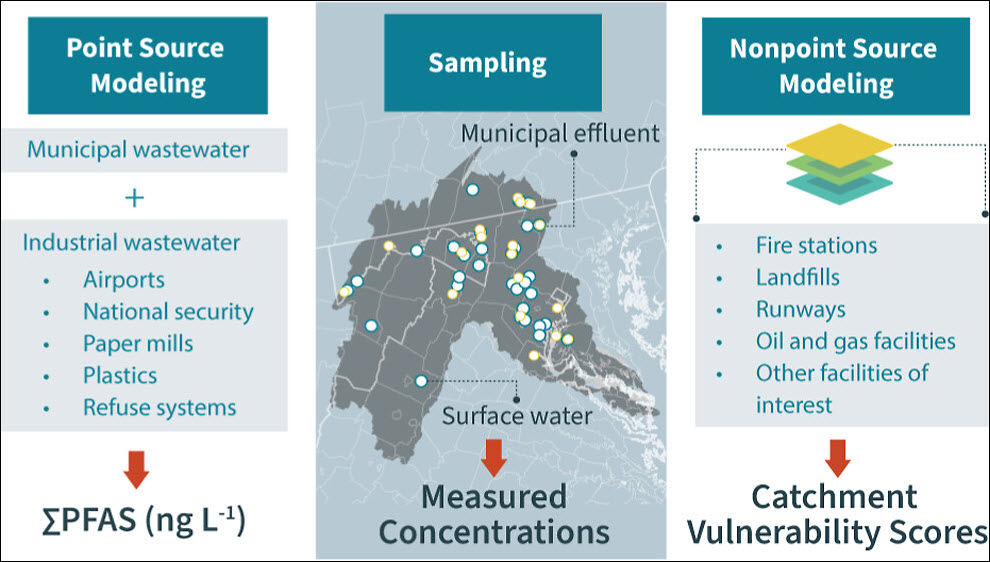
Conceptual diagram of the measurement and modeling approaches used in this study
By Chesapeake Bay Activities
May 2025 (approx.)
Detailed Description
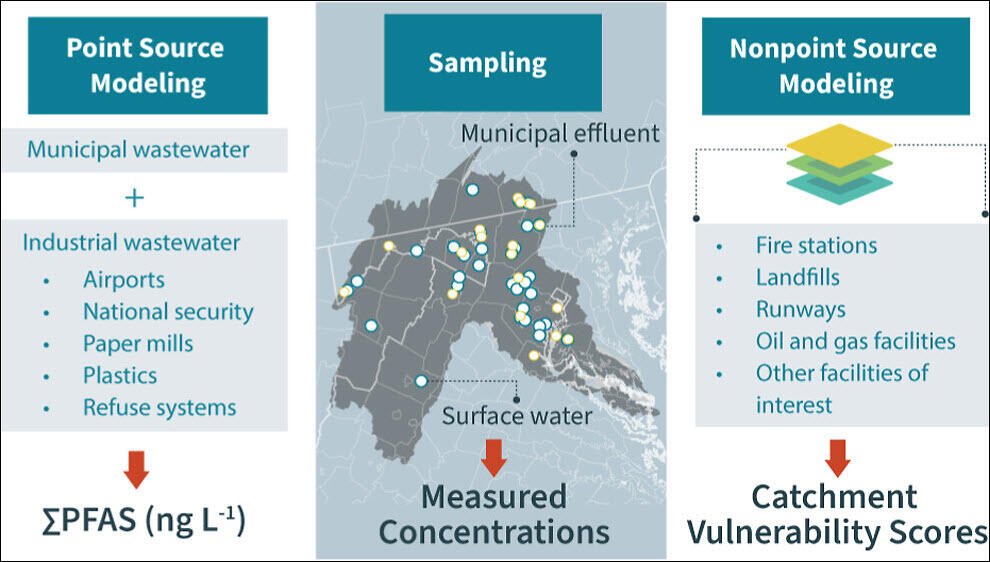
Conceptual diagram of the measurement and modeling approaches used in this study. ΣPFAS (ng/L), summed concentration of PFAS in nanograms per liter.
Sources/Usage
Public Domain.
Related

Municipal and industrial wastewater treatment plant effluent contributions to per- and polyfluoroalkyl substances in the Potomac River: A basin-scale measuring and modeling approach Municipal and industrial wastewater treatment plant effluent contributions to per- and polyfluoroalkyl substances in the Potomac River: A basin-scale measuring and modeling approach
Managing per- and polyfluoroalkyl substances (PFAS) in water resources requires a basin-scale approach. Predicted environmental concentrations (PEC) and stream-vulnerability scores for PFAS were determined for the Potomac River watershed in the eastern United States. Approximately 15% of stream reaches contained municipal and/or industrial wastewater treatment plant (WWTP) discharges...
Authors
Larry B. Barber, Samuel Miller, Lee Blaney, Paul M. Bradley, Kaycee Faunce, Jacob Fleck, Malinda Frick, Ke He, Ryan D. Hollins, Conor J. Lewellyn, Emily Majcher, Mitchell McAdoo, Kelly Smalling
Applying Multiple Tools to Inform Management of Per- and Polyfluoroalkyl Substances (PFAS) in the Potomac River Watershed
The reuse of municipal wastewater provides multiple benefits, including maintaining stream flow, recharging aquifers, and providing public water supply. However, along with the benefits are concerns related to the presence of ‘forever’ chemicals, like per- and polyfluoroalkyl substances (PFAS) in wastewater discharge. Managing PFAS in waterways is challenging because there are many potential PFAS...
Related
Municipal and industrial wastewater treatment plant effluent contributions to per- and polyfluoroalkyl substances in the Potomac River: A basin-scale measuring and modeling approach Municipal and industrial wastewater treatment plant effluent contributions to per- and polyfluoroalkyl substances in the Potomac River: A basin-scale measuring and modeling approach
Managing per- and polyfluoroalkyl substances (PFAS) in water resources requires a basin-scale approach. Predicted environmental concentrations (PEC) and stream-vulnerability scores for PFAS were determined for the Potomac River watershed in the eastern United States. Approximately 15% of stream reaches contained municipal and/or industrial wastewater treatment plant (WWTP) discharges...
Authors
Larry B. Barber, Samuel Miller, Lee Blaney, Paul M. Bradley, Kaycee Faunce, Jacob Fleck, Malinda Frick, Ke He, Ryan D. Hollins, Conor J. Lewellyn, Emily Majcher, Mitchell McAdoo, Kelly Smalling
Applying Multiple Tools to Inform Management of Per- and Polyfluoroalkyl Substances (PFAS) in the Potomac River Watershed
The reuse of municipal wastewater provides multiple benefits, including maintaining stream flow, recharging aquifers, and providing public water supply. However, along with the benefits are concerns related to the presence of ‘forever’ chemicals, like per- and polyfluoroalkyl substances (PFAS) in wastewater discharge. Managing PFAS in waterways is challenging because there are many potential PFAS...