



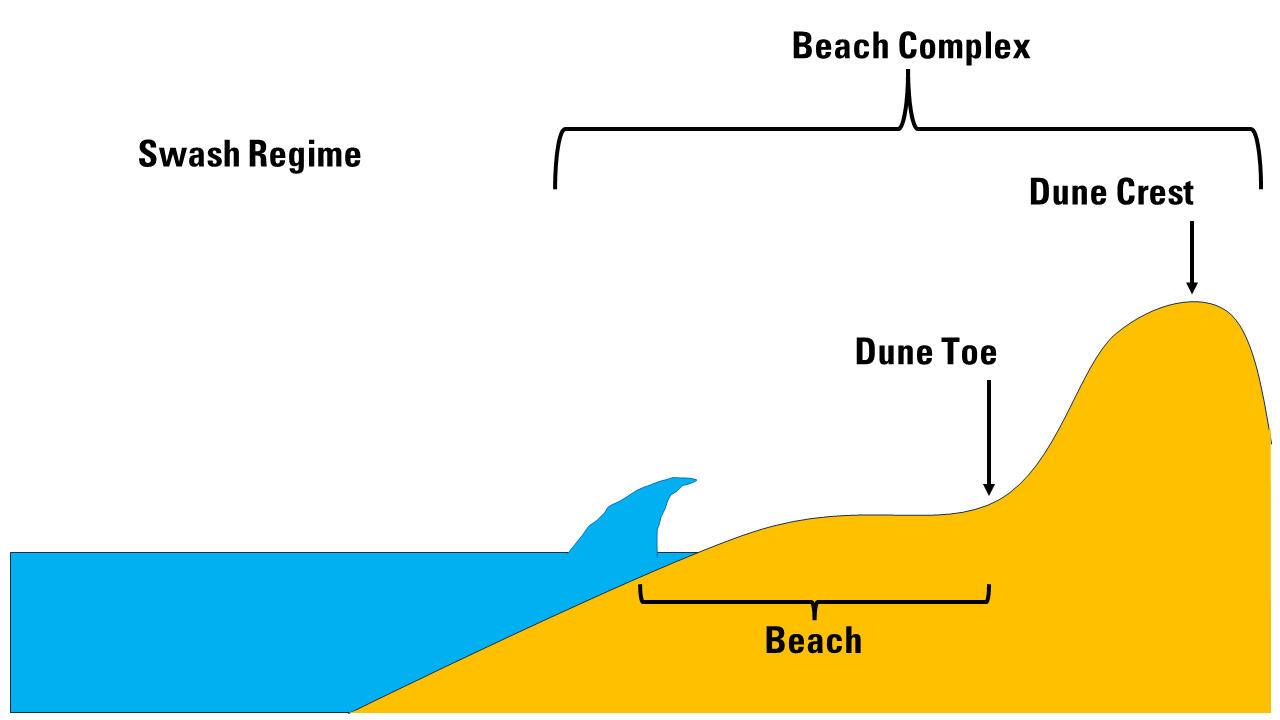
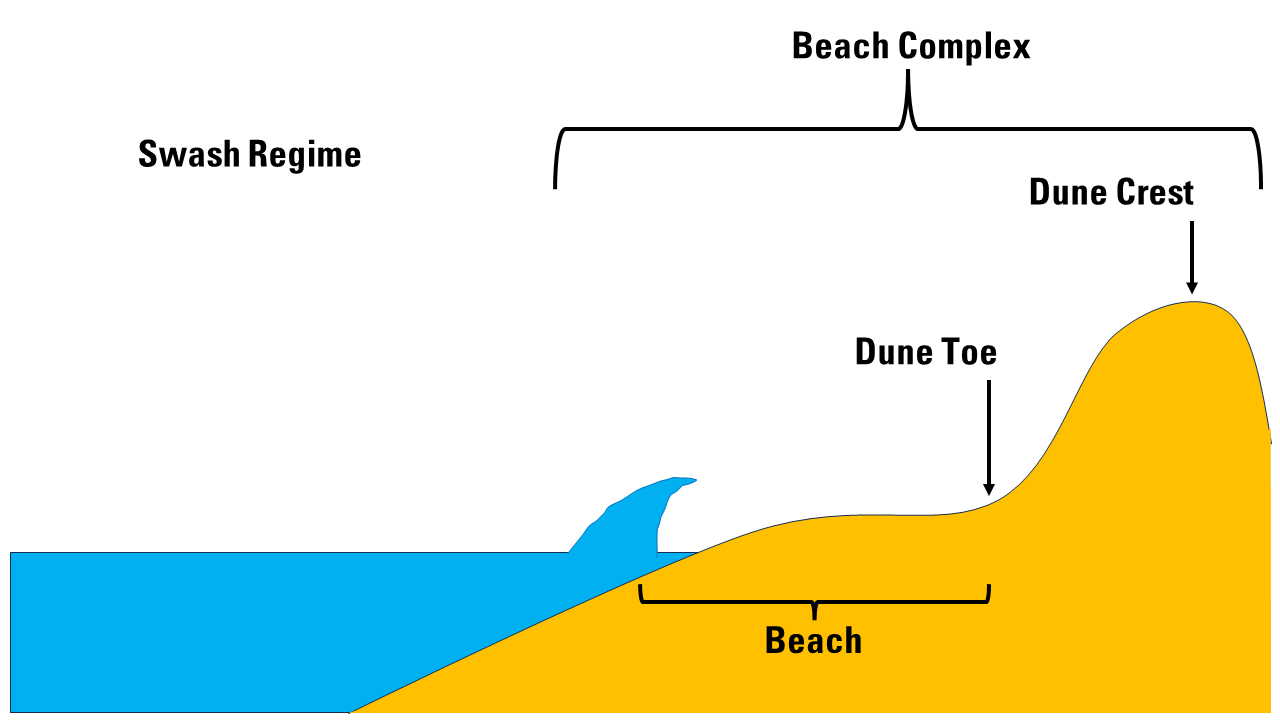
An illustration of a beach complex showing a "swash regime" - the relative level that the water reaches during everyday conditions
By St. Petersburg Coastal and Marine Science Center
2025 (approx.)


Detailed Description
Image 4. An illustration of a beach complex showing a "swash regime" - the relative level that the water reaches during everyday wave conditions. Water stays low on the beach and never reaches the dune toe.
Sources/Usage
Public Domain.
Related

Swash Regime
This informational webpage describes the swash regime, including depictions of the beach complex under its influence (Image 1), the conditions that define it, and any risks to the beach complex. Swash is the first of four storm-impact regimes, with minimal to no impacts expected from it.
How Storm-Impact Regimes Affect Beach Complexes: Coastal Hazards
This webpage explains coastal hazards caused by high water at the coast. These high-water levels, called "total water levels," happen when tides, waves, and storms combine and push the ocean higher than normal. This page provides an overview for community planners, emergency managers, and anyone else who wants to understand these risks.
Related
Swash Regime
This informational webpage describes the swash regime, including depictions of the beach complex under its influence (Image 1), the conditions that define it, and any risks to the beach complex. Swash is the first of four storm-impact regimes, with minimal to no impacts expected from it.
How Storm-Impact Regimes Affect Beach Complexes: Coastal Hazards
This webpage explains coastal hazards caused by high water at the coast. These high-water levels, called "total water levels," happen when tides, waves, and storms combine and push the ocean higher than normal. This page provides an overview for community planners, emergency managers, and anyone else who wants to understand these risks.