



Map of study area along the central and southern Cascadia Subduction Zone


Detailed Description
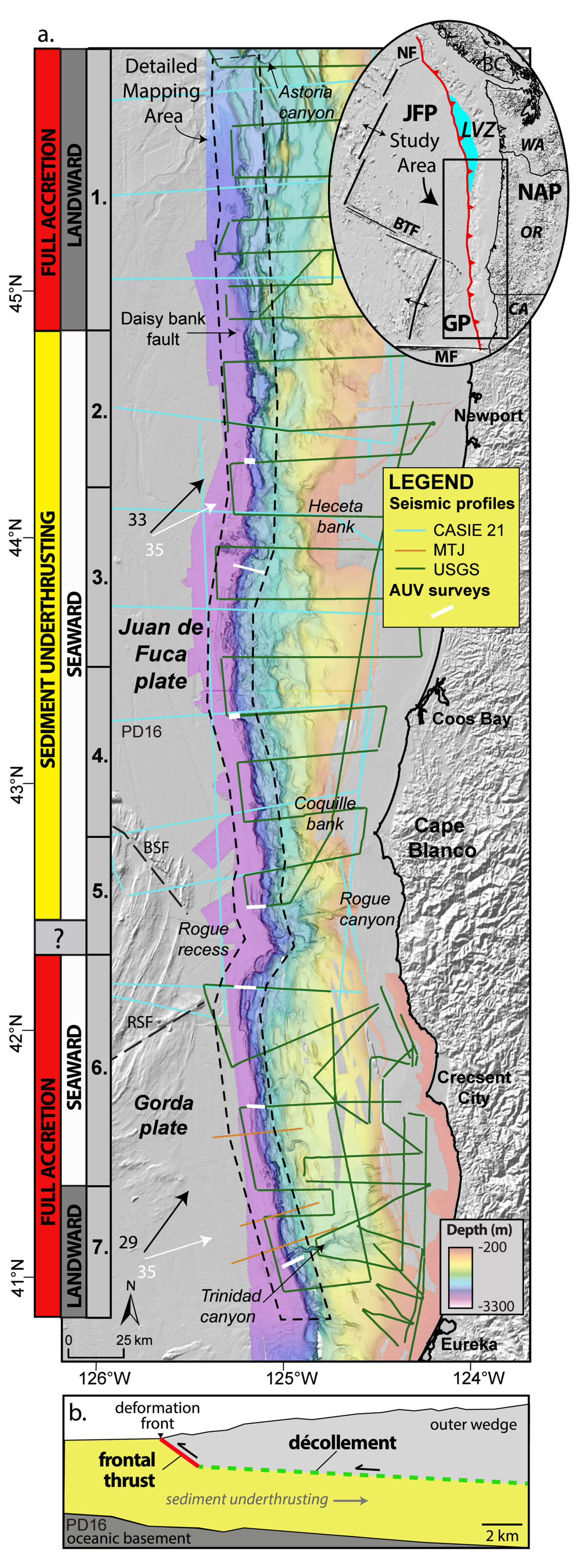
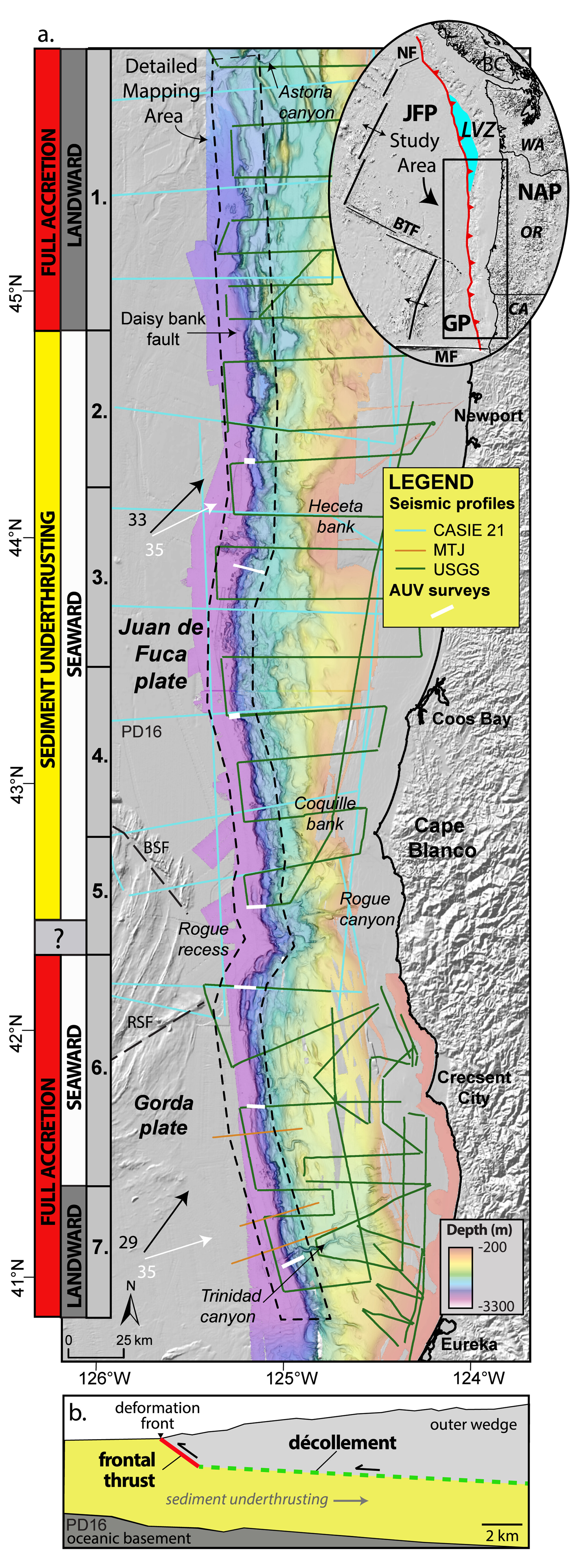
Map of the study area along the central and southern Cascadia subduction zone. (a) Topo-bathymetry map of the central and southern Cascadia subduction zone highlighting the extent of detailed frontal thrust fault zone (FTFZ) mapping (dashed black lines) along the deformation front (red line in inset map) and shipborne bathymetric and seismic data used in the study area. Accretionary mode and fault vergence along the deformation front (Carbotte et al., 2024; Gulick et al., 1998; Han et al., 2017; Lucas et al., 2025; Tréhu et al., 2022; Watt & Brothers, 2021) are shown with FTFZ section numbers identified in this study along the left side of the map. Bathymetric basemap shown as 30-m colored slope-shaded grid (Dartnell et al., 2023, 2026). Crustal-scale seismic reflection profiles (light blue lines, CASIE21, Carbotte et al., 2023; orange lines, MTJ, (Gulick et al., 1998; Trehu & Mendocino Working Group, 1995)), high-resolution USGS sparker seismic reflection profiles (green lines, Balster-Gee, Kluesner, et al., 2023; Balster-Gee, Miller, et al., 2023), AUV bathymetric and chirp surveys (white polygons), and Daisy Bank fault (Goldfinger et al., 1997) are discussed in the text. Black arrows indicate relative plate motions (rates in mm/yr) between the Juan de Fuca and Gorda plates, and the North American plate (DeMets et al., 2010); white arrows, relative plate motions (rates in mm/yr) between the Juan de Fuca plate and Oregon Coast Range (McCaffrey et al., 2007; Wells et al., 2002). BSF, Blanco pseudofault (Ren et al., 2023); RSF, reactivated pseudofault (Chaytor et al., 2004). Inset shows the major tectonic features of the Cascadia subduction zone. BTF, Blanco transform fault zone; GP, Gorda plate; JFP, Juan de Fuca plate; LVZ, landward vergent zone in light blue (Ledeczi et al., 2024); MF, Mendocino fault zone; NAP, North American plate; NF Nootka fault. (b) Representative cross-section showing the differentiation of décollement and frontal thrust structure along Cascadia's sediment-filled trench. From the study Widespread On-Fault Geologic Evidence for Variable Mode Coseismic Slip to the Trench in Cascadia.
Sources/Usage
Public Domain.