



National Environmental Policy Act (NEPA)
The U.S. Geological Survey (USGS) carries out a wide range of scientific research, mapping, and monitoring activities to support its mission to provide reliable scientific information about the Earth, its resources, and natural hazards. USGS actions are reviewed under the National Environmental Policy Act (NEPA) to evaluate potential environmental effects and to inform decision making.
NEPA is a law that requires federal agencies to assess environmental effects of their proposed actions before making decisions. The level of NEPA documentation depends on the nature and potential effects of the proposed action. The U.S. Geological Survey (USGS) follows the 2026 DOI Procedures for Implementation of the NEPA, which includes the 2026 Final Rule and Handbook. The Handbook provides guidance to NEPA practitioners across the Department while preserving flexibility to meet operational and project needs.
Below are additional links for more information on the National Environmental Policy Act.
NWHC Modernization Environmental Impact Statement (EIS)

The USGS National Wildlife Health Center (NWHC) has been developing a modernization plan to replace our current facilities that were originally constructed in the 1970s and 80s. An Environmental Impact Statement has been completed for this plan. Please click on the link for additional information.
Energy and Minerals Research Facility Environmental Assessment (EA)

An Environmental Assessment (EA) was prepared for the proposed Energy and Minerals Research Building. This process analyzed potential environmental impacts, mitigations, and provided opportunities for public comment.
Hilo Research Facility Environmental Assessment (EA)
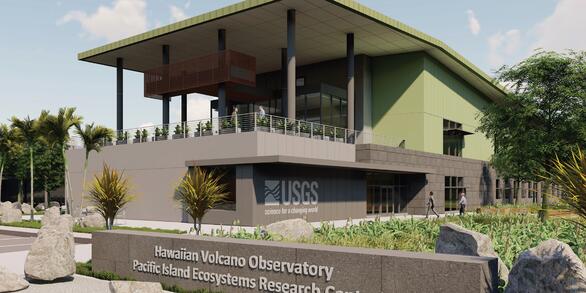
The U.S. Geological Survey (USGS) proposed to construct a facility on 6.8 acres of State-owned land in Hilo. The USGS facility will replace the USGS Hawaiian Volcano Observatory (HVO) whose existing buildings in Hawai‘i Volcanoes National Park were irreparably damaged by the 2018 Kīlauea eruption. The facility will also be the new home of the USGS Pacific Island Ecosystem.