



USGS Projects World Production Capacity for 8 Critical Minerals from 2026 to 2030
World Minerals Outlook projects graphite capacity could grow 20%
RESTON, Va. — The U.S. Geological Survey released projections of world production capacity for eight critical minerals for the next five years in the second World Minerals Outlook. This is a forward-looking assessment that is part of a larger effort to provide forecasts and scenarios for global mineral supply chains, as directed by the Energy Act of 2020.
The second World Minerals Outlook forecasts global production capacity for eight critical minerals through 2030: antimony, copper, graphite, niobium, potash, silicon, silver and tungsten — all of which are on the 2025 List of Critical Minerals. The United States depends on imports for more than 50% of annual consumption of each of these minerals. Seven of the eight are used in both defense production and advanced technology, in applications ranging from chip production (silicon) to advanced batteries and energy storage (graphite). Potash is primarily used in fertilizer. China is a major exporter of antimony, graphite and tungsten.


Currently more than 70% of world supply of natural graphite, silicon and tungsten is concentrated in China, and 92% of niobium supply is concentrated in Brazil. The report projects growth of 20% in global capacity to produce natural graphite and 18% in potash, and growth between 4% and 10% for antimony, copper, niobium, silicon, silver and tungsten. U.S. capacity to produce antimony, graphite and tungsten is expected to increase.
“In the 21st century, mineral security is national security. With the World Minerals Outlook’s preview of the next five years, the other excellent statistical publications, Earth MRI re-mapping the nation for critical minerals, and its ongoing mineral assessments, the USGS is helping map the path to American mineral independence,” said Assistant Secretary of the Interior Andrea Travnicek.
“In the World Minerals Outlook, the USGS makes future mineral production trends available to the White House, Congress, Federal and State agencies, industry, and the public. This information will help plan the policies and investments that will ensure supplies of critical minerals to drive the U.S. economy and national security,” said USGS Director Ned Mamula.
The World Minerals Outlook methodology pulls from multiple datasets that the USGS produces and analyzes, as well as from the expertise of USGS mineral specialists. It considers announced, funded projects in evaluating future capacity based on when they may come online; subtracts operations nearing the end of their announced life or with depleted resources; and accounts for idled capacity. When there are no available statistics for operations or a country's production capacity, the methodology uses a conservative approach that incorporates their actual production.
"The World Minerals Outlook gives us a clearer picture of where global critical mineral production is headed over the next five years,” said Andrew Stewart, lead author of the second World Minerals Outlook. “By identifying anticipated changes in production capacity, we can help policymakers and industry better understand potential supply risks and make informed decisions about future investments.”
In other findings, the second World Minerals Outlook noted:
- Antimony production capacity is projected to increase by 6%; it was mined in the United States for the first time since 2000.
- Copper production capacity is projected to increase by 9%; the need for copper in electronics and infrastructure, such as data centers is expected to be a larger share of the copper demand profile.
- Natural graphite production capacity is projected to increase by 20%; despite recent price drops, producers in China run at a loss to maintain market share.
- Niobium production capacity is projected to increase by 8%; some 90% of niobium is used to strengthen steel.
- Potash production capacity is projected to increase by 18%; the United States imported 92 percent of potash used in 2025, largely from Canada.
- Silicon metal production capacity is projected to increase by 5%; in 2025, the U.S. State Department launched the Pax Silica partnership with allies to increase production and other silicon metal facilities.
- Silver production capacity is projected to increase by 4%; silver is in nearly every electronic device, and that demand coupled with its use as a precious metal has increased prices.
- Tungsten production capacity is projected to increase by 10% or more; tungsten has not been mined commercially in the United States since 2015, but U.S. Defense Production Act awards support new projects in Nevada and Canada.
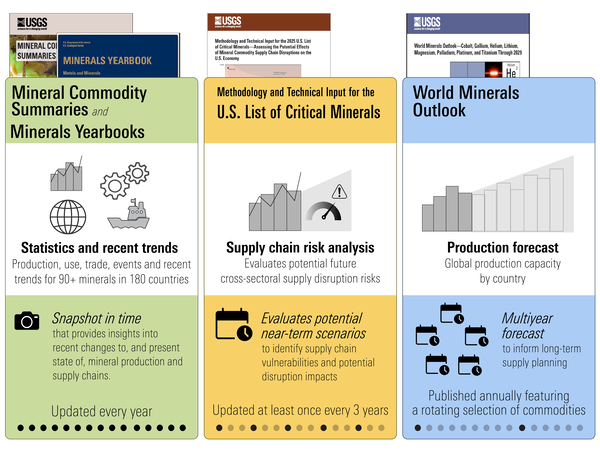
The World Minerals Outlook is part of a suite of USGS products offering a complete view of mineral availability to policymakers, industry and the public, including the annual Mineral Commodity Summaries, the more detailed and updated annual statistics in the Minerals Yearbooks volumes, and the List of Critical Minerals. On behalf of the Department of the Interior, the USGS maintains the whole-of-government List of Critical Minerals essential to the U.S. economy and national security and vulnerable to supply disruption.
In addition to production and market analysis, the USGS is actively working to map and assess critical-mineral resources throughout the U.S., both still in the ground and above-ground from numerous legacy mine mineral sites (and from active mines) through its Earth Mapping Resources Initiative known as Earth MRI, a partnership with state geological surveys.
The second World Minerals Outlook is available here.
World Minerals Outlook data is available here.
The third World Minerals Outlook will be published in 2027.
# # #
The USGS provides science for a changing world. Learn more at https://www.usgs.gov or follow us on Facebook @USGeologicalSurvey, YouTube @USGS, Instagram @USGS, or X at @USGS.