



Can't make it to the Moon? Try California's volcanoes!
If you listened to astronauts describing the surface of the Moon during the NASA Artemis II flyby yesterday, you might be interested to learn about the roles California's volcanoes - and the USGS - have played in the history of lunar exploration!
The California Volcano Monitor is a weekly column written by scientists and collaborators of the California Volcano Observatory. This week's contribution is from Jessica Ball, physical volcanologist with the U.S. Geological Survey.
California is where the history of USGS research into the Moon's geology really began. The first Astrogeologic Studies Unit (later Astrogeology) to be set up in the USGS was created in Menlo Park, California (the former home of the California Volcano Observatory). Starting in 1960, Gene Shoemaker led a small, NASA-funded group of geologists focused on lunar research in Menlo Park, including lunar geologic mapping, Apollo landing site selection, and providing expert training for astronauts before and during the Apollo Era. The group was later upgraded to a full research Branch of Astrogeology in 1961 and moved its headquarters to Flagstaff, Arizona in 1963.
However, USGS scientists in California - and California's volcanic landscapes - remained a key part of preparation for lunar landings. In fact, you can hardly throw a rock in California without hitting a lunar training site! Because of their resemblance to landscapes that scientists had observed on the Moon, Medicine Lake Volcano, the Coso Volcanic Field, Amboy Crater area in the Mojave Desert, Ubehebe Craters in Death Valley, and the Mono Craters area near Long Valley were all used for astronaut training and lunar rover testing.
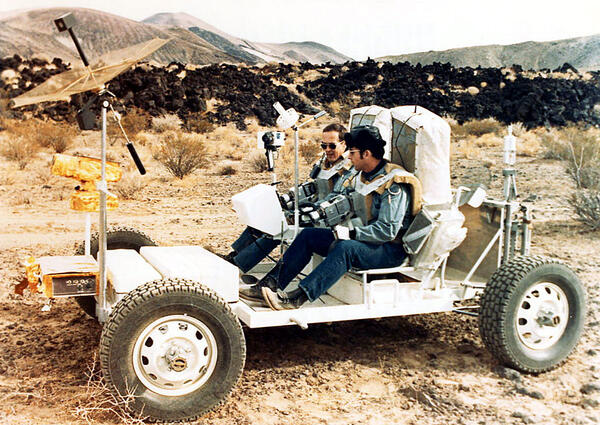
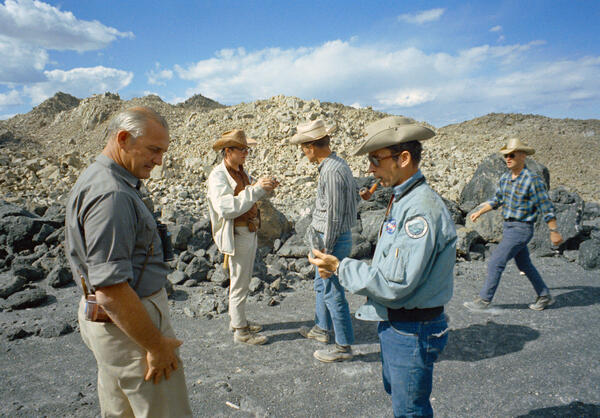
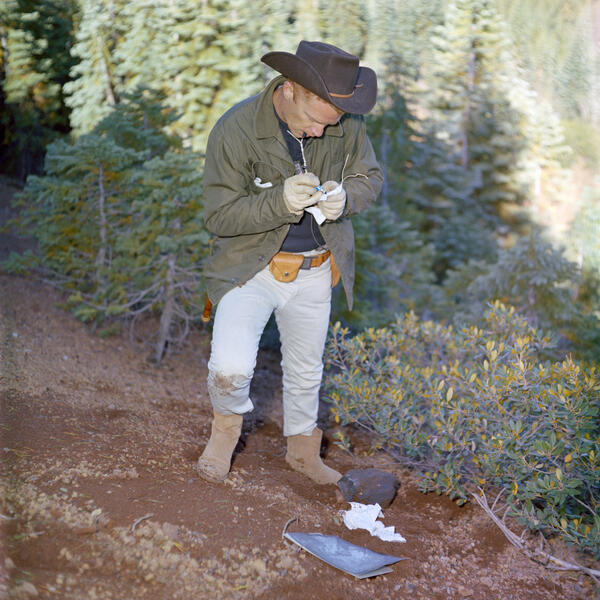
Here, we feature visits to the Coso Volcanic Field (first photo), Mono Craters (second photo), and Medicine Lake Volcano (third photo) with astronauts from multiple Apollo missions. In each spot, astronauts learned to map and sample volcanic rocks similar to what would be found on the Moon. They had to learn not only to identify and interpret what they were seeing, but also think of ways to define the geology of spots that they couldn't reach (for example, using rocks at the base inaccessible mountains to decide what rocks could be found on top). This was also a chance to practice communicating geologic observations to scientists who weren't physically present as practice for talking with NASA from the Moon - exactly what just happened on yesterday's flyby!